


Contents: Towing hooks ⇓ Trailer with brakes ⇓ Safety chains ⇓ Maximum trailer weight and maximum…⇓ Tips for driving with a trailer ⇓
If you are going to use your vehicle for towing, first check the local regulations. Regulations for towing trailers, cars or other types of vehicles may vary in different regions (countries). Before towing, consult your authorized Hyundai dealer.
Caution: Avoid towing a trailer for the first 2,000 km (1,200 mi) to allow your new vehicle to break in. Failure to do so could result in serious engine or transmission damage.
Towing hooks
Select the correct towbar combination, making sure that its location matches the mounting location on the trailer or towed vehicle. Use a towbar that distributes the load evenly across the chassis. The towbar must be securely attached to the vehicle by a qualified mechanic. DO NOT USE A TOWBAR THAT IS DESIGNED FOR TEMPORARY INSTALLATION, AND NEVER USE A TOWBAR THAT IS MOUNTED ONLY TO THE BUMPER OF THE VEHICLE.
Trailer with brakes
If your trailer has brakes, make sure they meet federal and local laws, are properly installed, and are in good working order.
Note: If you tow a trailer or a vehicle, your vehicle will require more frequent periodic maintenance due to the additional load on it. See "Periodic Maintenance for Heavy Duty Operation" in the Service Book.
Attention:
- Do not connect the trailer's brake system to the vehicle's brake system.
- When towing a trailer uphill at a steep angle (exceeding 12%), pay special attention to the engine coolant temperature gauge to prevent the engine from overheating. If the engine coolant temperature gauge needle enters the "H" (Hot) zone of the scale, stop the vehicle in a safe place and let the engine idle until it cools down. You can then continue driving.
Safety chains
If your vehicle and trailer or the vehicle you are towing become separated, the trailer or vehicle you are towing could continue to move uncontrollably across the road and collide with another vehicle. To prevent this potentially dangerous situation, the use of safety chains is mandatory in most regions (countries).
Maximum trailer weight and maximum towing hitch load
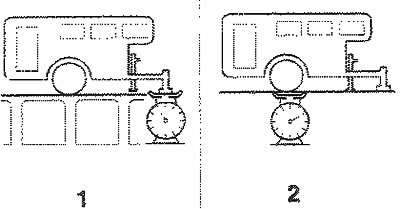
1 - Load on the coupling device
2 - Gross trailer weight
The hitch load can be increased or decreased by redistributing the load in the trailer. This can be verified by checking the gross weight of the loaded trailer and checking the hitch load.
Note:
- 1. Do not load the trailer so that the rear half is loaded more than the front. 60% of the trailer's load weight should be in the front half of the trailer, and the remaining 40% in the rear half.
- 2. The gross vehicle weight with a trailer must not exceed the maximum gross vehicle weight indicated on the vehicle identification plate (see here). The gross vehicle weight is the weight of the vehicle, the driver, all passengers and their luggage, luggage, towing hitch, load on the towing hitch and other additional equipment.
- 3. The load on the front or rear axle must not exceed the maximum axle load indicated on the vehicle identification plate (see here). It is possible that the mass of the trailer you are towing does not exceed the gross vehicle weight, but exceeds the maximum axle load. Incorrect loading of the trailer and/or too much luggage in the trunk of the car can lead to overloading of the rear axle. Redistribute the load and check the axle loads again.
- 4. The maximum permissible static vertical load on the coupling device is 44 kg.
- 5. The maximum permissible overhang of the hitch attachment points is: 690 mm.
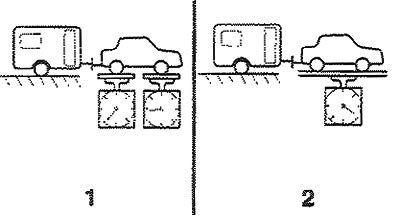
1 - Axle load 2 - Gross vehicle weight |
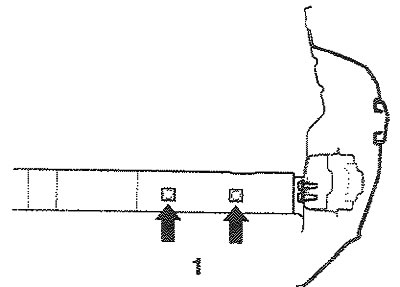
1 - Mounting points |
Caution: When towing a trailer, it is recommended to comply with the following technical requirements. The trailer weight must not exceed the values specified in the table below.
Warning: Improper loading of your vehicle and trailer can seriously affect the operation of the steering and braking systems, which can lead to an accident in which you can be seriously injured.
Tips for driving with a trailer
1. Before starting towing, check the connections of the hitch, safety chains, and the operation of the trailer lights, brake lights, and turn signals.
2. Always try to move at a moderate speed (no more than 100 km/h).
3. Towing a trailer requires more fuel.
4. For effective engine braking and charging system operation, do not engage fifth gear (manual transmission).
5. Always secure luggage in the trailer so that it cannot be thrown onto the road while driving.
6. Check the condition of the tires and the air pressure in all tires of the trailer and your car. Low air pressure in the tires can greatly affect the handling of the car. Also check the condition of the spare tire.
7. The car/trailer combination is more susceptible to crosswinds and shock waves. If you are being overtaken by a large vehicle, keep the steering wheel straight and maintain a constant speed. If the shock wave from the passing vehicle is too strong, reduce speed.
8. When parking your vehicle and trailer, especially on a slope, take the usual precautions. Turn the front wheels toward the curb, apply the parking brake, and move the gearshift lever to 1st or reverse (manual transmission) or move the selector to the "P" ("Park") position (automatic transmission). Furthermore, place chocks under each trailer wheel.
9. If the trailer has electric brakes, start moving your vehicle and trailer, and engage the trailer brake controller manually to make sure the brakes work. This will also help you check the wiring connections.
10. During the trip, periodically check the reliability of the luggage fastening and the operation of the lighting and brake lights of the trailer.
11. Avoid sudden starts, sharp acceleration and sharp braking.
12. Avoid sharp turns and abrupt changes in direction of travel.
13. Avoid holding the brake pedal for too long or pressing it too often. This can cause the brakes to overheat and become less effective.
14. Before descending a slope, shift into a lower gear to take full advantage of the engine braking effect. When climbing a long hill, shift into a lower gear and reduce your speed to avoid overloading the engine and causing it to overheat.
15. If you stop while going uphill, do not hold the car in place by pressing the accelerator pedal. This may cause the automatic transmission to overheat. Use the brake pedal or the parking brake.
Note: When towing, check the automatic transmission fluid more often than usual.
Caution: If the engine overheats while towing (the coolant temperature gauge is in the red zone of the scale), you can troubleshoot the problem as follows:
- 1. Turn off the air conditioner.
- 2. Reduce the speed of the car.
- 3. When climbing, engage a lower gear.
- 4. If you are stuck in a traffic jam, move the selector to the "P" ("Park") or "N" ("Neutral") position and let the engine run at increased idle speed.