


Contents: Trailer towing hitches ⇓ Trailer braking system ⇓ Safety chains ⇓ Recommendations for towing a trailer…⇓
Before using your vehicle for towing, you must check local regulations.
Due to differences in legislation between regions, requirements for towing trailers, cars or other vehicles and devices may also change. For more detailed towing information, please contact your Hyundai dealer.
Caution: To properly break in the vehicle's powertrain, do not use it for towing during the first 2,000 km of travel. Failure to do so may result in serious damage to the engine or transmission.
Trailer towing hitches
Select the correct type of hitch hook and ball head so that the installation location matches the type of trailer or vehicle being towed.
Use a non-leveling hitch that distributes the load evenly across the chassis.
The hitch must be securely attached to the vehicle and installed by a qualified mechanic. DO NOT USE HITCHES INTENDED FOR TEMPORARY INSTALLATION. NEVER USE HITCHES THAT MOUNT TO THE BUMPER ONLY.
Trailer braking system
If the trailer is equipped with a braking system, ensure that it complies with national or local legislation, is correctly installed and in good working order.
Note: Due to the increased loads caused by towing a trailer, more frequent vehicle maintenance is required.
Attention:
- It is prohibited to connect the trailer's brake system directly to the vehicle's brake system.
- To prevent the engine from overheating when towing a trailer on steep grades (more than 12%), carefully monitor the coolant temperature gauge. If the gauge needle moves toward the "H" (Hot) zone, stop the vehicle in a safe place and let the engine idle until it cools down. Once the engine has cooled sufficiently, you can continue driving.
Safety chains
If the coupling device fails, the towed trailer or vehicle will move uncontrollably, drifting into other or oncoming traffic lanes and colliding with another vehicle. To prevent this danger, in most regions the use of safety chains connecting the towing vehicle to the trailer is mandatory.
Permissible trailer weight
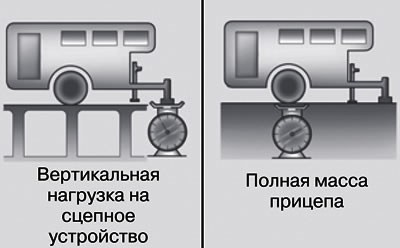
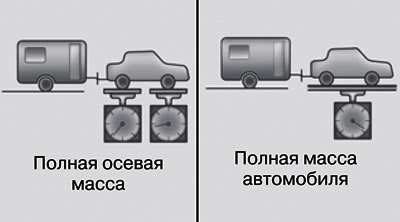
The vertical load on the hitch can be increased or decreased by redistributing the load in the trailer. This can be checked by determining the gross trailer weight with cargo, and then the load on the coupling device.
 |
 |
Note:
- 1. Do not load the rear of the trailer more than the front. Approximately 60% of the load weight should be placed in the front half of the loaded trailer, and 40% in the rear half.
- 2. The total mass of the vehicle with a trailer must not exceed the total transport mass specified in passport data plate car. The gross vehicle weight includes the weight of the vehicle, driver, all passengers and luggage, cargo, vehicle and trailer couplings and any additional equipment.
- 3. The load on the front or rear axle must not exceed the maximum axle load indicated on identification plate car. It is possible that the trailer you are towing does not exceed the Gross Vehicle Weight Rating (GVWR) but exceeds the Gross Axle Weight Rating (GAWR). Improper trailer loading and/or too much luggage in the trunk of your vehicle can cause the rear axle to be overloaded. Redistribute the load and recheck the axle loads.
- 4. The maximum permissible static vertical load on the coupling device is:
- - 4-door models 65 kg
- - 5-door models 60 kg
- 5. The maximum permissible overhang of the hitch attachment points is 1095 mm.

Caution: When towing a trailer, it is recommended to comply with the following technical requirements. The trailer weight must not exceed the values specified in the table below.

Warning: Improper loading of your vehicle and trailer can seriously affect the operation of the steering and braking systems, which can lead to an accident (crash) in which you can be seriously injured.
Recommendations for towing a trailer or car
1. Before starting towing, check the towing hitch and the attachment of the safety chains, as well as the serviceability of the side lights, brake lights and turn signals of the trailer.
2. Always maintain a moderate speed (no more than 100 km/h).
3. When towing, fuel consumption is higher than usual.
4. To ensure effective engine braking and sufficient generator charging current, do not engage fifth gear (in a car with a manual transmission) or overdrive (in a car with an automatic transmission).
5. Always securely fasten the load in the trailer to prevent it from shifting while driving.
6. Check the condition of the tires on the vehicle and trailer and the pressure in them. Insufficient tire pressure significantly impairs handling. Check the spare tire as well.
7. The vehicle-trailer coupling is more susceptible to the influence of crosswinds, gusts of wind and shock waves from oncoming traffic.
When passing large oncoming vehicles, maintain a constant speed and drive in a straight line. If the wind gusts are too strong, reduce speed.
8. When parking a vehicle with a trailer, especially on a slope, take the usual precautions. Turn the front wheels toward or away from the curb, set the parking brake securely, and engage 1st or reverse gear (in a car with a manual transmission) or set the selector lever to position "P" (in a car with an automatic transmission). Also, place chocks under each trailer wheel.
9. If the trailer is equipped with electric brakes, check their functionality by starting to move the trailer and manually engaging the trailer brake controller. At the same time, the reliability of the electrical wiring connections is checked.
10. While driving, check from time to time the fastening of the load and the serviceability of the light signaling and trailer brakes.
11. Avoid sudden starts, acceleration and braking.
12. Avoid making sharp turns and lane changes.
13. Do not press the brake pedal too long or too often. This will cause the brakes to overheat and reduce their effectiveness.
14. When driving downhill, use engine braking by engaging a lower gear.
On long climbs, engage a lower gear and reduce speed to avoid overloading and/or overheating the engine.
15. When stopping on an incline, do not use the accelerator pedal to prevent the vehicle from rolling. This will cause the automatic transmission to overheat. Apply the parking brake or press the brake pedal.
Note: When towing, check the transmission oil level more frequently.
Caution: If the engine overheats while towing (the temperature gauge arrow is near the red zone) it can be reduced or eliminated by taking the following measures:
- 1. Turn off the air conditioner.
- 2. Reduce your speed.
- 3. On an incline, shift to a lower gear.
- 4. In a traffic jam, move the selector lever to the "P" position or set it to neutral and let the engine run at high idle speed.