


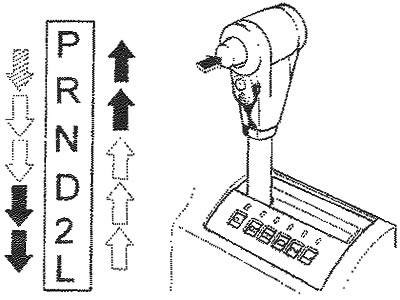
Hyundai's high-performance automatic transmission has four forward gears and one reverse gear. Gear shifting is automatic depending on the selector position. The selector lever has a conventional shifting algorithm, as shown in the figure.
At night, when the parking lights and headlights are turned on, the indicators on the gearbox panel light up automatically.
Caution: Do not move the selector lever to the "P" or "R" position while the vehicle is moving.
Note:
To move the selector, you need to press the button while simultaneously pressing the brake pedal.
To move the selector, you need to press the button.
You do not need to press the button to move the selector.
The purposes of each selector position are as follows:
"R" - Parking: Use this position to hold the vehicle in place while parked or starting the engine. When parking the vehicle, apply the parking brake and move the selector lever to the "P" (Park) position.
Caution: Do not move the selector lever to the "P" (Park) position until the vehicle has come to a complete stop. Failure to do so may result in damage to the automatic transmission.
"R" - Reverse: Use this position to reverse. Move the selector lever to the "R" (Reverse) position only after the vehicle has come to a complete stop.
"N" - Neutral position: In this position of the selector the automatic transmission is disengaged. In this position it is possible to start the engine, however it is not recommended except in cases when the engine stalls while the car is moving.
"D" - Movement: This mode is used for driving. One of the four gears is automatically engaged. Never shift the selector to position "2" or "L" if the vehicle speed exceeds 96 km/h.
"2" - Second gear: Use this mode when driving on slippery roads, when driving uphill, or for engine braking when going downhill. When the selector lever is in position "2", the transmission automatically shifts between first and second gears.
This means that there will be no shift to third gear. However, third gear may be engaged when the vehicle exceeds a certain speed to prevent the engine from exceeding the maximum permissible speed. When returning to normal driving conditions, move the selector to the "D" position.
"L" - Low gear: This mode is used when going up a steep hill or when using engine braking on a steep descent. When shifting to "L", the transmission will hold second gear for a while until the vehicle speed decreases enough to engage the lowest (first) gear. Do not exceed 50 km/h in the lowest "L" gear.
When the selector lever is in the iV position, the gearbox automatically shifts to first gear. However, it is possible to shift to second gear when the car exceeds a certain speed; if the speed continues to increase, third gear will be engaged to avoid exceeding the maximum engine speed.
Note:
- To ensure smooth and safe operation, fully depress the brake pedal before shifting the selector lever from the "P" (Park) or "N" (Neutral) position to the reverse gear position.
- To move the selector from the "P" ("Park") position to any other position, you must fully depress the brake pedal.
- You can always move the selector from the positions "R" ("Reverse"), "N" (Neutral), "O" ("Drive"), "2", "L" to the position "P" ("Park"). In this case, the car must be completely stopped so as not to damage the gearbox.
Attention:
- While the vehicle is moving, do not move the selector lever to position "P" or "R".
- Do not press the accelerator pedal while the transmission is in reverse or one of the forward gears with the brake pedal depressed.
- Always apply the brake pedal when moving the selector lever from the "P" or "N" positions to the "R", "D", "2", or "L" positions. o Do not use the "P" (Park) position instead of the parking brake. Even when leaving the vehicle for a short time, always apply the parking brake, move the selector lever to the "P" (Park) position, and turn off the ignition. Never leave the vehicle unattended with the engine running.
- Check the ATF level in your automatic transmission regularly and add fluid if necessary.
Correct driving techniques
Do not move the selector lever from the "N" or "T" position to any other position while the accelerator pedal is depressed.
While the vehicle is moving, the selector lever must not be moved to the "P" position.
(The original source of the article is the website: HyundaiBook)
Before moving the selector lever to the "R" position, make sure the vehicle is completely stopped.
Do not roll downhill in neutral. It is very dangerous. Always keep the gear engaged while the vehicle is moving.
Avoid driving in a manner that requires sudden braking. This will cause the brakes to overheat and become less effective. On long descents, engine braking (including lower gears) should be used to prevent the brakes from overheating.
When shifting into a lower gear, slow down the vehicle slightly. Otherwise, the lower gear may not engage.
Always use the parking brake when parked. Do not rely on shifting the selector lever to the "P" position to prevent the vehicle from moving.
Be especially careful when driving on slippery roads. Be especially careful when braking, accelerating and changing gears. On slippery roads, a sudden change in vehicle speed can cause the vehicle to lose traction and control over the vehicle.
For economical fuel consumption and smooth driving, turn on the "Overdrive" mode (high gear). If engine braking occurs in the "D" range or when a smooth climb requires repeated switching from 3rd to 4th gear and back, it is recommended to turn off the "Overdrive" mode. In all other cases, the "Overdrive" mode should be turned on.
Warning:
- Losing control of the vehicle at high speeds significantly increases the risk of the vehicle rolling over.
- Loss of control often occurs when two or more wheels leave the roadway and the driver attempts to steer the vehicle back onto the road. If your vehicle leaves the roadway, avoid turning the steering wheel abruptly. Instead, slow down before re-entering the road.
- Always wear your seat belts.