


Contents: Instrument panel ⇓ Instrument cluster and indicator…⇓ Brake pad wear alarm sound ⇓ Sound alarm buzzer ⇓
Instrument panel
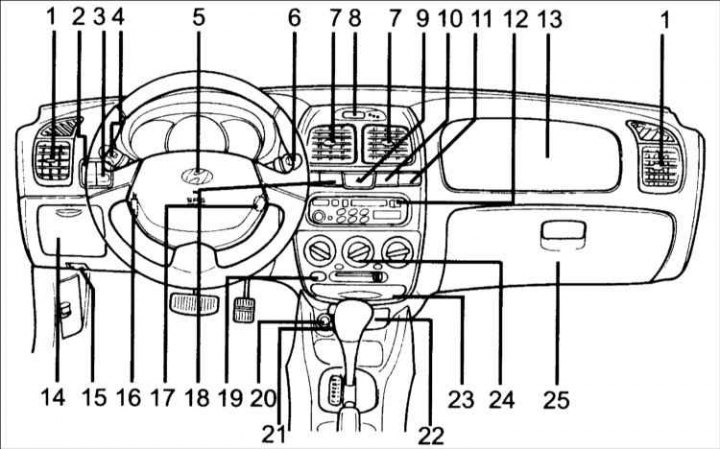
1 – side deflector of the ventilation system; 2 – headlight corrector switch; 3 – Rear window wiper/washer switch; 4 – combined headlight and turn signal switch; 5 – sound signal and additional passive safety system – driver"s airbag; 6 – Windscreen wiper/washer switch; 7 – central ventilation system deflector; 8 – electronic clock; 9 – Hazard warning light switch; 10 – Front fog light switch; 11 – Rear fog light switch; 12 – audio system; 13 – additional passive safety system – front passenger airbag; 14 – additional storage compartment for small items; 15 – hood lock release handle; 16 – steering column tilt adjustment lever; 17 – ignition switch; 18 – Rear window defroster switch; 19 – Air conditioning switch; 20 – cigarette lighter; 21 – Overdrive switch (only for cars with automatic transmission); 22 – ashtray; 23 – cup holder; 24 – Heater/Air Conditioner Control Panel; 25 – storage box.
Instrument cluster and indicator lights
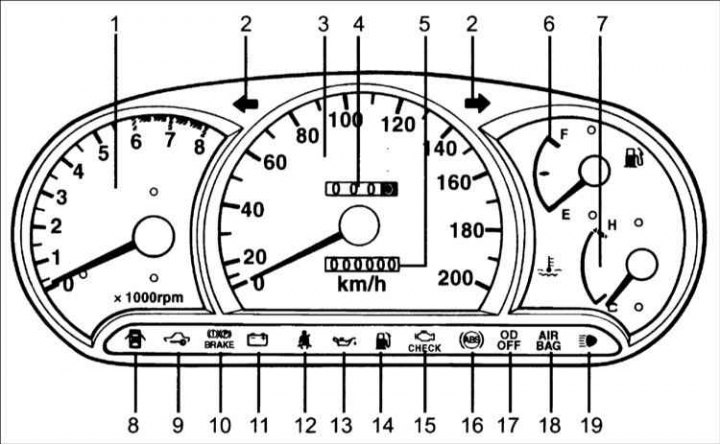
1 – tachometer; 2 – direction indicator lamps; 3 – speedometer; 4 – daily mileage counter; 5 – odometer (trip counter); 6 – fuel level indicator; 7 – coolant temperature indicator; 8 – Control lamp for signaling an open door; 9 – immobilizer control lamp; 10 – Parking brake/brake fluid emergency level indicator lamp; 11 – Low battery indicator lamp; 12 - Seatbelt warning indicator lamp not fastened;13 – Oil pressure indicator lamp; 14 – Fuel reserve indicator lamp; 15 – Malfunction Indicator Lamp (MIL); 16 – Anti-lock braking system (ABS) malfunction indicator lamp; 17 – Overdrive switch off indicator lamp; 18 – Supplemental Restraint System (SRS) Malfunction Indicator Lamp; 19 – high beam indicator lamp.
 Overdrive Disengagement Indicator Lamp (Automatic Transmission Only)
When the overdrive is engaged, the overdrive off indicator lamp will be extinguished. When the overdrive is disengaged, this lamp will light yellow.
 Direction indicator lamps
A green arrow will flash on the instrument panel to indicate the direction of the turn. If the arrow lights up but does not flash, flashes more quickly than usual, or does not light up at all, this indicates a fault in the turn signal circuits.
 Anti-lock brake system (ABS) malfunction indicator lamp
After turning the ignition key to the "ON" position, the anti-lock brake system malfunction indicator lamp comes on (ABS SRI) and then goes out after a few seconds.
If this light remains on, comes on while driving, or does not come on after the ignition key is turned to the "ON" position, it indicates a malfunction in the anti-lock brake system (ABS).
If this happens, you should contact an authorized Hyundai dealer as soon as possible to have the vehicle checked. The standard brake system will continue to operate, but without the assistance of the anti-lock brake system (ABS).
 High beam indicator lamp
This indicator lamp comes on when the high beam headlights are on.
 Seatbelt warning indicator lamp for unfastened seat belt signaling
This indicator light comes on when you turn the ignition key from the "LOCK" position to the "ON" or "START" position and remains on until your seat belt is fastened.
 Oil pressure warning light
Warning! Driving with low engine oil or with the oil pressure warning light on may cause engine damage (scuffing, seizure, etc.). If this light comes on while the engine is running, it means that the engine oil pressure is below the minimum permissible value. In normal condition, this light comes on when the ignition key is turned to the "ON" position and goes out after the engine starts. If the light remains on after the engine starts, there is a serious engine malfunction. In this case, immediately stop the vehicle in a safe place, turn off the engine, and check the oil level. If the oil level is below the minimum permissible value, add oil to the engine to the normal level and start the engine again. If the light remains on after the engine starts, turn off the engine immediately. In any case where the oil pressure warning light remains on after the engine starts, contact your nearest authorized HYUNDAI dealer before using the vehicle.
 Parking brake/brake fluid level warning light
The parking brake/brake fluid level warning lamp should come on when the parking brake is applied and when the ignition key is turned to the "ON" or "START" position. When the parking brake is released, this lamp should go out after the engine starts. When the parking brake is released, the parking brake/brake fluid level warning lamp should come on when the ignition key is turned to the "ON" or "START" position and go out after the engine starts. If this lamp comes on at any other time, you should slow down and stop the vehicle completely at the side of the road in a safe place. The brake system warning lamp indicates that the brake fluid level in the brake hydraulic system reservoir has dropped below the minimum permissible level and that DOT3 or DOT4 brake fluid must be added. After adding brake fluid, if no further faults are found, immediately take the vehicle to an authorized HYUNDAI dealer for inspection. If faults in the brake system are found, the vehicle must not be driven and must be taken to an authorized HYUNDAI dealer for inspection using a professional towing service.
The Hyundai car is equipped with a dual-circuit diagonal braking system. This means that even if one of the brake system circuits is damaged, you will be able to use two wheels for braking. In this case, more force on the brake pedal and a longer brake pedal travel will be required to stop the car. Moreover, the braking distance of the car will be increased.
If one of the brake circuits fails, shift into a lower gear to use engine braking to stop the vehicle.
 Low battery indicator light
The lamp lights up when the ignition key is in the "ON" position and goes out after the engine starts. If the indicator lamp remains on after the engine starts, there is a malfunction in the charging system.
If the indicator light comes on while the vehicle is moving, stop the vehicle immediately and check the condition and tension of the alternator drive belt. After that, contact an authorized Hyundai dealer to have the charging system checked.
Warning! If the alternator drive belt becomes loose or breaks while the vehicle is in motion, serious engine damage may occur. The engine may overheat because this belt also drives the water pump.
 Door open warning light
The lamp lights up when one of the side doors or the rear (fifth) door is not closed or is not closed tightly.
 Fuel reserve indicator light
The lamp lights up when the fuel level in the fuel tank reaches the minimum reserve value. When the lamp lights up, it means that you need to refuel. Driving the vehicle with the fuel reserve indicator lamp on or when the fuel level is below the "E" (Empty) mark may cause misfires and damage to the catalytic converter.
 Additional passive restraint system malfunction indicator lamp (SRS) (SRI)
The SRI indicator lamp comes on and flashes for 6 seconds after the ignition key is turned to the "ON" position or after the engine is started, and then goes out.
The indicator light also comes on if there is a malfunction in the supplemental restraint system (SRS). If the indicator light (SRI) does not come on or remains on after flashing for approximately 6 seconds after the ignition switch is turned to the "ON" position, or comes on while the vehicle is being driven, have the vehicle checked by an authorized HYUNDAI dealer.
Brake pad wear alarm sound
The front brake pads have a wear indicator that makes an unpleasant squealing sound as the brake pad wears down, signaling that the front brake pads need to be replaced. This noise may come and go or be constant while the vehicle is in motion. It can also be heard when the brake pedal is pressed hard. If you drive with worn brake pads, you can damage your expensive brake disc.
 Malfunction Indicator Light (MIL)
The light comes on when a malfunction is detected in components related to emission control systems. The light comes on when the ignition key is turned to the "ON" position, and then goes out after a few seconds. If the light comes on while the vehicle is being driven or does not come on after the ignition key is turned to the "ON" position, take the vehicle to your nearest authorized HYUNDAI dealer to have the systems checked.
Sound alarm buzzer
The alarm buzzer sounds when the rear lights are on and the driver's door is open.