


The designations of the circuits protected by the fuses are indicated on the fuse box cover.
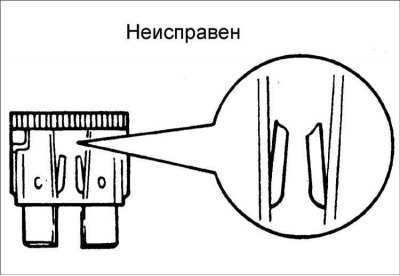
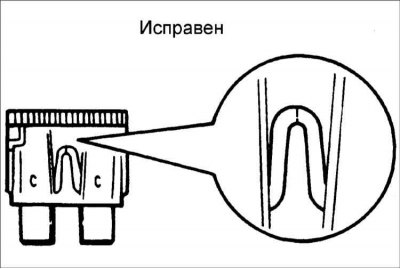
Before removing a fuse, turn off the circuit in question (or the ignition), then pull the fuse out of the contacts. The wire should be visible inside the fuse; if the fuse is blown, the wire will be broken or melted.
 |
 |
The article is borrowed from the website: HYUNDAIBOOK.RU
Always use fuses of the required rating. Never use a fuse of a different rating or replace it with anything else.
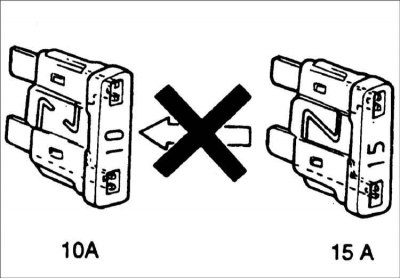
Do not replace a fuse more than once without eliminating the source of the fault. The current protected by the fuse is indicated on the top of the fuse: note that fuses are colored differently for easy identification.
If a fuse blows immediately after replacement, do not replace it again until you have installed and corrected the cause of the fault. In most cases, the cause of the fault is a short circuit caused by poor insulation. If the fuse protects several circuits, try to find the circuit that is causing the fuse to blow, turning on each circuit in turn (if possible). Always keep a set of spare fuses of different ratings in the car. They should be secured to the base of the fuse box.
Electrical circuits protected by fuses located in the engine compartment
Circuit | Current, A |
| Generator | 100 |
| ECM | 20 |
| Window lifters | 30 |
| Condenser | 20 |
| Battery | 50 |
| Lamps | 20 |
| Radiator | 20 |
| ABS | 30 |
| ABS | 20 |
| Ignition | 30 |
| Fan | 30 |