HyundaiBook.ru
Repair Chevrolet Repair Honda Repair Toyota Repair Land Rover Repair VAZ Repair Renault Repair Nissan
English Русский
Български
Беларускі
Український
Српски
Hrvatski
Română
Polski
Slovenský
Magyar
ArticlesSitemapContacts  


  Accent   Elantra   Getz   Grandeur   Sonata   Santa Fe   Tucson   Others
Tucson 1 (2005-2010) Tucson 2 (2009-2015)
  • Main
  • Tucson
  • LM (2009-2015)
  • Power unit
  • Intake and exhaust systems
  • Diesel Engine Exhaust System — Removal and Installation

Diesel Engine Exhaust System — Removal and Installation (Hyundai Tucson LM)

0
1. Perform steps 1-8 of section "Removal the intake manifold" (for diesel engines).

2. Disconnect the engine wiring harness connectors.

(1) Disconnect the pressure change sensor connector (A). (With diesel particulate filter).

(2) Disconnect the exhaust gas temperature sensor connector (B). (With diesel particulate filter).

(3) Disconnect the oxygen sensor connector (C).
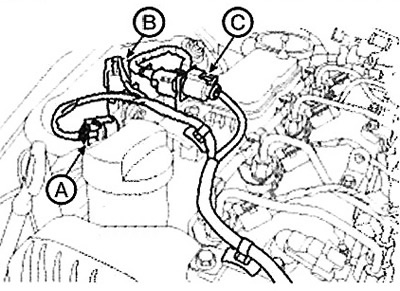
(3) Disconnect the oxygen sensor…


(4) Disconnect the fuel rail pressure regulator connector (A).

(5) Disconnect the air control valve connector (B).
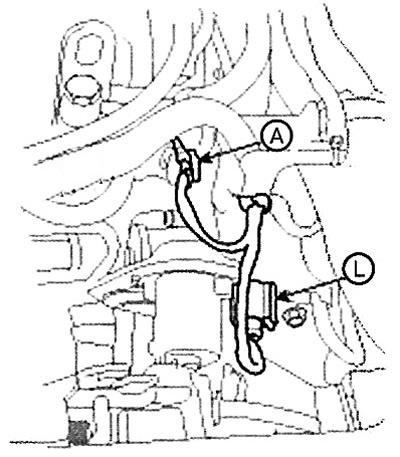
(5) Disconnect the air control valve…


(6) Disconnect the connector (A) of the air-fuel mixture vortex control actuator.

(7) Disconnect the coolant temperature sensor (ECTS) connector (B).

(8) Disconnect the connector (C) of the electric variable geometry turbocharger (E-VGT) actuator.


(9) Disconnect the exhaust gas recirculation (EGR) actuator connector (D).
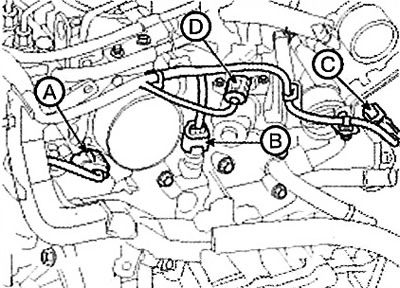
(9) Disconnect the exhaust gas…


3. Remove the wire harness protector (A).
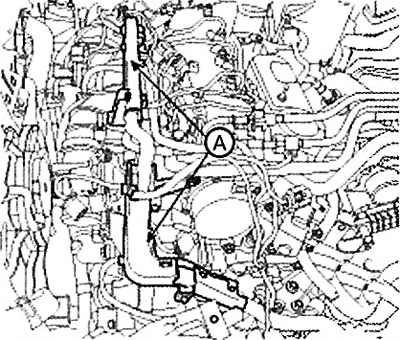
3. Remove the wire harness protector…


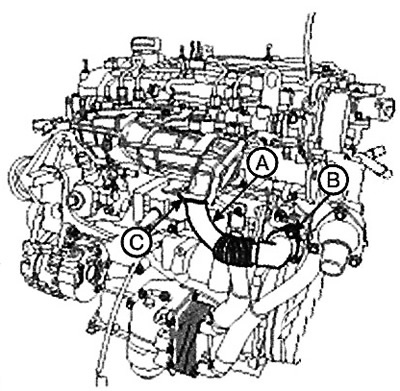
4. Disconnect the turbocharger water hose (A). (For standard power engines only.).

5. Disconnect the heater hose (B).
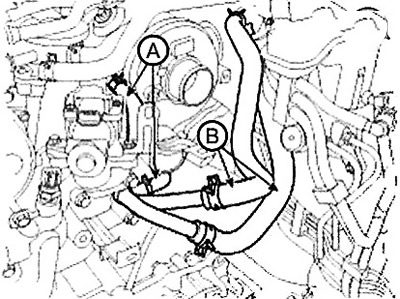
5. Disconnect the heater hose (B).


6. Remove the front muffler (A).

Note: Tightening torque: 39.2-58.8 Nm
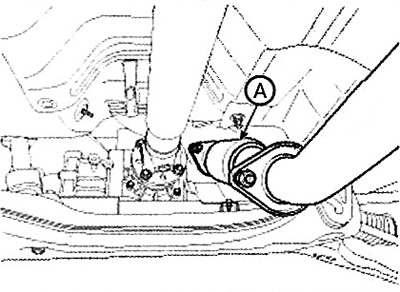

Note: Tightening torque: 39.2-58.8 Nm


7. Remove the heat shield (A) of the diesel particulate filter (or heated catalytic converter (WCC)).


Note: Tightening torque: 17.7-21.6 Nm.
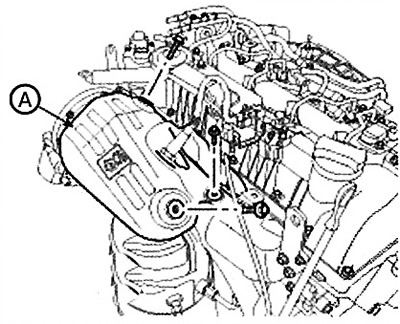

Note: Tightening torque: 17.7-21.6 Nm.


8. Remove the DPF (or heated catalytic converter (WCC)) converter assembly support bracket (A).

Note: Tightening torque: 44.1-53.9 Nm.


When installing the exhaust manifold, pre-tighten the bolts, then tighten them to the specified torque in the specified order.
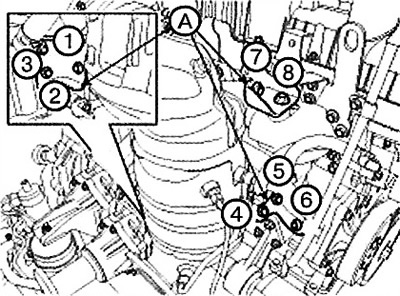
When installing the exhaust manifold,…


9. Remove the diesel particulate filter (or heated catalytic converter (WCC)) converter assembly (A).

Note: Tightening torque: 49.0-68.6 Nm.
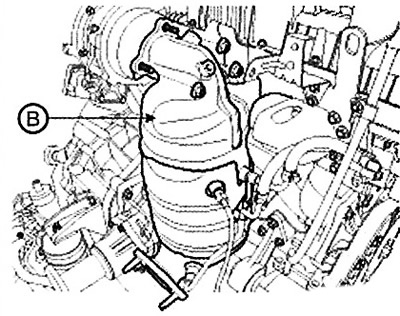

Note: Tightening torque: 49.0-68.6 Nm.
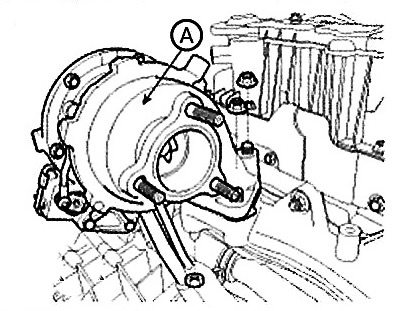

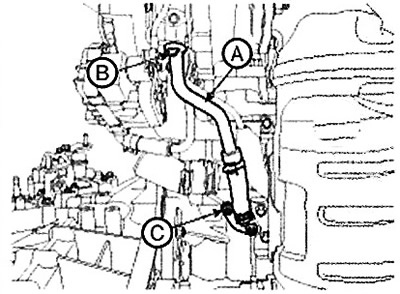
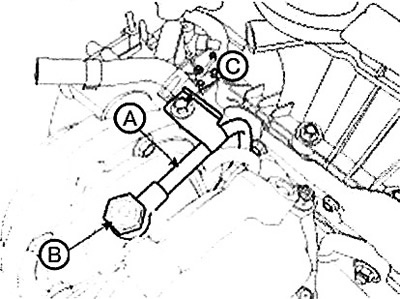
10. Remove the oil drain pipe (A) from the turbocharger.


Note:

Tightening torque:
  • Bolts (B): 9.8 - 11.8 Nm.
  • Nuts (C): 19.6 - 26.5 Nm.


Nuts (C): 19.6 - 26.5 Nm.


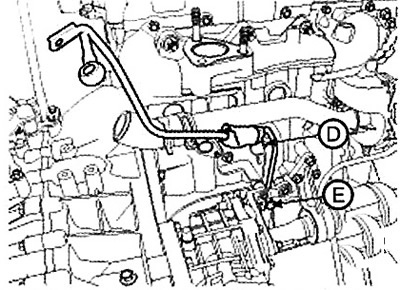
11. Remove the turbocharger oil supply pipe (A).

Note: Tightening torque:
  • Bolt (B): 11.8 - 17.7 Nm.
  • Bolt (C): 9.8 - 11.8 Nm.
  • Bolts (D, E): 19.6 - 26.5 Nm.


Bolts (D, E): 19.6 - 26.5 Nm.

12. Remove the turbocharger assembly (A).

Note: Tightening torque: 49.0-68.6 Nm.


Note: Tightening torque: 49.0-68.6 Nm.


13. Remove the exhaust manifold heat shield (A).

Note: Tightening torque: 9.8-11.8 Nm.
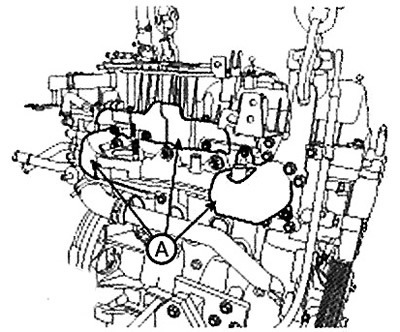

Note: Tightening torque: 9.8-11.8 Nm.


14. Remove the exhaust manifold (A) with the gasket (B).

Note: Tightening torque: 39.2-44.1 Nm.


When installing the bushings, the larger part should be facing towards the cylinder block.
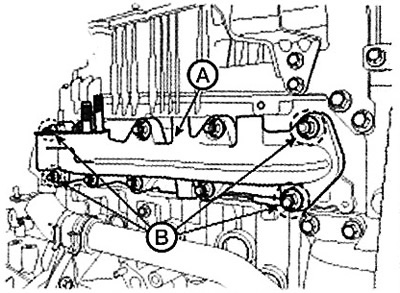
When installing the bushings, the…


15. Disconnect the coolant inlet hose (A).
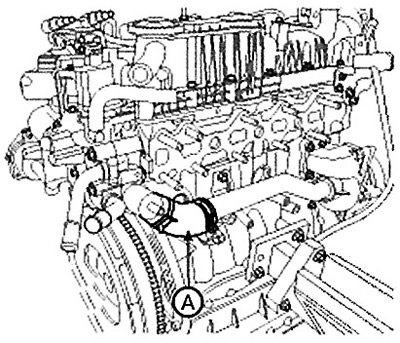


15. Disconnect the coolant inlet hose…


16. Disconnect the exhaust gas recirculation (EGR) vacuum pipe (A).
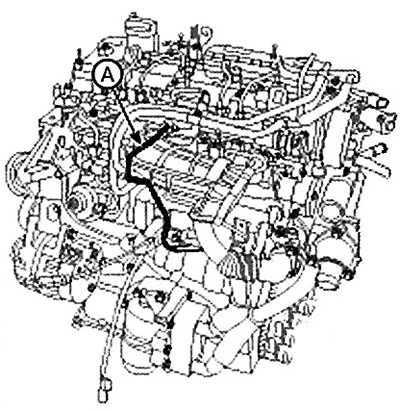
16. Disconnect the exhaust gas…


17. Remove the air control valve (A).

Note: Tightening torque: 8.8-10.8 Nm.
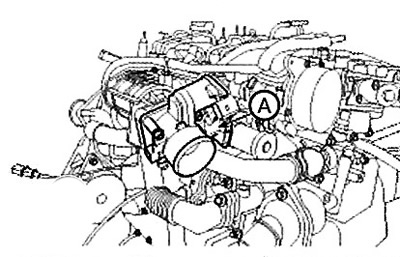

Note: Tightening torque: 8.8-10.8 Nm.


18. Remove the coolant outlet pipe (A).

Note: Tightening torque: 7.8-11.8 Nm.
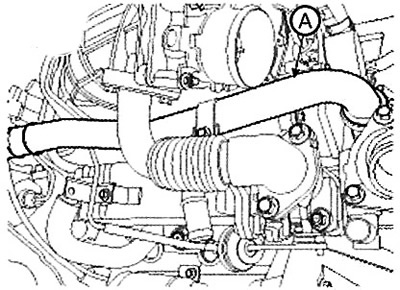

Note: Tightening torque: 7.8-11.8 Nm.


19. Remove the exhaust gas recirculation (EGR) pipe assembly (A).


Note:

Tightening torque:
  • Bolts (B): 19.6-23.5 Nm.
  • Bolts (C): 9.8-11.8 Nm.


Bolts (C): 9.8-11.8 Nm.


Before installing the exhaust gas recirculation (EGR) pipe (B), be sure to install the O-ring (A) into the intake manifold.

Caution: If the O-ring is inserted into the intake manifold when installing the EGR pipe, it may be damaged, resulting in exhaust gas leakage.
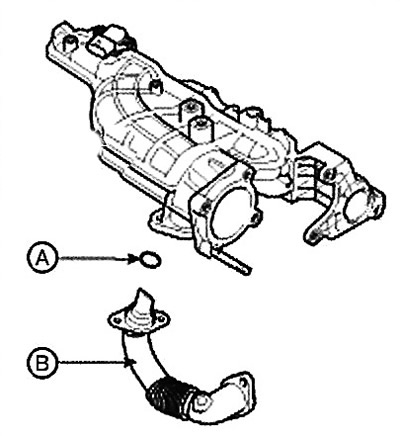

Caution: If the O-ring is inserted into…


20. Disconnect the EGR cooler hose (A) and oil cooler hoses (B).
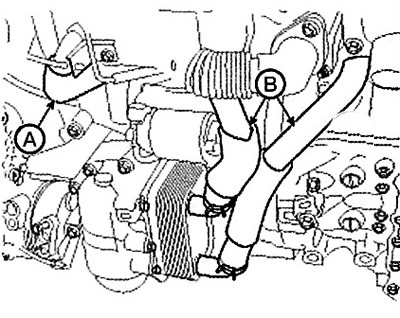
20. Disconnect the EGR cooler hose (A)…


21. Remove the exhaust gas recirculation (EGR) cooler (A).


Note: Tightening torque:
  • Bolt (B): 9.8 - 11.8 Nm.
  • Nut (C): 19.6 - 26.5 Nm.


When installing the EGR cooler, pre-tighten the bolts and nuts, then tighten them to the specified torque in the specified order.
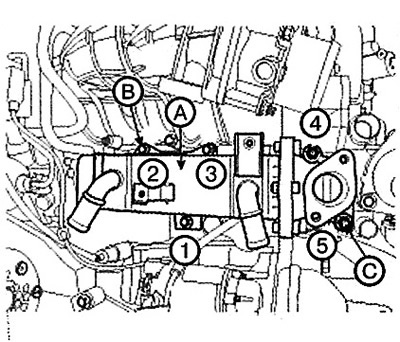
When installing the EGR cooler,…


22. Remove the thermostat housing and EGR assembly (A).

Note: Tightening torque: 19.6-24.5 Nm.
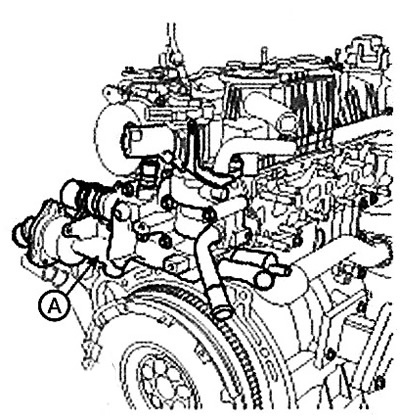

Note: Tightening torque: 19.6-24.5 Nm.


23. Installation is carried out in the reverse order of removal.
This article is available at russian, bulgarian, belarusian, ukrainian, serbian, croatian, romanian, polish, slovak, hungarian
This article has been reviewed by: Konstantin Smirnov
Add to social network:

Previous
Tucson 2: Intake and exhaust systems
Next

Exhaust manifold of diesel engines — device
Exhaust system of gasoline engines
Diesel engine intake system
Intake system of gasoline engines
Turbocharger and intercooler of diesel engine
Silencer for gasoline engines
Diesel Engine Silencer
We recommend other articles on the topic of Hyundai manuals:

Exhaust gas cleaning system (SOHC engine) Hyundai Accent 1 (1994-1999)
Engine and exhaust system Hyundai Elantra 1 (1990-1995, petrol)
Electronic immobilizer (anti-theft engine start blocking system) Hyundai Getz (2002-2011)
Engine cooling system Hyundai Sonata 3 (1993-1998)
Removal, inspection and installation of the exhaust system… Hyundai Santa Fe 2 (2007-2012, petrol)
Electronic immobilizer (anti-theft engine start blocking system) Hyundai Matrix (2001-2010, petrol)
Link in different formats to this article

Visitor comments
No comments yet


How much will 27 + 27 ?


Tucson 2 (2009-2015) 
  • General information
  • Faults en route
  • User manual
  • Maintenance
  • Power unit
  • Gasoline engines
  • Diesel engines
  • Engine cooling system
  • Engine lubrication system
  • Engine power system
  • Control system
  • Intake and exhaust systems
  • Engine electrical equipment
  • Transmission
  • Clutch
  • Mechanical gearbox
  • Automatic gearbox
  • Drive shafts
  • Chassis
  • Suspension and wheels
  • Brake system
  • Steering
  • Body
  • Exterior (external elements)
  • Interior (internal elements)
  • Security systems
  • Air conditioning and heater
  • Electrical equipment
  • Electrical circuits
Tucson 1 (2005-2010) 
  • General information
  • User manual
  • Maintenance
  • Power unit
  • Gasoline engine G6BA
  • Gasoline engine G4GC
  • Diesel engine D4EA
  • Fuel system (gasoline)
  • Fuel system (diesel)
  • Engine lubrication system
  • Engine cooling system
  • Engine electrical equipment
  • Transmission
  • Clutch
  • Car gearbox
  • Drive shafts and cardan
  • Chassis
  • Car suspension
  • Steering
  • Brake system
  • Body
  • Exterior (external elements)
  • Interior (internal elements)
  • Air conditioning and heater
  • Airbags
  • Electrical equipment
  • Equipment and devices
  • Electrical circuits
HyundaiBook.ru © 2018-2026 · Mobile version · Sitemap: EN BG BY UA RS HR RO PL SK HU · Administration · Site search · Hyundai owners Accent 1 · Accent 2 · Accent 3 · Elantra 1 · Elantra 2 · Elantra 3 · Getz · Sonata 3 · Sonata 4 · Santa Fe 2 · Tucson 1 · Tucson 2 · Matrix ·
This site uses cookies to optimize its functionality. By continuing, you agree to our terms.