


Compression check
Note: If there is a loss of power, increased fuel consumption or increased oil consumption, it is necessary to check the compression in the engine cylinders.
1. Warm up and stop the engine. Warm up the engine to normal operating temperature (80-95°C).
2. Disconnect the inlet (A) and outlet (B) fuel hoses from the fuel filter.
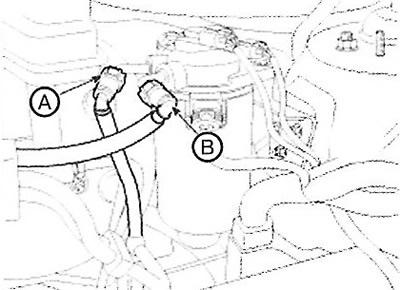
3. Turn the crankshaft to release fuel from the high pressure pump.
Note: Collect residual fuel by placing the return hose in a suitable container.
4. Disconnect the high pressure fuel line and remove the injector and washer.
5. Measure the compression pressure in the cylinder:
Install the special tool (09351-27000, 09351-1M100) into the injector hole.
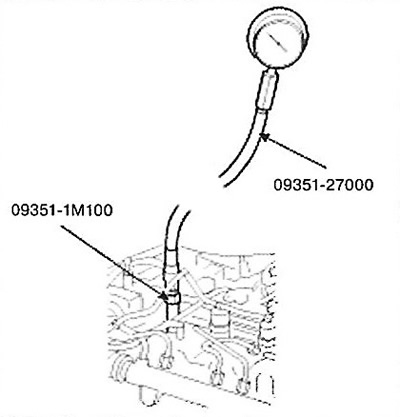
Measure the pressure by turning the crankshaft.
Note: Use a fully charged battery pack to rotate the crankshaft at a speed of 200 rpm or more.
Repeat the above steps for each cylinder.
Attention: This work must be done in the shortest possible time.
Note:
- Nominal compression pressure: 2157.45kPa (22kg/cm²) (at 200rpm).
- Minimum compression pressure value: 1863.25 kPa (19 kg/cm²).
- The difference between the compression of each cylinder: no more than 294.2 kPa (3 kg/cm²).
If the measured value in one or more cylinders is below the limit, add a little engine oil to the cylinder injector holes, repeat steps 1 and 2 and re-measure the compression pressure.
If the re-measured pressure is higher, the cause may be wear or damage to the piston ring or cylinder surface.
If the pressure measured again does not become higher, the cause may be damaged valve seats or a valve not seating properly. Another possible cause may be a damaged cylinder head gasket.
6. Install the injectors, washers and connect the high pressure fuel line.
7. Connect the inlet and outlet hoses to the fuel filter.