


Contents: Starting the engine from an external…⇓ Procedure for starting the engine…⇓ Starting the engine by towing ⇓
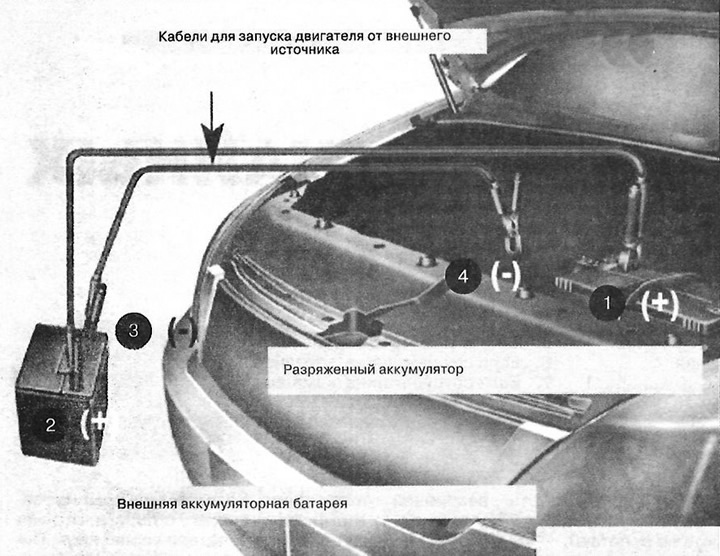
Connect cables in the direct numbering sequence and disconnect them in the reverse numbering sequence.
Starting the engine from an external source
This method of starting the engine can be dangerous if done incorrectly. Therefore, to avoid causing harm to yourself, the car and the battery when jumping-starting the engine, do it as follows. If in doubt, we strongly recommend entrusting these operations to an experienced specialist or a towing service.
Caution: Use only a 12-volt external power system. If you apply 24-volt power (two 12-volt batteries connected in series, or a 24-volt motor-generator unit) to a 12-volt starter, ignition system, or other electrical equipment, this may cause irreparable damage to the latter.
Warning: Battery: Never attempt to check the battery fluid level as this may cause the battery to rupture or explode, resulting in serious injury.
Warning. Battery. Keep open flames and sparks away from the battery. It produces hydrogen gas, which can explode in their presence. To avoid serious injury and damage to the vehicle, follow these instructions carefully! If you are not sure how to perform this operation correctly, seek qualified assistance. Car batteries contain sulfuric acid. It is poisonous and corrosive. When jump starting the engine, wear protective glasses and make sure that the acid does not come into contact with your skin, clothing or vehicle.
Do not attempt to jump start the engine if the battery is frozen or has a low electrolyte level, as the battery may rupture or explode.
Procedure for starting the engine from an external source
1. Make sure the external battery voltage is 12V and ground its negative terminal.
2. If the booster battery is in another vehicle, do not allow them to touch.
3. Disconnect all electrical loads not needed at the moment.
4. Connect the jumper cables in exactly the same order as shown in the illustration. First connect one end of the jumper cable to the positive terminal of the discharged battery (1), then connect the other end to the positive terminal of the booster battery (2). Then connect one end of the other jumper cable to the negative terminal of the booster battery (3), and the other end to a solid, stationary metal part (such as an engine lift bracket) located away from it (4). Do not connect it to or near parts that will move when the engine starts cranking. Do not touch the ends of the jumper cables to anything other than the corresponding battery terminals and grounding points. Do not lean over the battery when connecting the cables.
Caution: Battery cables: Do not connect the negative terminals of the discharged battery and the external battery together. This may cause the discharged battery to overheat and crack, resulting in acid release.
5. Start the engine from the external battery and let it run at 2,000 rpm, then start the engine from the discharged battery.
If the cause of your battery discharge is unclear, have your vehicle inspected by an authorized Hyundai dealer.
Starting the engine by towing
Do not start the engine by pushing your vehicle equipped with a manual transmission, as this may damage the exhaust gas reduction system. You can't start the engines of cars with an automatic transmission in this way. Follow the instructions in this section for starting the engine from an external source.
Caution: Never tow a vehicle to jump start its engine, as the sudden forward movement after starting may cause it to collide with the towing vehicle.