


Contents: Low Tire Pressure Position Indicator ⇓ TPMS (Tire Pressure Monitoring…⇓ Replacing a tire equipped with a…⇓
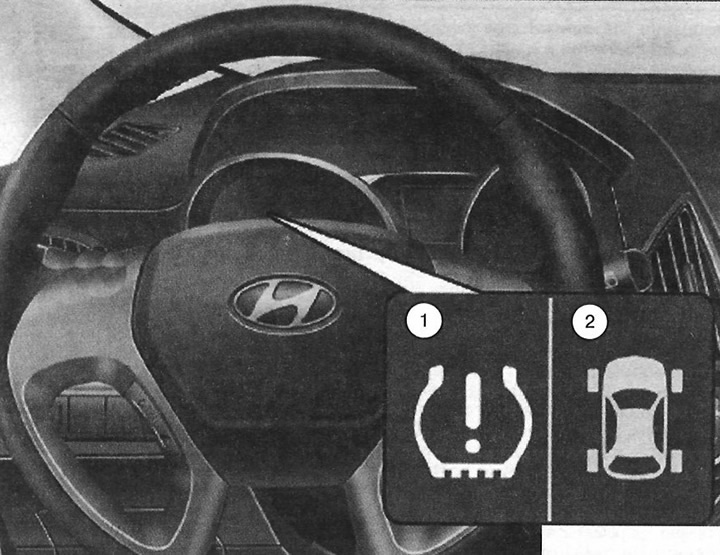
1. Low Tire Pressure Warning Light/TPMS Malfunction Indicator.
2. Low tire pressure position indicator.
In cold weather, check the pressure in each tire monthly, including the spare tire (if equipped), and, if necessary, increase the tire pressure to the manufacturer's recommended pressure (indicated on the vehicle's information plate).
If the vehicle is equipped with tires that are different in size from those indicated on the plates, the appropriate pressure level must be determined for them.
As an additional safety system, the vehicle may be equipped with a tire pressure monitoring system (TPMS), which provides an indication of a significant decrease in pressure in one or more tires using a low tire pressure warning light.
If the low tire pressure indicator lights up, you should stop the car as soon as possible, check the condition of the tires and bring them to the normal pressure. Continuing to drive with low tire pressure can lead to overheating and mechanical destruction of the tires. Using tires with lower pressure than normal also leads to increased fuel consumption, reduced tire life and can affect the controllability and braking distance of the car.
Please note that using TPMS does not eliminate the need to properly maintain your tires and maintain proper tire pressure, even if the pressure drop is not sufficient to trigger the TPMS warning light.
The vehicle is also equipped with a TPMS malfunction indicator to ensure that the system is operating properly. The TPMS malfunction indicator is combined with the low tire pressure indicator. When the system detects a malfunction, the indicator will flash for approximately one minute, then remain on continuously. This sequence will repeat after subsequent vehicle starts as long as the malfunction exists. When the malfunction indicator is illuminated, the system may not be able to properly detect or signal low tire pressure. A TPMS malfunction can be caused by a variety of reasons, including installing or replacing tires or wheels. Always check the TPMS malfunction indicator after replacing one or more tires or wheels, or when swapping tires or wheels, to ensure that the TPMS is working properly.
Note: If the TPMS, low pressure, and position indicators do not come on within three seconds after turning the ignition switch to the ON position or starting the engine, or if they remain on for about three seconds after turning on, have the system checked by your nearest authorized Hyundai dealer.

Low Tire Pressure Position Indicator
When the tire pressure monitoring system warning lights come on, it means that the pressure in one or more tires is significantly low. The low tire pressure position warning light indicates which tire has low pressure (the corresponding lamp lights up). If any of these warning lights come on, reduce your speed immediately and, avoiding sharp turns, bring the vehicle to a smooth stop. In this case, you should stop the vehicle immediately and check the tire pressure.
Inflate the tires to the normal pressure indicated on the information labels located on the B-pillar of the driver's side exterior trim panel. If you cannot get to a service station or the tire does not hold the added air volume, replace the low-pressure tire with the spare tire. This may turn on the tire pressure monitoring system (TPMS) malfunction indicator; the low tire pressure indicator comes on again after starting the engine and driving continuously for 20 minutes and until the affected tire is repaired or replaced.
Caution: In cold weather, the low tire pressure indicator may illuminate even if the tire pressure is set to the recommended pressure for warm weather. This does not indicate a malfunction of the TPMS, since a decrease in temperature causes a proportional decrease in tire pressure. When driving from a cold to a hot area or vice versa, or if the outside temperature is significantly higher or lower, check the tire pressure and adjust it to the recommended level.
Warning: Danger of low pressure. Too low tire pressure can lead to loss of vehicle control and increased braking distance. Continuing to drive with low tire pressure can lead to overheating and mechanical destruction of the tires.

TPMS (Tire Pressure Monitoring System) Malfunction Indicator
If there is a malfunction in the tire pressure monitoring system, the low tire pressure indicator will flash for approximately one minute and then remain on. If low tire pressure is detected correctly at the same time as the system malfunction, the tire pressure monitoring system (TPMS) malfunction indicator and the low tire pressure warning light will come on simultaneously. For example, if the left front tire sensor is malfunctioning, the TPMS malfunction indicator will come on, but if the right front, right rear, or left rear tire is not properly inflated, the corresponding tire low pressure warning light will come on in addition to the TPMS indicator.
Attention.
- The TPMS malfunction indicator may also illuminate when the vehicle is driven near electrical cables or radio transmitters (e.g., vehicle inspection stations, government agencies, radio broadcasting stations, military installations, airports, broadcasting stations, etc.). The resulting interference may cause the tire pressure monitoring system (TPMS) to malfunction.
- The TPMS malfunction indicator may also come on if electronic devices, such as laptop computers, are operating in the vehicle. The resulting interference may cause the tire pressure monitoring system (TPMS) to malfunction.
Replacing a tire equipped with a TPMS sensor
If a tire is flat, the warning messages "Low Tire Pressure" and "Position" will appear. Have the tire repaired by an authorized Hyundai dealer as soon as possible or replace the tire with the spare tire.
Caution: Never use puncture sealant to repair a tire or inflate a flat tire. Using tire sealant can damage the tire pressure sensor. If sealant was used, the tire pressure sensor will need to be replaced.
Each wheel has a tire pressure sensor, which is mounted inside the tire behind the valve stem. It is necessary to use wheels that are compatible with the TPMS system. It is recommended that you always have your tires serviced by an authorized Hyundai dealer. Even if you replace the problem tire with the spare tire, the low tire pressure indicator will remain on until the removed tire is repaired and installed. After replacing a low-pressure tire with the spare tire, the TPMS malfunction indicator may remain on for several minutes because the TPMS sensor is not mounted on the spare tire.
Once a low tire has been inflated to the recommended level and installed on the vehicle, or a new TPMS sensor has been installed on the tire, the TPMS malfunction indicator and low tire pressure warning light will go out after a few minutes of driving. If the indicators do not go out after a few minutes, see an authorized Hyundai dealer.
Caution: If the TPMS sensor on the original wheel continues to operate, the tire pressure monitoring system may not function properly. Tires with TPMS sensors should be repaired or replaced by an authorized Hyundai dealer.
A tire that is underinflated may not look any different from a tire with normal pressure. Always use a quality tire pressure gauge to measure tire pressure. Note that a tire that is warmer (e.g. after being driven) will have a higher pressure level than a tire that is colder (if the vehicle has not been driven for more than three hours or has been driven less than 1.6 km in a three-hour period). Allow the tire to cool before measuring the pressure. Before inflating the tire to the recommended pressure, make sure the tire is at normal temperature. This means that the vehicle has not been driven for three hours or has been driven less than 1.6 km in a three-hour period.
Caution: If your vehicle is equipped with a tire pressure monitoring system, do not use tire sealant. Using liquid tire sealant may damage the tire pressure sensor.
Attention.
- The TPMS system is not designed to alert you to sudden tire failure caused by external factors such as sharp objects on the road.
- If the vehicle's handling becomes unstable, immediately remove your foot from the gas pedal, press the brake pedal smoothly and with little force, and slowly stop the vehicle in a safe place on the road.
Attention. TPMS protection. Improper use, modification, or deactivation of Tire Pressure Monitoring System (TPMS) components may affect the functionality of the system to notify the driver of a decrease in tire pressure or a malfunction of the TPMS system. Improper use, modification, or deactivation of Tire Pressure Monitoring System (TPMS) components may void the warranty for this vehicle system.