


Contents: Towing service ⇓ Removable tow hook (if equipped) ⇓ Emergency towing ⇓ Precautions when towing a damaged…⇓
Towing service
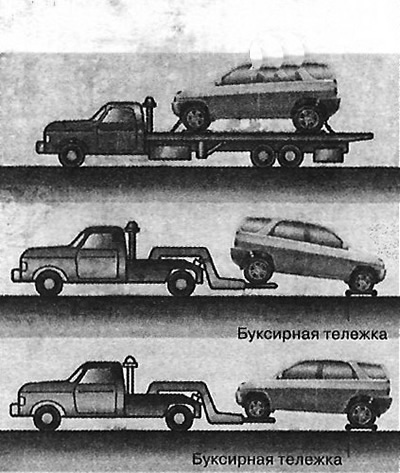
If emergency towing is necessary, it is recommended to use an authorized Hyundai dealer or a commercial towing service. To prevent damage to the vehicle, it is important to follow proper lifting and towing procedures. It is recommended to use wheel dollies or tow trucks.
Towing a four-wheel drive vehicle must be done using a towing dolly or flatbed to ensure that all wheels are off the road surface.
Warning: Never tow a 4WD vehicle with its wheels on the ground. This could cause serious damage to the drive axle and transmission or the 4WD system.
A front-wheel drive vehicle may be towed with the rear wheels on the ground (without a dolly) and the front wheels raised off the ground. Use dollies under the front wheels if any loaded wheels or suspension components are damaged, or if the vehicle is towed with the front wheels on the ground.
When using a commercial towing vehicle and no towing dollies are available, the front of the vehicle should always be lifted, not the rear.
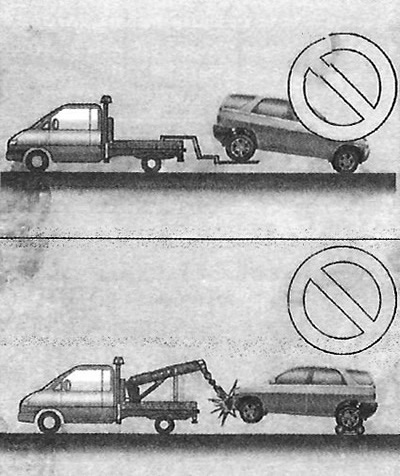
Attention.
- Do not tow your vehicle backwards with the front wheels on the ground as this may damage your vehicle.
- Do not tow the vehicle with a flexible hitch. Use wheel lifting equipment or a tow truck.
In case of emergency towing of a vehicle without using wheel towing dollies:
1. Turn the ignition key to the ACC (Auxiliary) position.
2. Place the gear shift lever in position N (Neutral).
3. Release the vehicle's parking brake.
Caution: Failure to place the gearshift lever in the N (Neutral) position may damage the gearbox.
Removable tow hook (if equipped)
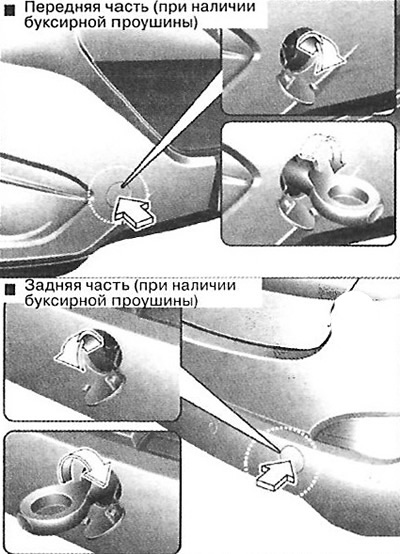
1. Open the rear tailgate and remove the towing hook from the tool box.
2. Remove the cover from the hole by pressing on the bottom of the cover on the front or rear bumper.
3. Install the towing hook by turning it clockwise until it is fully secured.
4. After use, pull out the tow hook and put the cover back.
Emergency towing
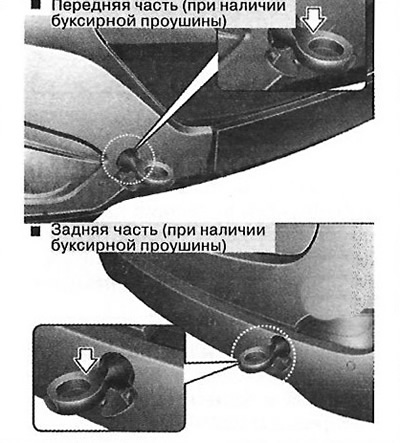
Caution: If emergency towing is required, it is recommended that you use an authorized Hyundai dealer or a commercial towing service.
If a towing service is unable to assist in an accident, the vehicle may be towed for a period of time using a cable or chain that is attached to the emergency towing hook at the bottom of the front (or rear) of the vehicle. Be very careful when towing the vehicle. The driver must be seated in the vehicle to steer and operate the pedals. This method of towing is only acceptable on paved roads for short distances and at low speeds. The wheels, axles, transmission, steering, and brakes must be in good condition.
Do not use tow hooks to pull a vehicle out of mud, sand or other conditions from which it cannot free itself.
Avoid situations where you tow a heavier vehicle with a lighter one.
Drivers of both vehicles need to communicate with each other frequently.
Attention.
- Attach the tow rope to the tow hook.
- Using any part of the vehicle other than the tow bar for towing may damage the vehicle body.
- Use only cables or chains specifically designed for towing vehicles. Securely attach the cable or chain to the existing towing hook.
Before emergency towing, make sure the hook is not broken or damaged.
Attach the rope or chain securely to the hook.
Do not jerk the hook. Apply gradual and even force.
[The original can be read on the resource: hyundaibook.ru]
To avoid damaging the hook, do not pull it sideways or vertically. Always pull straight forward.
Attention.
- Be very careful when towing your vehicle.
- Avoid sudden starts and other maneuvers that place additional stress on the emergency towing hook, cable, or chain. The hook, cable, or chain may break and cause serious injury or damage.
- If the disabled vehicle is unable to move, do not continue towing forcibly. Contact an authorized Hyundai dealer or a professional towing service for assistance.
- Tow the vehicle as straight as possible.
- Do not stand near the vehicle while it is being towed.
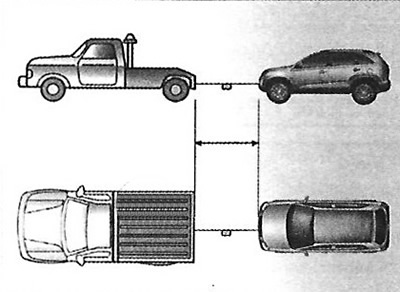
The length of the towing rope should not exceed 5 m. For visibility, attach a white or red cloth (about 30 cm wide) in the middle of the rope.
Drive carefully to avoid slack in the towing rope when towing.
Precautions when towing a damaged vehicle
- Turn the ignition key to the ACC (Accessory) position to prevent the steering wheel from locking.
- Place the gear shift lever in position N (Neutral).
- Release the vehicle's parking brake.
- Press the brake pedal with more force than usual due to the weakening of the brake effect.
- Steering will require more effort due to the power steering system being disabled.
- If you are going down a long hill, your brakes will not work as effectively as they would otherwise overheat. Stop frequently and let your brakes cool down.
Attention.
- Automatic transmission.
- Towing a vehicle on all four wheels is only permitted in forward motion. Make sure the ignition key is in the ACC (Auxiliary) position and the steering wheel is unlocked. The driver must be seated in the towed vehicle to steer it and press the pedals.
- To avoid serious damage to the manual transmission, the vehicle speed during towing should not exceed 15 km/h.
- Before towing, check for automatic transmission fluid leaks under the vehicle. If there are automatic transmission fluid leaks, a flatbed truck or towing dolly must be used.