


Contents: Checking the steering wheel play ⇓ Checking the steering wheel effort…⇓ Replacing the power steering fluid ⇓ Removal air from the system ⇓ Checking the power steering pump…⇓
Checking the steering wheel play
1. Set the front wheels to the straight-ahead position.
2. Measure the distance the steering wheel turns without moving the wheels.
Note: Standard value: 0-30mm.
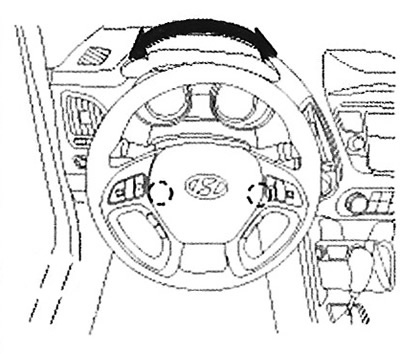
3. If the play exceeds the standard value, check the steering column, shaft and rods.
Checking the steering wheel effort for a stationary vehicle
1. Place the vehicle on a level surface and set the front wheels in the straight-ahead position.
2. Start the engine and turn the steering wheel from lock to lock several times to warm up the power steering fluid.
3. Install a dynamometer on the steering wheel. Set the engine speed to 500-700 rpm, then rotate the steering wheel and read the dynamometer value when the wheels begin to turn.
Note: Standard value: 3.0 kgf.
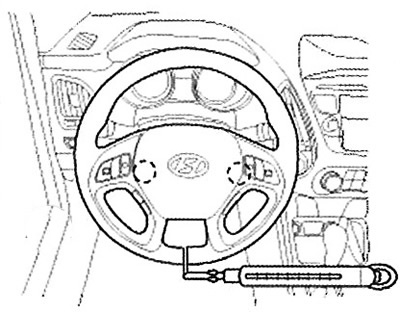
4. If the measured value is greater than the standard, check the steering gear and power steering pump.
Replacing the power steering fluid
Caution: Always use genuine PSF-4 fluid. Using another type of power steering fluid or transmission fluid may result in increased wear and difficult handling in cold weather.
1. Lift the reservoir, then disconnect the return hose to drain the liquid. Try not to spill the liquid on the body and other parts. Wipe up any spilled liquid immediately.
2. Connect a tube of suitable diameter to the disconnected return hose and lower the end of the hose into a suitable container.
3. Raise the front wheels and turn the steering wheel from lock to lock until fluid stops flowing from the tube.
4. Connect the return hose to the tank.
5. Fill the reservoir with power steering fluid and bleed air from the power steering system.
Removal air from the system
Caution: Always use genuine PSF-4 fluid. Using another type of power steering fluid or transmission fluid may result in increased wear and difficult handling in cold weather.
1. Raise the front wheels.
2. Fill the reservoir with power steering fluid up to the "COLD MAX" mark on the reservoir.
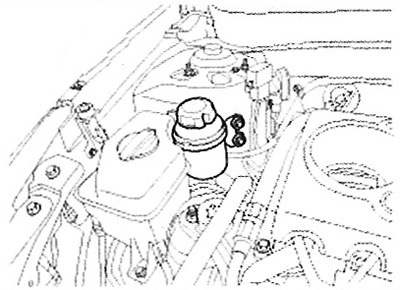
Caution: Avoid starting the engine. If the engine is started before steps 3 and 4 are completed, abnormal noise may occur from the power steering pump.
3. Turn the steering wheel from lock to lock 5 - 6 times for 15 - 20 seconds.
4. Turn the crankshaft 1 - 2 times with the starter, quickly turning the ignition key from the "ON" position to the "START" position, but without starting the engine.
5. Turn the steering wheel from lock to lock 5-6 times for 15-20 seconds. Start the engine and continue to turn the steering wheel from lock to lock until air bubbles stop appearing in the reservoir.
6. Check the color and level of the power steering fluid in the reservoir. If necessary, top up the fluid to the "COLD MAX" level.
Note: If the fluid level decreases and increases when you turn the steering wheel, the fluid overflows the edge of the reservoir when you start the engine, or the fluid is white, then the air has not been completely removed from the power steering system. Therefore, if necessary, repeat steps 5 and 6.
Checking the power steering pump discharge pressure
1. Disconnect the high pressure line from the power steering pump and install the special tools between the pump and the line as shown in the figure below.
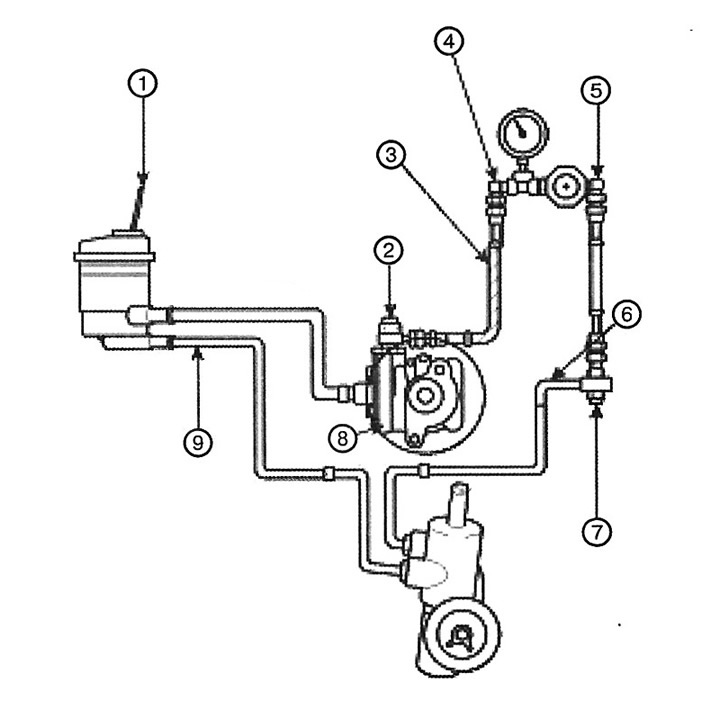
1. Temperature sensor
2. Adapter (09572-21200, 09572-22100)
3. Relieve oil pump pressure
4. Oil pressure gauge (09572-21000)
5. Shut-off valve (closed)
6. Pressure hose
7. Adapter for oil pressure gauge (09572-22100)
8. Oil pump
9. Tank
2. Start the engine and turn the steering wheel several times until the power steering fluid temperature rises to approximately 50 - 60°C.
3. Set the engine speed to approximately 600 rpm.
4. Close the shut-off valve of the special tool and measure the fluid pressure.
Note: Discharge pressure: 90 - 100 kg/cm².
Caution: Do not keep the gauge shut-off valve closed for more than 10 seconds.
5. Remove the special tools and connect the high pressure line to the pump. Tighten the eye bolt.
6. Remove air from the power steering system.
The original source of the article is the website: hyundaibook.ru