


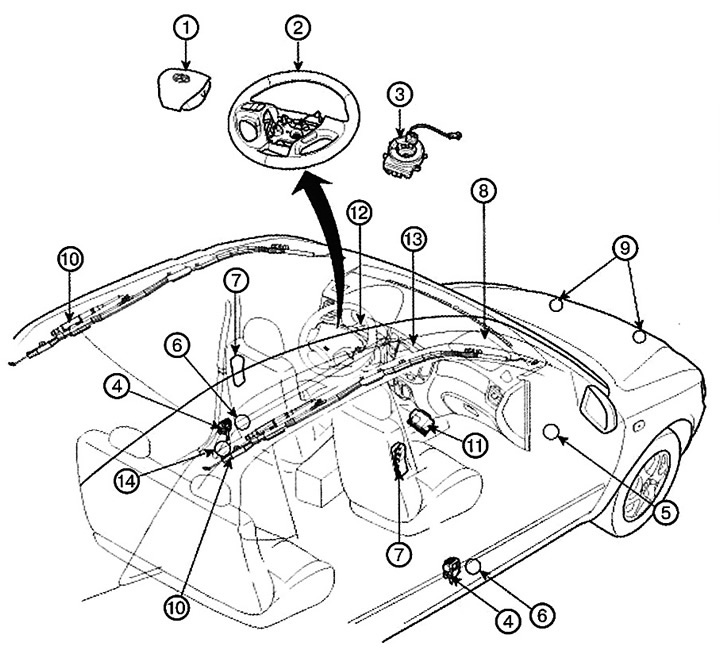
1. Driver's airbag (DAB)
2. Steering wheel
3. Contact disk
4. Seat belt pretensioner (SBP)
5. Passenger airbag switch (PAB)
6. Side Impact Sensor (SIS)
7. Side airbag (SAB)
8. Passenger airbag (PAB)
9. Forward Impact Sensor (FIS)
10. Curtain air bag (CAB)
11. SRSCM (Supplementary Restraint System Control Module)
12. Airbag warning light
13. Passenger airbag on/off lamp (PAB)
14. Anchor pretensioner
The airbag system provides driver and passenger protection in addition to the safety belts to reduce the risk and severity of injury by deploying and inflating the driver and passenger airbags, side airbags, and seat belt pretensioners during certain types of frontal or side impacts.
The system includes: a driver airbag module located in the steering wheel hub and consisting of a folded airbag shell and a gas generator; passenger airbag module, located in the instrument panel on the passenger side and consisting of a folded airbag shell and a gas generator; side airbag modules located in the backrest of the driver and passenger seats and consisting of a folded airbag shell and a gas generator; side curtain airbag modules located in the side parts of the ceiling and consisting of a folded airbag shell and a gas generator; an electronic control unit (ECU) installed in the center console and controlling the system; accelerometer measuring the negative acceleration of a vehicle; a spring-loaded connecting element (contact disk) located in the steering column; wiring and system connectors; soft knee padding located under the steering column. The impact force detection function is provided by the ECU using an electronic accelerometer, which continuously measures the vehicle's acceleration and sends a corresponding signal to the microprocessor via the amplifying and filtering circuits. The airbag is triggered in the event of a moderate to severe frontal or near-frontal side impact.
Only specially trained personnel are allowed to perform work on the airbag system. Therefore, such work must be preceded by a careful study of this Manual. When performing work on the airbag system, strict precautions must be taken to prevent injury to service personnel (in case of accidental airbag deployment) or the driver (due to airbag failure).
The driver airbag module (DAM), passenger airbag (PAM), includes the airbag itself and a gas generator. The gas generator is made in the form of a pyropatron with an igniter. In the event of a frontal or side impact of sufficient force, causing the ECU sensor contacts to close, current is supplied to the ignition circuit, resulting in the pyropatron being ignited and the airbag being filled with gas.
Attention.
1. When removing the air bag module or when handling a new air bag module, place the module with the outer trim facing up. The dual lock lever of the air bag module wire connector must be in the locked position and positioned so as not to damage the connector. Do not store steering wheel trims stacked on top of each other. (Storing the trims with the metal part facing up may cause an accident if the air bag is accidentally deployed.).
2. It is prohibited to check the resistance at the igniter terminals (this may cause the airbag to deploy, which is extremely dangerous).
3. Store the air bag module at a temperature not exceeding 93°C in a normal humidity environment and free from electrical interference.
4. Before performing electric welding work, it is necessary to disconnect the airbag wire connector located under the steering column next to the steering column switch unit connector.
Precautionary measures
1. Work on the airbag may be started no less than 3 minutes after the ignition key has been set to the OFF position and the wire has been disconnected from the negative terminal ("-") of the battery, except in cases where the electrical wiring is being checked.
Note: The information contained in the memory is not erased when the ignition is turned off or when the wires from the battery are disconnected.
2. When replacing parts installed at the factory, use only original and high-quality parts.
It is prohibited to use airbag parts taken from another vehicle. Replace parts with new ones only.
3. Carefully inspect all SRS components before installing them. If any of the airbag system components falls or if cracks, dents or other defects appear on the module housing, bracket or wire connector, replace them with new ones.
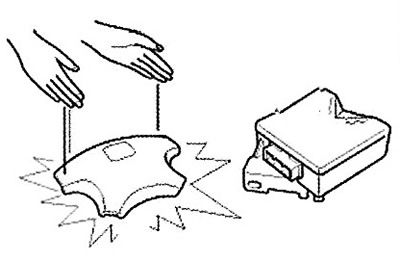
4. Before removing any parts of the passive restraint system, always disconnect the SRS connector.
5. Do not attempt to disassemble the airbag modules, as they do not have any maintenance-ready components. Once the airbag is activated, it cannot be repaired or reused.
When storing airbags, observe the following requirements:
Store the removed airbag with the outer trim facing up.
Avoid exposing the airbag modules to water or other liquids as this may cause damage.
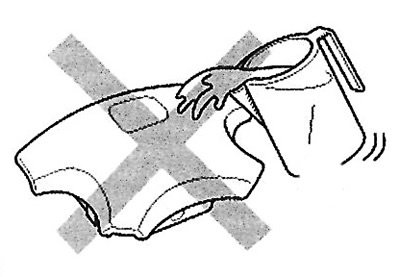
Keep the airbag module away from heat sources.
Do not perform any tests on the airbag wiring such as resistance testing.
During repairs, inspections or replacements, you should position yourself in such a way as to not be in the airbag area.
Avoid possible impacts to the passive safety system module and to the impact sensor area when the ignition is on. Turn off the ignition and wait three minutes before performing any work on the passive safety system.
When performing work, be careful not to accidentally hit (when using wrenches, hammers, etc.) the area where the passive restraint system module and crash sensors are located, as this may result in accidental deployment of the airbags and cause injury and damage.
After an accident that triggered the front airbags, replace the airbags and the Passive Safety Control Unit (SRS). After a collision, when the side airbags are activated, replace the side airbag, the front and side collision sensors on the required side, and the passive Safety Control unit (SRS). After a collision, if the front or side airbags fail, check the Passive Safety System Control Unit (SRS) and the side collision sensors for damage or deformations. If there is no damage, replace the Passive Safety System (SRS) control unit and the front and / or side impact sensor.
Do not disassemble the SRS control module, front and side impact sensors.
Turn off the ignition, disconnect the negative battery terminal and wait three minutes before installing or replacing the SRS control unit.
Make sure there is no fluid or oil on the surface of the SRS control unit, front and side impact sensors, and clean them from dust.
Store the SRS control unit, front and side impact sensors at a temperature of 15-25°C and a relative humidity of 30-80%.