
HyundaiBook.ru
Repair Chevrolet Repair Honda Repair Toyota Repair Land Rover Repair VAZ Repair Renault Repair Nissan
English Русский
Български
Беларускі
Український
Српски
Hrvatski
Română
Polski
Slovenský
Magyar
ArticlesSitemapContacts  


  Accent   Elantra   Getz   Grandeur   Sonata   Santa Fe   Tucson   Others
Matrix (2001-2010, petrol)
  • Main
  • Hyundai
  • Matrix (2001-2010)
  • Body
  • Passive safety system
  • General information about the passive safety system

General information about the passive safety system (Mitsubishi Matrix)

0
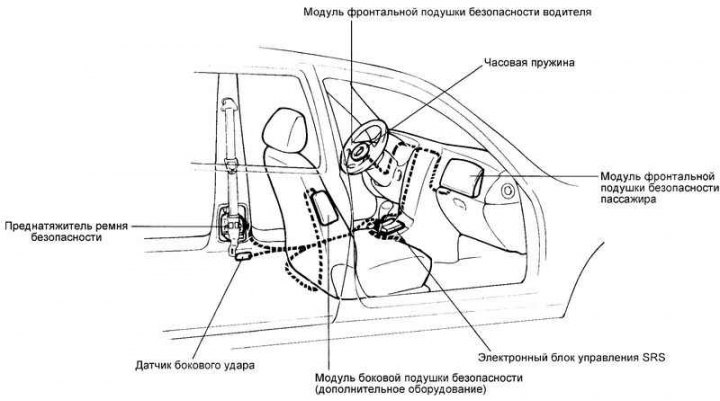
Fig. 8.41. Security system components

Fig. 8.41. Security system components


The Supplemental Restraint System (SRS) is designed to work in conjunction with seat belts to enhance safety in crashes and reduce the risk of injury when front and side airbags deploy by keeping front occupants in their seats during a frontal or side impact.

The supplemental passive safety system (SRS) consists of the following elements: the driver's front airbag (located in the center of the steering wheel), which contains a module with a folded airbag and an inflator (gas generator); front passenger front airbag (located in the instrument panel on the passenger side), which contains a module with a folded airbag and an inflator (gas generator); side airbags (located in the outer sidewalls of the driver's and front passenger's seat backs), each of which contains a module with a folded airbag and an inflator (gas generator); sRS electronic control unit (mounted under the center part of the floor console), which controls the entire system; acceleration sensor (accelerometer), which determines the deceleration of the car (the presence of an impact from the outside); clock spring of the intermediate connection located in the steering column; electrical wiring and system connectors; knee buffer (knee bolster), located under the steering column. The external impact recognition function in the SRS electronic control unit is performed by an electronic acceleration sensor, which constantly measures the acceleration of the vehicle and transmits a corresponding signal through the amplifying and filtering circuits to the microprocessor. The additional passive safety system (SRS) is designed in such a way that the airbags will deploy in the event of an accident with a frontal or near-frontal impact of varying severity (from moderate to severe).

Only qualified personnel are allowed to service the supplemental passive restraint systems (SRS) and related components. Before starting work, service personnel should carefully read this manual. Special care must be taken when servicing the SRS system to avoid injury or death to the service personnel (as a result of unauthorized deployment of the air bag) or the driver (as a result of the SRS system not functioning properly after unqualified service or repair).
This article is available at russian, bulgarian, belarusian, ukrainian, serbian, croatian, romanian, polish, slovak, hungarian
This article has been reviewed by: Konstantin Smirnov
Add to social network:

Previous
Matrix: Passive safety system
Next

Safety precautions when performing SRS maintenance and repair
Electrical passive safety system
Airbag module and airbag inflator (gas generator)
SRS Wiring Harness
Activation of the SRS warning lamp
We recommend other articles on the topic of Hyundai manuals:

Passive safety system Hyundai Accent 3 (2005-2010)
Safety precautions when working with the ignition system Hyundai Elantra 1 (1990-1995, petrol)
Maintenance of the additional passive restraint system SRS Hyundai Getz (2002-2011)
A few words about safety Hyundai Sonata 3 (1993-1998)
Keys, door locks, sunroof, anti-theft system Hyundai Santa Fe 2 (2007-2012, petrol)
General information about the passive safety system Hyundai Tucson 2 (2009-2015)

Link in different formats to this article

Visitor comments
No comments yet


How much will 44 + 48 ?


Matrix (2001-2010, petrol) 
  • User manual
  • Control devices
  • Salon equipment
  • Car driving
  • Current service
  • Vehicle specifications
  • Power unit
  • Engine specifications
  • Engine maintenance
  • Engine repair 1.6 l
  • Engine repair 1.8 l
  • Cooling and lubrication system
  • Power and exhaust system
  • Control system
  • Transmission
  • Transmission specifications
  • Clutch
  • Mechanical gearbox
  • Automatic gearbox
  • Drive shafts
  • Chassis
  • Suspension and wheels
  • Steering
  • Brake system
  • Body
  • Exterior (external elements)
  • Passive safety system
  • Heater and air conditioner
  • Electrical equipment
  • Specifications
  • Equipment and devices
  • Power devices
  • Electrical circuits
HyundaiBook.ru © 2018-2026 · Mobile version · Sitemap: EN BG BY UA RS HR RO PL SK HU · Administration · Site search · Hyundai owners Accent 1 · Accent 2 · Accent 3 · Elantra 1 · Elantra 2 · Elantra 3 · Getz · Sonata 3 · Sonata 4 · Santa Fe 2 · Tucson 1 · Tucson 2 · Matrix ·
This site uses cookies to optimize its functionality. By continuing, you agree to our terms.