
HyundaiBook.ru
Repair Chevrolet Repair Honda Repair Toyota Repair Land Rover Repair VAZ Repair Renault Repair Nissan
English Русский
Български
Беларускі
Український
Српски
Hrvatski
Română
Polski
Slovenský
Magyar
ArticlesSitemapContacts  


  Accent   Elantra   Getz   Grandeur   Sonata   Santa Fe   Tucson   Others
Elantra 1 (1990-1995, petrol) Elantra 2 (1995-2000, petrol) Elantra 3 (2000-2006)
  • Main
  • Elantra
  • XD (2000-2006)
  • User manual
  • Control devices
  • Speed controller (cruise control)

Speed controller (cruise control) (Hyundai Elantra XD)

0
Contents: Turning on the speed controller ⇓ Turning off the speed controller ⇓ Restoring the set speed ⇓ Increase the set speed ⇓ Decrease the set speed ⇓
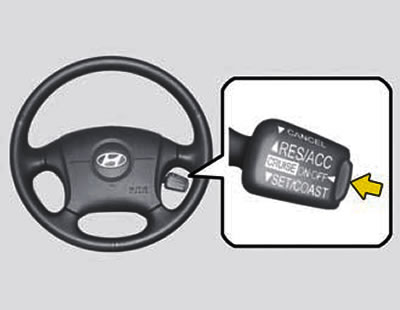
For added driving comfort, the cruise control automatically maintains a set…


For added driving comfort, the cruise control automatically maintains a set speed when driving on highways and in other free-flowing traffic conditions. The system can be used starting from a speed of approximately 40 km/h.

Turning on the speed controller
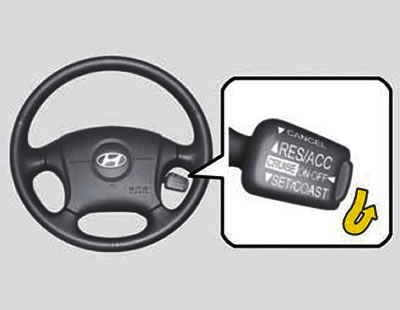


1. Press the main switch located on the end of the drum switch. At the same…


1. Press the main switch located on the end of the drum switch. At the same time, the "CRUISE" indicator light ("Speed controller") lights up in the instrument cluster. The system is enabled.

2. Increase the speed to the required value above 40 km/h.

3. Press the control switch down to the position "SET (COAST)" ("Installation (Roll-on)") and release it.


4. Remove your foot from the accelerator pedal: the selected speed will be maintained automatically.

5. To increase speed, press the accelerator pedal and accelerate the car to a speed higher than the set speed. When you remove your foot from the pedal, the previously selected speed will be restored.

Warning: To avoid accidentally turning on the speed controller when it is not needed, make sure that the main switch of the system is in the off position.


Turning off the speed controller
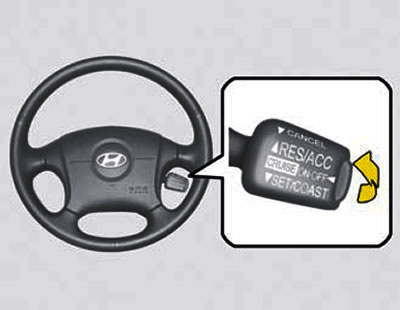


To cancel the set speed, press the system control switch toward the steering…


To cancel the set speed, press the system control switch toward the steering wheel to the "CANCEL" position. In addition, the cruise control can be turned off in one of the following ways:
  • By pressing the brake pedal.
  • By pressing the clutch pedal (on cars with manual transmission).
  • By setting the selector lever to the "N" or "P" position (in a car with an automatic transmission).
  • By reducing the speed of movement to less than 40 km/h.
  • By turning off the system with the main switch.

Restoring the set speed
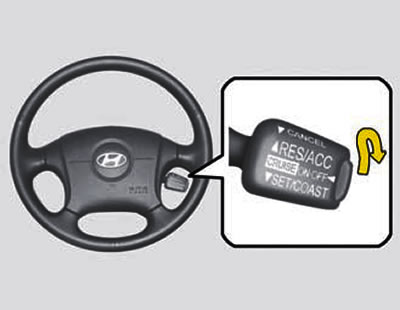


To automatically restore the speed set before cancellation, press the control…


To automatically restore the speed set before cancellation, press the control switch to the position "RESUME (ACCEL)" ("Recovery (Acceleration)") and release it. In this case, the speed must be higher than 40 km/h.


Increase the set speed


1. Press the switch to the position "RESUME (ACCEL)" and hold it.

2. Increase the speed to the desired value and release the switch. As you hold the switch down, the speed will gradually increase.

Decrease the set speed
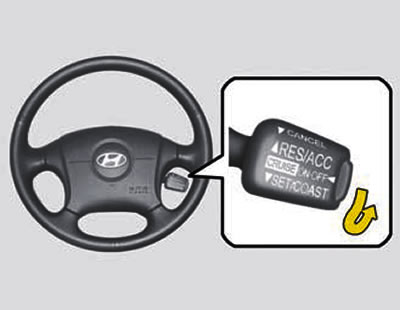


1. Press the switch to the position «SET (COAST)» («Installation (Roll-on)»)…


1. Press the switch to the position "SET (COAST)" ("Installation (Roll-on)") and hold it. The speed of movement will decrease.

2. Once the speed has dropped to the desired level, release the switch. Keeping the switch pressed will gradually decrease the speed.

Warning:
  • If you are not using the speed controller, the main switch should be in the off position.
  • Use the speed controller only when driving on uncongested highways and in good weather.
  • Do not use the cruise control in conditions where maintaining a constant speed may be unsafe, such as in heavy or changing traffic or on slippery road surfaces (in rain, ice or snow) or on winding roads or on slopes greater than 6%.
  • When the speed controller is on, constantly monitor changes in the road conditions.
  • When the cruise control is engaged on a vehicle with a manual transmission, do not shift into neutral without pressing the clutch pedal: this will cause the engine to over-rev. If such a throw occurs, press the clutch pedal or turn off the system with the main switch.
  • When you press the brake pedal while driving with the cruise control engaged, the system is deactivated, which is usually determined by a change in the engine sound. This indicates that the system is working properly.
  • When the system is operating normally, it is activated after changing the speed by pressing the shoulder "SET (COAST)" switch or after pressing the brake pedal after about 3 seconds. This delay is normal.
This article is available at russian, bulgarian, belarusian, ukrainian, serbian, croatian, romanian, polish, slovak, hungarian
This article has been reviewed by: Konstantin Smirnov
Add to social network:

Previous
Elantra 3: Control devices
Next

Sound signal
Steering wheel tilt adjustment lever
Safety luggage net
Rear door (5-door models)
Trunk lid (4-door models)
Ventilation, heating and air conditioning controls
Heating and ventilation
Air Conditioning Control
Automatic climate control
Operation of the air conditioning system in manual control mode
We recommend other articles on the topic of Hyundai manuals:

Checking the idle speed Hyundai Accent 1 (1994-1999)
Engine Idle Speed Control Modulator (ISC) Hyundai Getz (2002-2011)
Device for maintaining the set speed (cruise control) of the car Hyundai Sonata 3 (1993-1998)
Cruise control Hyundai Santa Fe 2 (2007-2012, petrol)
Cruise control is a device Hyundai Tucson 1 (2005-2010)
Idle speed control valve Hyundai Matrix (2001-2010, petrol)

Link in different formats to this article

Visitor comments
No comments yet


How much will 18 + 50 ?


Elantra 3 (2000-2006) 
  • User manual
  • Control devices
  • Audio system
  • Starting the engine and driving
  • Faults en route
  • Maintenance and care
  • Technical information
  • Power unit
  • Gasoline engines
  • Diesel engines
  • Lubrication system
  • Cooling system
  • Fuel system (gasoline)
  • Fuel system (diesel)
  • Decreased toxicity
  • Ignition system
  • Transmission
  • Clutch
  • Mechanical gearbox
  • Automatic gearbox
  • Drive shafts and axles
  • Chassis
  • Car suspension
  • Steering
  • Brake system
  • Body
  • Exterior (external elements)
  • Interior (internal elements)
  • Air conditioning system
  • Electrical equipment
  • Equipment and devices
  • Headlights and lighting
  • Power devices
  • Electrical circuits
Elantra 2 (1995-2000, petrol) 
  • General information
  • Maintenance
  • Power unit
  • Engine repair
  • Cooling system
  • Intake and exhaust system
  • Fuel system
  • Transmission
  • Clutch
  • Manual gearbox
  • Automatic gearbox
  • Drive shafts and axles
  • Chassis
  • Front suspension
  • Rear suspension
  • Steering
  • Brake system
  • Body
  • Body elements
  • Electrical equipment
  • Equipment and devices
  • Electrical diagrams
Elantra 1 (1990-1995, petrol) 
  • General information
  • Introduction to the guide
  • Maintenance
  • Power unit
  • Minor engine repair
  • Engine overhaul
  • Lubrication system
  • Cooling system
  • Fuel injection system
  • Ignition system
  • Exhaust system
  • Transmission
  • Clutch
  • Manual gearbox
  • Automatic gearbox
  • Drive shafts
  • Chassis
  • Front suspension
  • Rear suspension
  • Steering
  • Wheels and tires
  • Troubleshooting
  • Brake system
  • Body
  • Body elements
  • Electrical equipment
  • Equipment and devices
  • Power devices
  • Heating and air conditioning
  • Electrical circuits
HyundaiBook.ru © 2018-2026 · Mobile version · Sitemap: EN BG BY UA RS HR RO PL SK HU · Administration · Site search · Hyundai owners Accent 1 · Accent 2 · Accent 3 · Elantra 1 · Elantra 2 · Elantra 3 · Getz · Sonata 3 · Sonata 4 · Santa Fe 2 · Tucson 1 · Tucson 2 · Matrix ·
This site uses cookies to optimize its functionality. By continuing, you agree to our terms.