


The pistons displace the brake fluid contained in the cylinder. The resulting hydraulic pressure is distributed in the brake system through pipes and hoses to the wheel cylinders.
In the cylinders, the pistons press the brake shoes against the brake discs or, on the rear wheels, the brake shoes against the brake drums.
Fluid pressure is transmitted to the brake cylinders via two independent pipelines (brake circuits).
If one circuit fails, the other circuit remains operational.
Manual (parking) the brake acts through cables on the rear wheels.
Caution: If one of the brake circuits fails, it is necessary to press the brake pedal with greater force (with a longer pedal stroke), to obtain the same braking efficiency.
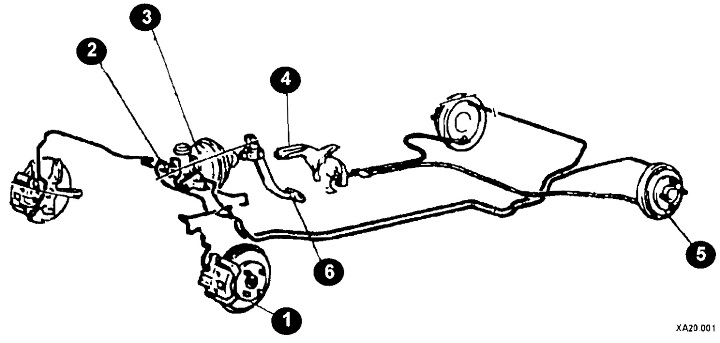
Brake system diagram (models with rear drum brakes)
1 - front wheel brake;
2 - master brake cylinder;
3 - vacuum booster;
4 - parking brake;
5 - rear wheel brake;
6 - pedal.
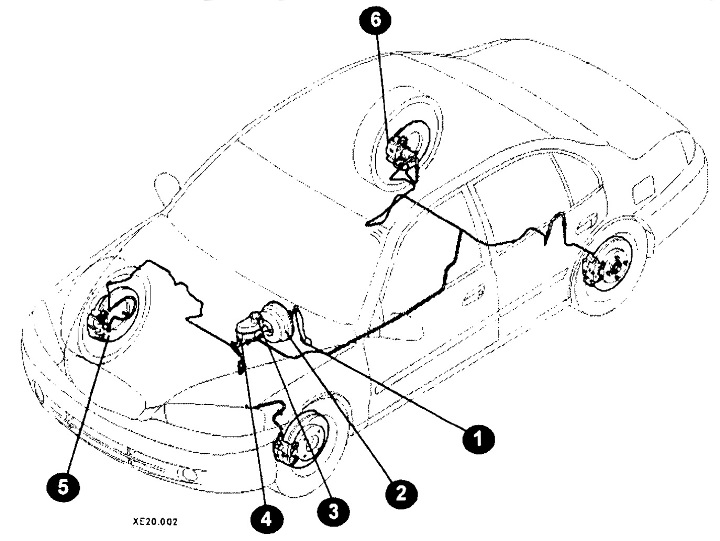
Brake system diagram (models with rear disc brakes)
1 - pedal;
2 - vacuum booster;
3 - expansion tank;
4 - master brake cylinder;
5 - front wheel brake;
6 - rear wheel brake.
Attention: The parking brake is not shown.