


Checking the pressure in the fuel lines (cars with gasoline engines)
1. Release any residual pressure in the fuel line.
Caution: A diagnostic trouble code (DTC) may be displayed after removing the fuel pump relay. Clear this code using a scanner (GDS) after completing the work to relieve residual pressure in the fuel line.
2. Install the special tool (SST).
Caution: Even after performing the operations described in the section "Relieving residual pressure in the fuel line", some residual pressure may still exist in the system. Therefore, to prevent residual fuel from splashing out, cover the hose connection with a cleaning cloth before disconnecting any fuel lines.
Disconnect the fuel supply line from the fuel rail.
Install a fuel pressure gauge between the fuel supply line and the fuel rail (see figure below).
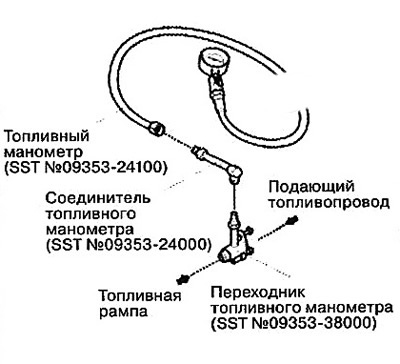
3. With the ignition on, inspect the connection points of the fuel supply line, fuel rail and special devices for leaks.
4. Measure the fuel pressure.
Start the engine and measure the fuel pressure at idle speed. Fuel pressure: 324-363 kPa.
Note: If the fuel pressure is different from the standard value, repair or replace the corresponding part (see the table below).

Turn off the engine and observe the fuel pressure gauge readings. The pressure should not drop for about 5 minutes after the engine is turned off.
Note: If the fuel pressure drops, repair or replace the appropriate part (see table below).

Turn off the ignition.
5. Relieve residual pressure in the fuel line (see section "Relieving residual pressure in the fuel line").
Caution: A diagnostic trouble code (DTC) may be displayed after removing the fuel pump relay. Clear this code using a scanner (GDS) after completing the work to relieve residual pressure in the fuel line.
6. Completing the check:
Remove the special tool from the fuel supply line and fuel rail.
Connect the fuel supply line and the fuel rail.
Relief of residual pressure in the fuel line
Caution: Even after performing the operations described in the section "Relieving residual pressure in the fuel line", some residual pressure may still exist in the system. Therefore, to prevent residual fuel from splashing out, cover the hose connection with a cleaning cloth before disconnecting any fuel lines.
1. Turn the ignition key to the "OFF" position and disconnect the negative (-) cable from the battery.
2. Remove the fuel pump relay (A).
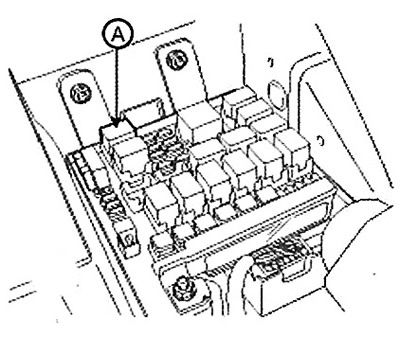
Caution: After removing the fuel pump relay, a malfunction code (DTC) may be displayed. Clear this code using a scanner (GDS) after completing the work to relieve residual pressure in the fuel line.
3. Connect the negative (-) battery cable.
4. Start the engine and let it idle, then turn the ignition key to the "OFF" position and wait until the engine stops completely.
5. Disconnect the cable from the negative (-) battery terminal and install the fuel pump relay (A).
6. Connect the negative (-) battery cable.
7. Clear the diagnostic trouble code (DTC) related to the fuel pump relay using the scanner (GDS).