
HyundaiBook.ru
Repair Chevrolet Repair Honda Repair Toyota Repair Land Rover Repair VAZ Repair Renault Repair Nissan
English Русский
Български
Беларускі
Український
Српски
Hrvatski
Română
Polski
Slovenský
Magyar
ArticlesSitemapContacts  


  Accent   Elantra   Getz   Grandeur   Sonata   Santa Fe   Tucson   Others
Elantra 1 (1990-1995, petrol) Elantra 2 (1995-2000, petrol) Elantra 3 (2000-2006)
  • Main
  • Elantra
  • XD (2000-2006)
  • Power unit
  • Fuel system (diesel)
  • EDC control system

EDC control system (Hyundai Elantra XD)

0
Contents: Crankshaft speed sensor ⇓ Camshaft Position Sensor ⇓ Temperature sensors ⇓ Air flow meter ⇓
The electronic diesel engine control system EDC for Common Rail includes three large systems:

1. Sensors for recording operating mode parameters, which convert various material parameters into electrical signals.

2. ECU for generating output electrical signals based on signals from sensors and a given algorithm.

3. Drives for converting the ECU output electrical signals into mechanical parameters.

Crankshaft speed sensor
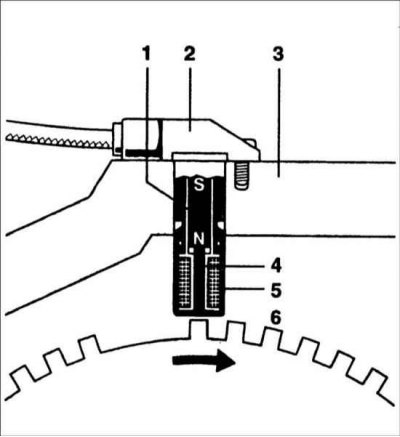


1 – permanent magnet; 2 – casing; 3 –…

1 – permanent magnet; 2 – casing; 3 – engine crankcase; 4 – metal rod; 5 – coil; 6 – toothed rotor


The position of the piston in the engine cylinder is decisive in determining the moment of fuel injection into the combustion chamber. Since the pistons are rigidly connected to the crankshaft via connecting rods, the crankshaft position sensor transmits information to the control unit regarding the position of all pistons. The inductive speed sensor detects the rotational speed of the crankshaft, and this important input variable is transmitted to the ECU.


A ferromagnetic rotor with 60 teeth is fixed to the crankshaft, with 2 teeth missing from the rotor. This gap is located in a certain position relative to the crankshaft and the position of the piston in the first cylinder. The sensor is a permanent magnet and a metal rod with an inductive coil. When the rotor teeth pass near the sensor pole, a sinusoidal voltage is induced in it, the amplitude of which increases with increasing crankshaft rotation frequency.

Camshaft Position Sensor


The camshaft controls the intake and exhaust valves and rotates at half the speed of the crankshaft. As the piston moves toward top dead center, the position of the camshaft indicates which piston is on the compression stroke or exhaust stroke.

Information is taken from a thematic website www.hyundaibook.ru

The camshaft position sensor works on the Hall effect. A short-term signal from the sensor tells the ECU that the piston of the first cylinder has entered the compression stroke.

Temperature sensors
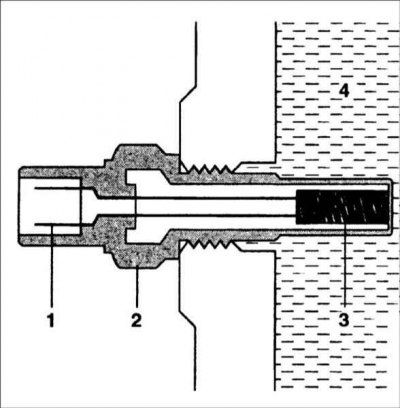


1 – connector; 2 – body; 3 – NTC…

1 – connector; 2 – body; 3 – NTC resistor


Temperature sensors are installed in various places of the engine and are designed to measure the temperature of the coolant, air entering the engine, engine oil and fuel returning to the fuel tank. The core of each sensor is a resistor whose resistance changes depending on the temperature with a negative temperature coefficient (NTC). The voltage drop across the resistor is transmitted to the ECU via an analog-to-digital converter (ADC). The sensor characteristic is stored in the ECU memory as a function of voltage.
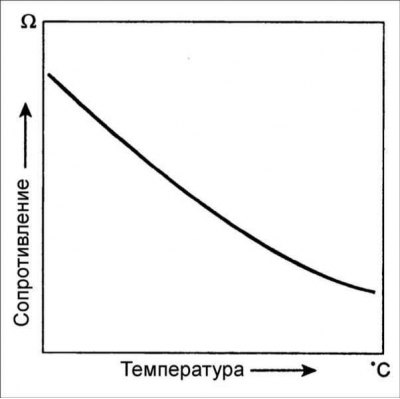


Temperature sensor characteristic (NTC)

Temperature sensor characteristic (NTC)


Air flow meter
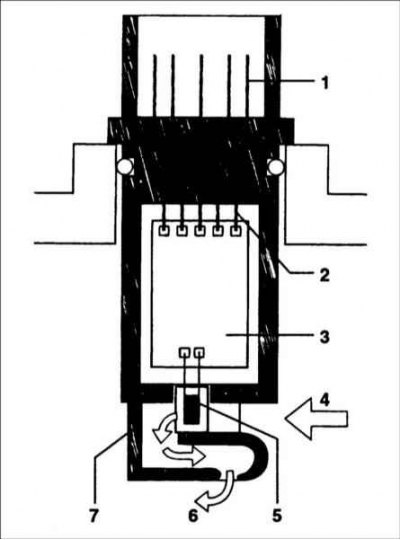


1 – connector contacts; 2 – internal…

1 – connector contacts; 2 – internal connections; 3 – electronic unit; 4 – air inlet hole; 5 – sensor element; 6 – air outlet hole; 7 – body


The fuel injection system is designed to precisely dose fuel depending on the amount of incoming air under various engine operating conditions. The correct air-fuel ratio is necessary to reduce the amount of harmful substances in the exhaust gases. This requires the use of sensors that accurately record the actual air flow entering the engine cylinders at any given moment.

The accuracy of the sensor should not be affected by pulsations, the exhaust gas recirculation system and the temperature of the air entering the engine. An air flow meter with a heated thin film meets these requirements. A micromechanical measuring system records the air flow and its direction.
This article is available at russian, bulgarian, belarusian, ukrainian, serbian, croatian, romanian, polish, slovak, hungarian
This article has been reviewed by: Konstantin Smirnov
Add to social network:

Previous
Elantra 3: Fuel system (diesel)
Next

Common Rail Fuel System
Reducing toxicity of exhaust gases
Additional fuel injection
Main fuel injection
Controlled fuel injection
Engine Control Unit (ECU)
Controlling the maximum amount of air entering the engine
Active shock absorber that reduces engine speed variations
Engine shutdown
Glow plugs
We recommend other articles on the topic of Hyundai manuals:

Automatic transmission and ignition switch control system Hyundai Accent 1 (1994-1999)
Control of heating and ventilation system Hyundai Getz (2002-2011)
Twin Camshaft Engine Emission Control System Hyundai Sonata 3 (1993-1998)
Distributed fuel injection control system Hyundai Santa Fe 2 (2007-2012, petrol)
Hydroelectronic control unit of the anti-lock braking system… Hyundai Tucson 1 (2005-2010)
Table 2.15. Technical characteristics of the control system Hyundai Matrix (2001-2010, petrol)

Link in different formats to this article

Visitor comments
No comments yet


How much will 25 + 32 ?


Elantra 3 (2000-2006) 
  • User manual
  • Control devices
  • Audio system
  • Starting the engine and driving
  • Faults en route
  • Maintenance and care
  • Technical information
  • Power unit
  • Gasoline engines
  • Diesel engines
  • Lubrication system
  • Cooling system
  • Fuel system (gasoline)
  • Fuel system (diesel)
  • Decreased toxicity
  • Ignition system
  • Transmission
  • Clutch
  • Mechanical gearbox
  • Automatic gearbox
  • Drive shafts and axles
  • Chassis
  • Car suspension
  • Steering
  • Brake system
  • Body
  • Exterior (external elements)
  • Interior (internal elements)
  • Air conditioning system
  • Electrical equipment
  • Equipment and devices
  • Headlights and lighting
  • Power devices
  • Electrical circuits
Elantra 2 (1995-2000, petrol) 
  • General information
  • Maintenance
  • Power unit
  • Engine repair
  • Cooling system
  • Intake and exhaust system
  • Fuel system
  • Transmission
  • Clutch
  • Manual gearbox
  • Automatic gearbox
  • Drive shafts and axles
  • Chassis
  • Front suspension
  • Rear suspension
  • Steering
  • Brake system
  • Body
  • Body elements
  • Electrical equipment
  • Equipment and devices
  • Electrical diagrams
Elantra 1 (1990-1995, petrol) 
  • General information
  • Introduction to the guide
  • Maintenance
  • Power unit
  • Minor engine repair
  • Engine overhaul
  • Lubrication system
  • Cooling system
  • Fuel injection system
  • Ignition system
  • Exhaust system
  • Transmission
  • Clutch
  • Manual gearbox
  • Automatic gearbox
  • Drive shafts
  • Chassis
  • Front suspension
  • Rear suspension
  • Steering
  • Wheels and tires
  • Troubleshooting
  • Brake system
  • Body
  • Body elements
  • Electrical equipment
  • Equipment and devices
  • Power devices
  • Heating and air conditioning
  • Electrical circuits
HyundaiBook.ru © 2018-2026 · Mobile version · Sitemap: EN BG BY UA RS HR RO PL SK HU · Administration · Site search · Hyundai owners Accent 1 · Accent 2 · Accent 3 · Elantra 1 · Elantra 2 · Elantra 3 · Getz · Sonata 3 · Sonata 4 · Santa Fe 2 · Tucson 1 · Tucson 2 · Matrix ·
This site uses cookies to optimize its functionality. By continuing, you agree to our terms.