
HyundaiBook.ru
Repair Chevrolet Repair Honda Repair Toyota Repair Land Rover Repair VAZ Repair Renault Repair Nissan
English Русский
Български
Беларускі
Український
Српски
Hrvatski
Română
Polski
Slovenský
Magyar
ArticlesSitemapContacts  


  Accent   Elantra   Getz   Grandeur   Sonata   Santa Fe   Tucson   Others
Elantra 1 (1990-1995, petrol) Elantra 2 (1995-2000, petrol) Elantra 3 (2000-2006)
  • Main
  • Elantra
  • J1 (1990-1995)
  • Transmission
  • Drive shafts
  • Drive shaft with ball joint — repair

Drive shaft with ball joint — repair (Hyundai Elantra J1)

0
Contents: Disassembly ⇓ Assembly ⇓

Disassembly


Remove the clamps securing the protective cover.
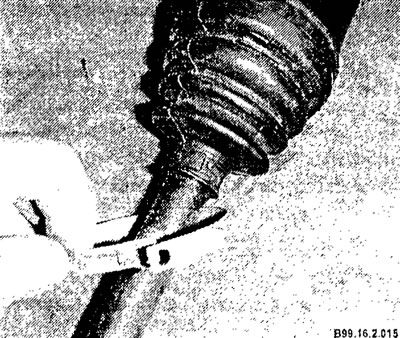
Remove the clamps securing the…


Remove the protective cover from the inner hinge housing.

Remove the inner joint housing from the drive shaft.

Remove old grease from the constant velocity joint.

Remove the snap ring from the end of the drive shaft.

Remove the inner race with balls from the drive shaft.

Using paint, mark the relative positions of the inner ring and separator.
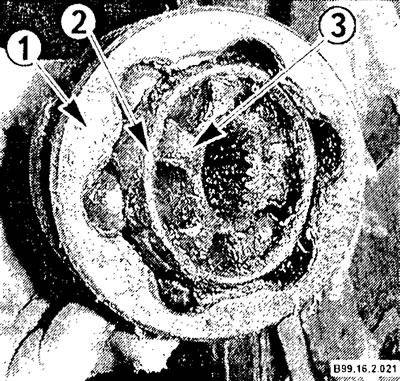
1 - CV joint housing;

1 - CV joint housing;
2 - separator;
3 - inner ring.


Using a screwdriver blade, remove the balls from the separator.
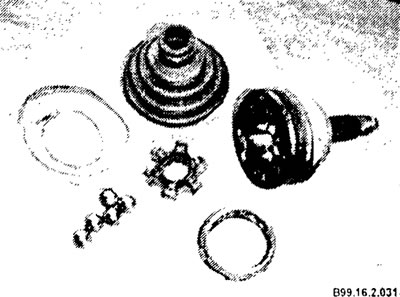
(The article is based on information website: «HyundaiBook.ru»)

Using a screwdriver blade, remove the…


Rotate the inner ring 90°, aligning the inner ring tabs with the separator windows and remove the inner ring from the separator.


Drive shaft elements (models produced…

Drive shaft elements (models produced before 2002)
1 - shaft/housing;
2, 5 - retaining ring;
3 - CV joint housing (TJ);
4 - hinge assembly;
6, 8 - clamp;
7 - protective cover;
9 - hinge assembly.
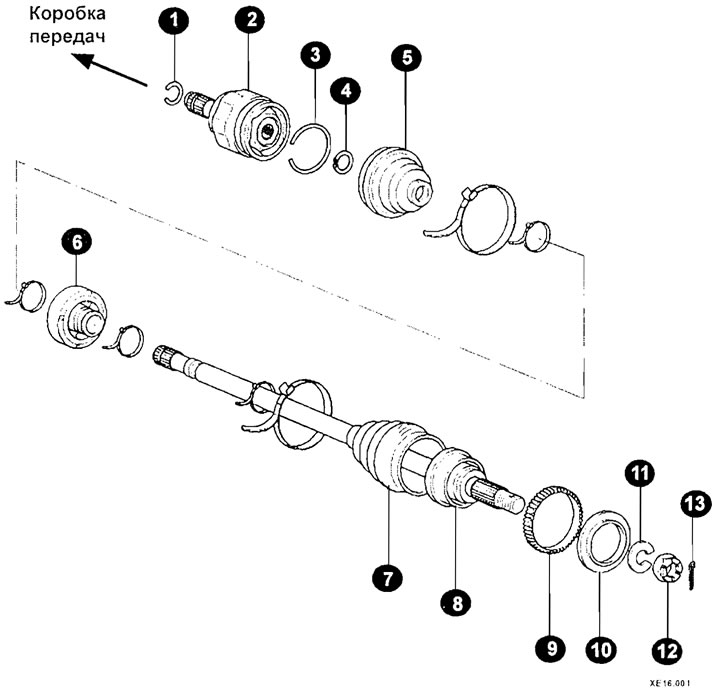

Drive shaft elements (models from 2002)

Drive shaft elements (models from 2002)
1 - retaining ring;
2 - hinge (DOJ);
3, 4 - retaining ring;
5 - case;
6 - dynamic damper;
7 - case;
8 - hinge (BJ);
9 - toothed wheel (models with ABS);
10 - oil seal;
11 - washer;
12 - nut;
13 - cotter pin.


Using solvent, clean all hinge parts. Check the condition of the parts for pitting, scratches, cracks and damage. If there are any defects, replace the joint assembly.
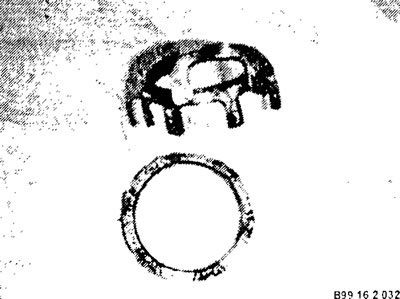
The photo shows a broken hinge separator

The photo shows a broken hinge separator


Assembly


Install the inner ring into the separator, aligning the alignment marks.

Insert the balls into the separator windows.

To avoid damaging the protective cover when installing it on the drive shaft, wrap the splines of the drive shaft with adhesive tape.

Slide the small boot retaining clip onto the drive shaft, then slide the boot onto the drive shaft and remove the adhesive tape.

Further assembly is carried out in reverse order.
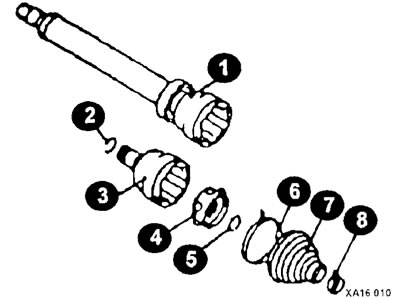
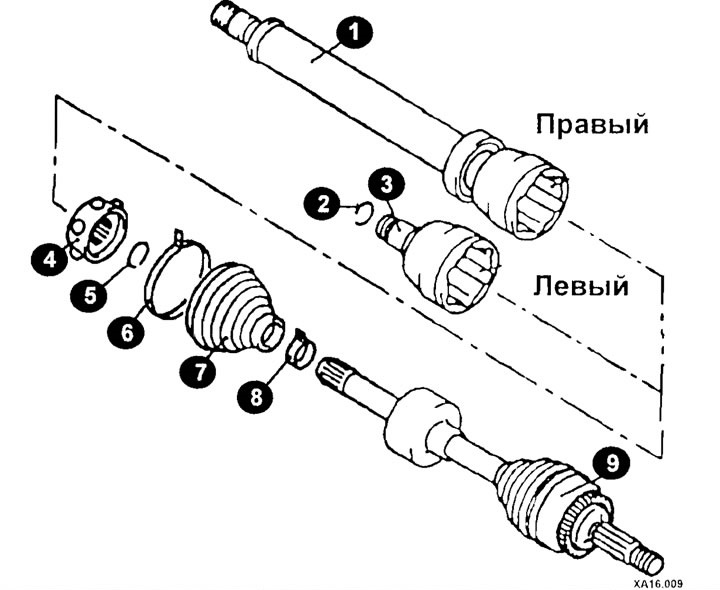
CV joint repair kit

CV joint repair kit
1 - right wheel CV joint housing;
2 - retaining ring;
3 - left wheel CV joint housing;
4 - hinge assembly;
5 - retaining ring;
6, 8 - clamp;
7 - case.
This article is available at russian, bulgarian, belarusian, ukrainian, serbian, croatian, romanian, polish, slovak, hungarian
This article has been reviewed by: Konstantin Smirnov
Add to social network:

Previous
Elantra 1: Drive shafts
Next

Roller Joint Drive Shafts — Repair
Drive shaft — removal and installation
Checking protective covers
General description of drive shafts
Troubleshooting Drive Shafts
We recommend other articles on the topic of Hyundai manuals:

Drive shaft with ball and Birfield type CV joints Hyundai Accent 2 (1999-2005)
Replacing the drive shaft oil seal ring Hyundai Getz (2002-2011)
Ball joint and steering seals. Steering and drive shaft boots Hyundai Sonata 3 (1993-1998)
Front wheel drive shaft (CV joint with length compensator (DOJ)… Hyundai Santa Fe 2 (2007-2012, petrol)
Checking the moment of resistance to rotation of the ball joint… Hyundai Tucson 1 (2005-2010)
Front wheel drive shaft (CV joint with length compensator (DOJ)… Hyundai Matrix (2001-2010, petrol)

Link in different formats to this article

Visitor comments
No comments yet


How much will 32 + 43 ?


Elantra 3 (2000-2006) 
  • User manual
  • Control devices
  • Audio system
  • Starting the engine and driving
  • Faults en route
  • Maintenance and care
  • Technical information
  • Power unit
  • Gasoline engines
  • Diesel engines
  • Lubrication system
  • Cooling system
  • Fuel system (gasoline)
  • Fuel system (diesel)
  • Decreased toxicity
  • Ignition system
  • Transmission
  • Clutch
  • Mechanical gearbox
  • Automatic gearbox
  • Drive shafts and axles
  • Chassis
  • Car suspension
  • Steering
  • Brake system
  • Body
  • Exterior (external elements)
  • Interior (internal elements)
  • Air conditioning system
  • Electrical equipment
  • Equipment and devices
  • Headlights and lighting
  • Power devices
  • Electrical circuits
Elantra 2 (1995-2000, petrol) 
  • General information
  • Maintenance
  • Power unit
  • Engine repair
  • Cooling system
  • Intake and exhaust system
  • Fuel system
  • Transmission
  • Clutch
  • Manual gearbox
  • Automatic gearbox
  • Drive shafts and axles
  • Chassis
  • Front suspension
  • Rear suspension
  • Steering
  • Brake system
  • Body
  • Body elements
  • Electrical equipment
  • Equipment and devices
  • Electrical diagrams
Elantra 1 (1990-1995, petrol) 
  • General information
  • Introduction to the guide
  • Maintenance
  • Power unit
  • Minor engine repair
  • Engine overhaul
  • Lubrication system
  • Cooling system
  • Fuel injection system
  • Ignition system
  • Exhaust system
  • Transmission
  • Clutch
  • Manual gearbox
  • Automatic gearbox
  • Drive shafts
  • Chassis
  • Front suspension
  • Rear suspension
  • Steering
  • Wheels and tires
  • Troubleshooting
  • Brake system
  • Body
  • Body elements
  • Electrical equipment
  • Equipment and devices
  • Power devices
  • Heating and air conditioning
  • Electrical circuits
HyundaiBook.ru © 2018-2026 · Mobile version · Sitemap: EN BG BY UA RS HR RO PL SK HU · Administration · Site search · Hyundai owners Accent 1 · Accent 2 · Accent 3 · Elantra 1 · Elantra 2 · Elantra 3 · Getz · Sonata 3 · Sonata 4 · Santa Fe 2 · Tucson 1 · Tucson 2 · Matrix ·
This site uses cookies to optimize its functionality. By continuing, you agree to our terms.