
HyundaiBook.ru
Repair Chevrolet Repair Honda Repair Toyota Repair Land Rover Repair VAZ Repair Renault Repair Nissan
English Русский
Български
Беларускі
Український
Српски
Hrvatski
Română
Polski
Slovenský
Magyar
ArticlesSitemapContacts  


  Accent   Elantra   Getz   Grandeur   Sonata   Santa Fe   Tucson   Others
Tucson 1 (2005-2010) Tucson 2 (2009-2015)
  • Main
  • Tucson
  • JM (2005-2010)
  • Power unit
  • Gasoline engine G4GC
  • Timing drive mechanism — installation

Timing drive mechanism — installation (Hyundai Tucson JM)

0
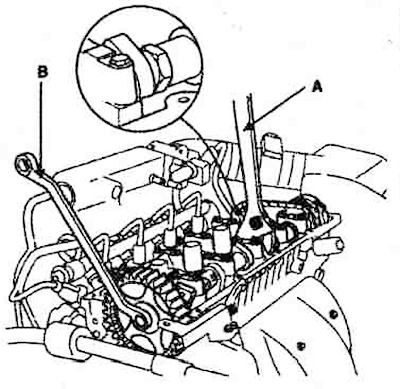
1. Install the camshaft drive gear and tighten the mounting bolt. Holding the camshaft hexagon with an adjustable wrench (A), tighten the bolt with a spanner (B) to a torque of 100-120 Nm.

1. Install the camshaft drive gear and…


2. Install the cylinder head cover (A) and tighten the 12 mounting bolts (B).
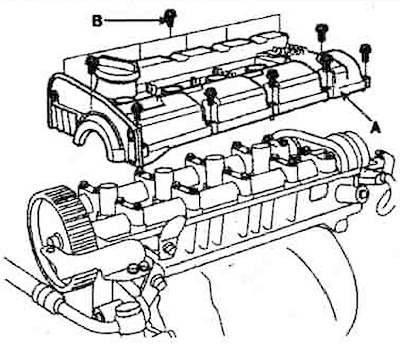
2. Install the cylinder head cover (A)…


3. Install the crankcase ventilation hose (A) and breather hose (B).
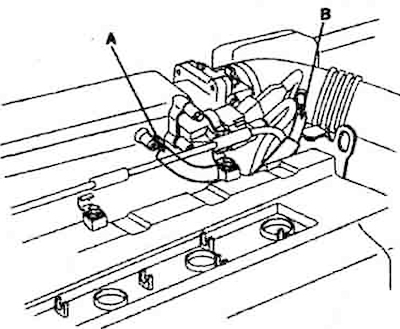
3. Install the crankcase ventilation…


4. Install the throttle cable (A) to the cylinder head cover.
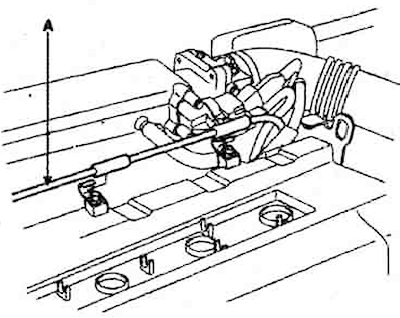


4. Install the throttle cable (A) to…


5. Connect the high-voltage wires to the spark plugs.

6. Install the crankshaft gear (A).
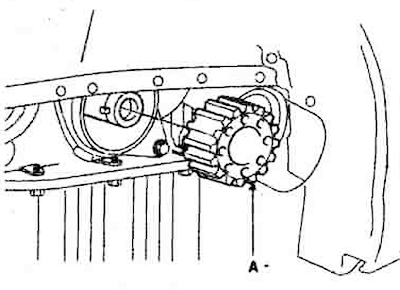
6. Install the crankshaft gear (A).


7. Align the hole on the camshaft gear (A) with the timing mark on the cylinder head, which corresponds to the position of the piston of the first cylinder at the top dead center of the compression stroke.
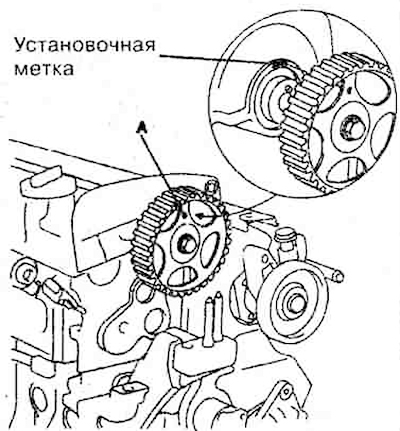
7. Align the hole on the camshaft gear…


8. Align the timing mark on the crankshaft gear with the mark on the cylinder block.
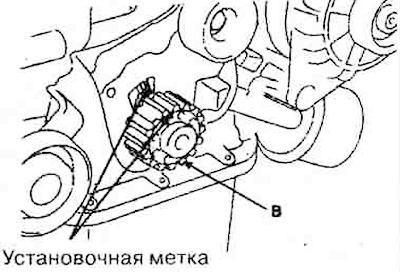


8. Align the timing mark on the…


9. Install the intermediate pulley (A) and tighten the bolt (B) to 43-55 N·m.
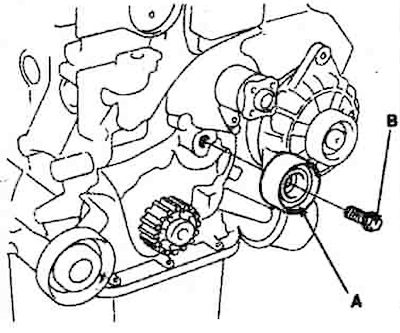
9. Install the intermediate pulley (A)…


10. Install the tension pulley (A) and tighten the bolt with washer (B).
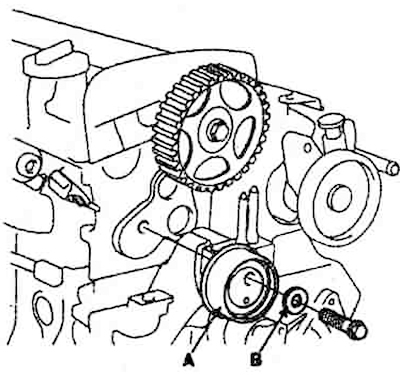
10. Install the tension pulley (A) and…


11. Install the drive belt in the following sequence:

Crankshaft gear (A) - intermediate pulley (B) - camshaft drive gear (C) - tension pulley (D).
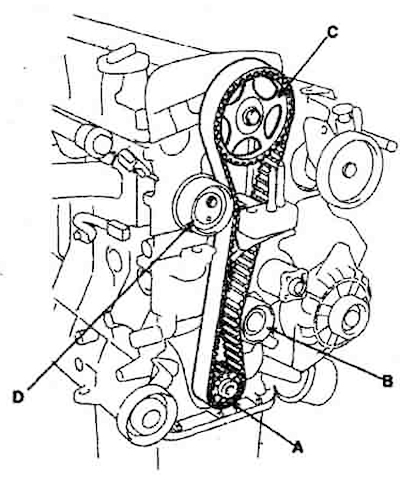
Crankshaft gear (A) - intermediate…


12. Adjust the drive belt tension.


13. Install the lower drive belt cover (A) and tighten the 5 cover mounting bolts (B) to 8-10 Nm.
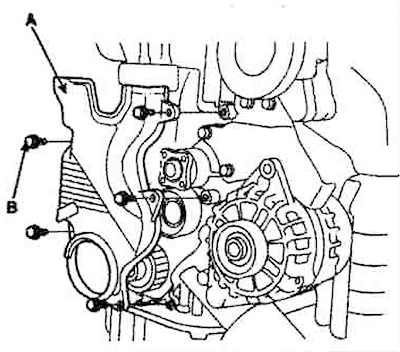
13. Install the lower drive belt cover…


14. Install the flange and crankshaft pulley (A). Make sure that the mark on the pulley matches the timing mark "T" on the lower drive belt cover. Tighten the crankshaft pulley bolt (B) to 170-180 Nm.
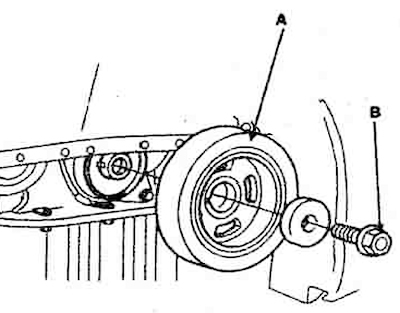
14. Install the flange and crankshaft…


15. Install the upper drive belt cover and secure it with 4 bolts.

16. Install the water pump pulley.

17. Install the power steering pump drive belt.

18. Install the compressor drive belt.

19. Install the generator drive belt.

20. Install the bracket (A) and tighten the mounting bolts (B) to 43-55 Nm.
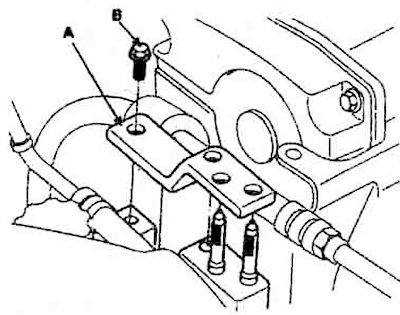
20. Install the bracket (A) and tighten…


21. Install the engine support bracket and tighten the bolt (B) and nuts (C) to a torque of 50-60 Nm, and nut D to a torque of 60-80 Nm.
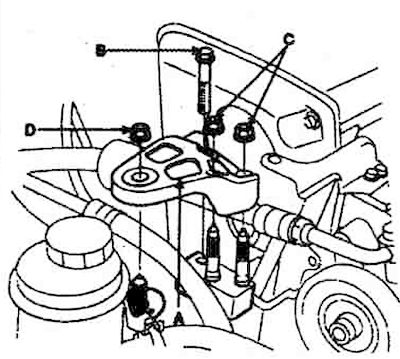


21. Install the engine support bracket…


22. Install the right side cover (A) with two bolts (B).
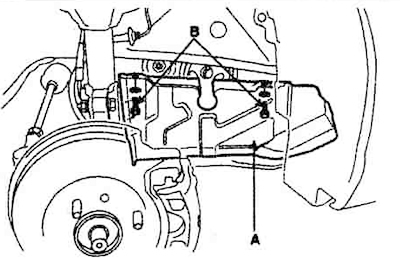
22. Install the right side cover (A)…


23. Install the right front wheel.

24. Install the engine cover.
This article is available at russian, bulgarian, belarusian, ukrainian, serbian, croatian, romanian, polish, slovak, hungarian
This article has been reviewed by: Konstantin Smirnov
Add to social network:

Previous
Tucson 1: Gasoline engine G4GC
Next

Cylinder head — device
Checking the technical condition of gears, tensioners, pulleys and drive belts
Timing drive mechanism — removal
Gas distribution mechanism drive-device
Cylinder head — removal
Disassembly, inspection of technical condition of parts and assembly of cylinder head
Checking the technical condition of the cylinder head phase shifter
Cylinder head — installation
Removal and installation the engine with gearbox assembly
We recommend other articles on the topic of Hyundai manuals:

Drive axle in block with automatic transmission Hyundai Accent 1 (1994-1999)
Variable Valve Timing (CVVT) mechanism on 1.8 and 2.0 L engines Hyundai Elantra 3 (2000-2006)
Three-point seat belt with inertia locking mechanism Hyundai Getz (2002-2011)
Checking the condition of the timing belts and balance mechanism… Hyundai Sonata 4 (2001-2012, petrol)
Removal, inspection and installation of the timing mechanism… Hyundai Santa Fe 2 (2007-2012, petrol)
Table 3.19. Technical characteristics of the drive mechanism Hyundai Matrix (2001-2010, petrol)

Link in different formats to this article

Visitor comments
No comments yet


How much will 37 + 31 ?


Tucson 2 (2009-2015) 
  • General information
  • Faults en route
  • User manual
  • Maintenance
  • Power unit
  • Gasoline engines
  • Diesel engines
  • Engine cooling system
  • Engine lubrication system
  • Engine power system
  • Control system
  • Intake and exhaust systems
  • Engine electrical equipment
  • Transmission
  • Clutch
  • Mechanical gearbox
  • Automatic gearbox
  • Drive shafts
  • Chassis
  • Suspension and wheels
  • Brake system
  • Steering
  • Body
  • Exterior (external elements)
  • Interior (internal elements)
  • Security systems
  • Air conditioning and heater
  • Electrical equipment
  • Electrical circuits
Tucson 1 (2005-2010) 
  • General information
  • User manual
  • Maintenance
  • Power unit
  • Gasoline engine G6BA
  • Gasoline engine G4GC
  • Diesel engine D4EA
  • Fuel system (gasoline)
  • Fuel system (diesel)
  • Engine lubrication system
  • Engine cooling system
  • Engine electrical equipment
  • Transmission
  • Clutch
  • Car gearbox
  • Drive shafts and cardan
  • Chassis
  • Car suspension
  • Steering
  • Brake system
  • Body
  • Exterior (external elements)
  • Interior (internal elements)
  • Air conditioning and heater
  • Airbags
  • Electrical equipment
  • Equipment and devices
  • Electrical circuits
HyundaiBook.ru © 2018-2026 · Mobile version · Sitemap: EN BG BY UA RS HR RO PL SK HU · Administration · Site search · Hyundai owners Accent 1 · Accent 2 · Accent 3 · Elantra 1 · Elantra 2 · Elantra 3 · Getz · Sonata 3 · Sonata 4 · Santa Fe 2 · Tucson 1 · Tucson 2 · Matrix ·
This site uses cookies to optimize its functionality. By continuing, you agree to our terms.