
HyundaiBook.ru
Repair Chevrolet Repair Honda Repair Toyota Repair Land Rover Repair VAZ Repair Renault Repair Nissan
English Русский
Български
Беларускі
Український
Српски
Hrvatski
Română
Polski
Slovenský
Magyar
ArticlesSitemapContacts  


  Accent   Elantra   Getz   Grandeur   Sonata   Santa Fe   Tucson   Others
Elantra 1 (1990-1995, petrol) Elantra 2 (1995-2000, petrol) Elantra 3 (2000-2006)
  • Main
  • Elantra
  • XD (2000-2006)
  • Body
  • Air conditioning system
  • Pumping atmospheric air out of the air conditioning system

Pumping atmospheric air out of the air conditioning system (Hyundai Elantra XD)

0
Caution! If the air conditioning system circuit has been opened and atmospheric air has entered it, it must be pumped out using a vacuum pump. After installing an air conditioning component, the system must be evacuated for 15 minutes. A unit that has been opened for repair and maintenance must be evacuated for 30 minutes.


Procedure


1. The engine must be turned off.

2. Connect the inlet pipe of the pressure gauges to the compressor and close the high and low pressure valves.

3. Make sure the refrigerant has been removed from the air conditioning system.

4. Connect the central hose of the pressure gauges to the inlet of the vacuum pump.

5. Start the vacuum pump and open the high and low pressure valves.

6. After 10 minutes, the vacuum should be 94.39 kPa. If the required vacuum is not achieved, there is a leak in the air conditioning system that must be repaired in the following order:.
  • Close both valves and stop the vacuum pump;.
  • Charge approximately 0.4 kg of refrigerant into the air conditioning system;
  • Check the air conditioning system for leaks. Repair any leaks found;
  • Re-discharge and evacuate the air conditioning system. If no leaks are found, continue pumping the system.
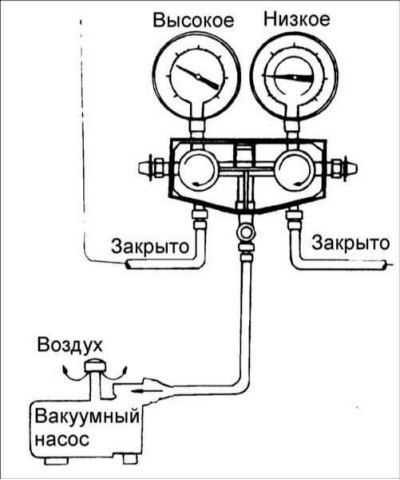
7. Start the vacuum pump.


7. Start the vacuum pump.


8. Open both discharge valves until a vacuum of 94.39 kPa is obtained.

9. After the low pressure gauge shows a vacuum close to 94.39 kPa, continue pumping for 15 minutes.
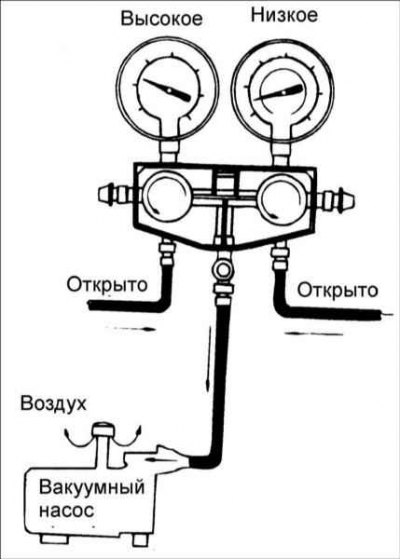
10. After pumping for 15 minutes, close…


10. After pumping for 15 minutes, close the discharge valves and stop the vacuum pump. Disconnect the hose from the vacuum pump. The system is now ready for charging.
This article is available at russian, bulgarian, belarusian, ukrainian, serbian, croatian, romanian, polish, slovak, hungarian
This article has been reviewed by: Konstantin Smirnov
Add to social network:

Previous
Elantra 3: Air conditioning system
Next

Air conditioning system discharge
Installation of pressure gauges to measure pressure
Precautionary measures
Connecting the elements of the air conditioning system
Notes when replacing air conditioning system components
Connecting the outlet valve to the refrigerant cylinder
Charging the air conditioning system
Performance check
Air Conditioning Compressor Lubricant Oil
Checking and adjusting the tension of poly V-belts
We recommend other articles on the topic of Hyundai manuals:

Pumping atmospheric air out of the air conditioning system Hyundai Accent 2 (1999-2005)
Pumping atmospheric air out of the air conditioning system Hyundai Getz (2002-2011)
Pumping out refrigerant from the air conditioning system Hyundai Sonata 4 (2001-2012, petrol)
Air conditioning system Hyundai Santa Fe 2 (2007-2012, petrol)
Technical characteristics of the air conditioning, heating and… Hyundai Tucson 1 (2005-2010)
Air conditioning system Hyundai Matrix (2001-2010, petrol)

Link in different formats to this article

Visitor comments
No comments yet


How much will 41 + 40 ?


Elantra 3 (2000-2006) 
  • User manual
  • Control devices
  • Audio system
  • Starting the engine and driving
  • Faults en route
  • Maintenance and care
  • Technical information
  • Power unit
  • Gasoline engines
  • Diesel engines
  • Lubrication system
  • Cooling system
  • Fuel system (gasoline)
  • Fuel system (diesel)
  • Decreased toxicity
  • Ignition system
  • Transmission
  • Clutch
  • Mechanical gearbox
  • Automatic gearbox
  • Drive shafts and axles
  • Chassis
  • Car suspension
  • Steering
  • Brake system
  • Body
  • Exterior (external elements)
  • Interior (internal elements)
  • Air conditioning system
  • Electrical equipment
  • Equipment and devices
  • Headlights and lighting
  • Power devices
  • Electrical circuits
Elantra 2 (1995-2000, petrol) 
  • General information
  • Maintenance
  • Power unit
  • Engine repair
  • Cooling system
  • Intake and exhaust system
  • Fuel system
  • Transmission
  • Clutch
  • Manual gearbox
  • Automatic gearbox
  • Drive shafts and axles
  • Chassis
  • Front suspension
  • Rear suspension
  • Steering
  • Brake system
  • Body
  • Body elements
  • Electrical equipment
  • Equipment and devices
  • Electrical diagrams
Elantra 1 (1990-1995, petrol) 
  • General information
  • Introduction to the guide
  • Maintenance
  • Power unit
  • Minor engine repair
  • Engine overhaul
  • Lubrication system
  • Cooling system
  • Fuel injection system
  • Ignition system
  • Exhaust system
  • Transmission
  • Clutch
  • Manual gearbox
  • Automatic gearbox
  • Drive shafts
  • Chassis
  • Front suspension
  • Rear suspension
  • Steering
  • Wheels and tires
  • Troubleshooting
  • Brake system
  • Body
  • Body elements
  • Electrical equipment
  • Equipment and devices
  • Power devices
  • Heating and air conditioning
  • Electrical circuits
HyundaiBook.ru © 2018-2026 · Mobile version · Sitemap: EN BG BY UA RS HR RO PL SK HU · Administration · Site search · Hyundai owners Accent 1 · Accent 2 · Accent 3 · Elantra 1 · Elantra 2 · Elantra 3 · Getz · Sonata 3 · Sonata 4 · Santa Fe 2 · Tucson 1 · Tucson 2 · Matrix ·
This site uses cookies to optimize its functionality. By continuing, you agree to our terms.