
HyundaiBook.ru
Repair Chevrolet Repair Honda Repair Toyota Repair Land Rover Repair VAZ Repair Renault Repair Nissan
English Русский
Български
Беларускі
Український
Српски
Hrvatski
Română
Polski
Slovenský
Magyar
ArticlesSitemapContacts  


  Accent   Elantra   Getz   Grandeur   Sonata   Santa Fe   Tucson   Others
Elantra 1 (1990-1995, petrol) Elantra 2 (1995-2000, petrol) Elantra 3 (2000-2006)
  • Main
  • Elantra
  • J1 (1990-1995)
  • General information
  • Introduction to the guide
  • Safe maintenance of your vehicle

Safe maintenance of your vehicle (Hyundai Elantra J1)

0
Contents: Jack installation locations ⇓ Not recommended ⇓
In fact, it is impossible to anticipate every risk associated with vehicle maintenance, but caution and common sense can prevent most accidents.

Safety rules for mechanics cover everything from "don't smoke near gasoline" to "use the right tool for the job." To avoid putting your health at risk, you should develop the skills to perform work safely and take all possible precautions.
  • Keep a fire extinguisher and first aid kit near your workplace.
  • Wear safety glasses when cutting, chopping, drilling, grinding or using lifting levers. If you wear glasses to improve your vision, then they must be made of tempered glass so that they can also be used as safety glasses, or you must wear safety glasses over your regular glasses.
  • Protect your eyes when working with batteries. Batteries contain sulfuric acid. If sulfuric acid comes into contact with your skin, wash the area with water or a mixture of water and baking soda and seek medical attention immediately.
  • Use safety stands when performing any work under the vehicle. Jacks are used to lift cars; safety stands are used to keep the car in a raised position until you want to lower it.
  • In all cases where the vehicle is not raised on stands, it is necessary to place chocks under the wheels and apply the parking brake.

Jack installation locations
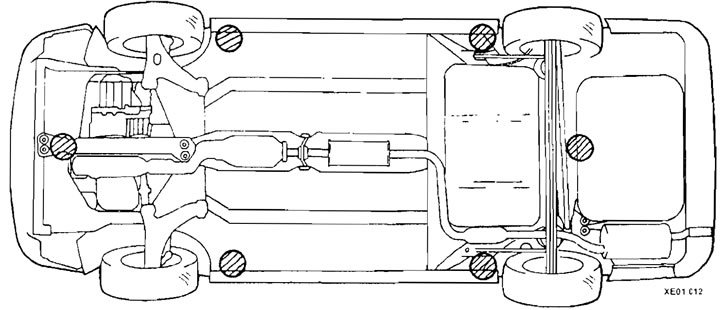


Jack installation locations

  • Provide adequate ventilation when using any chemicals. Asbestos dust produced by brake lining wear is carcinogenic.
  • Disconnect the battery ground cable when working on the electrical system.
  • Follow instructions when working with materials that are potentially hazardous to health. Both brake fluid and antifreeze are toxic and can cause poisoning of the body.
  • Maintain the instrument in proper order. Loose hammer heads, mushroom-shaped punches and chisels, frayed or poorly grounded electrical cords, excessively worn screwdrivers, loose open-end wrenches, cracked heads, slipping ratchets, or faulty light bulb sockets can cause accidents.
  • Use a tool of the size and name that is necessary for the given work.
  • Whenever possible, pull the wrench handle toward you rather than pushing it away from you.
  • Make sure that the adjustable wrenches fit tightly against the nut or bolt and that the force applied to them is such that the edge contacts the fixed jaw of the wrench.
  • The keys or heads must fit the nut or bolt and sit on them without distortion.
  • Apply the parking brake and place chocks under the wheels if the work being carried out requires the engine to be running.


Not recommended


Do not run the engine in a garage or where there is no ventilation. Carbon monoxide is poisonous! Early symptoms of carbon monoxide poisoning include headache, irritability, blurred vision (blurred vision or inability to focus) and/or drowsiness. If you or your helpers experience any of these symptoms, stop work immediately and get fresh air. Ventilate the area thoroughly before returning to the vehicle.

Wear a tie or other loose clothing when working near rotating parts. Short sleeves are much safer than long ones. It is better to hide long hair under a hat.

Use pockets as toolboxes. If dropped or hit against an object, the screwdriver may cause injury to the body. Even a handkerchief sticking out of your back pocket can get wrapped around a rotating shaft, pulley or fan.

Smoking when working near gasoline, cleaning solutions or other flammable materials.

Smoking while working near a battery. When charging a battery, explosive gas evaporates from it.

Wash your hands with gasoline.
This article is available at russian, bulgarian, belarusian, ukrainian, serbian, croatian, romanian, polish, slovak, hungarian
This article has been reviewed by: Konstantin Smirnov
Add to social network:

Previous
Elantra 1: Introduction to the guide
Next

Tools and equipment for repair
Some tips for car owners on repairs
Precautions when repairing a car
Preliminary engine checks
Reasons that require engine repair
We recommend other articles on the topic of Hyundai manuals:

Vehicle Identification Number Hyundai Accent 1 (1994-1999)
Maintenance of the additional passive restraint system SRS Hyundai Getz (2002-2011)
Maintenance of vehicle electrical equipment Hyundai Sonata 3 (1993-1998)
Vehicle identification data Hyundai Santa Fe 2 (2007-2012, petrol)
Maintenance performed by the vehicle owner Hyundai Tucson 2 (2009-2015)
Towing a broken down vehicle Hyundai Matrix (2001-2010, petrol)

Link in different formats to this article

Visitor comments
No comments yet


How much will 11 + 10 ?


Elantra 3 (2000-2006) 
  • User manual
  • Control devices
  • Audio system
  • Starting the engine and driving
  • Faults en route
  • Maintenance and care
  • Technical information
  • Power unit
  • Gasoline engines
  • Diesel engines
  • Lubrication system
  • Cooling system
  • Fuel system (gasoline)
  • Fuel system (diesel)
  • Decreased toxicity
  • Ignition system
  • Transmission
  • Clutch
  • Mechanical gearbox
  • Automatic gearbox
  • Drive shafts and axles
  • Chassis
  • Car suspension
  • Steering
  • Brake system
  • Body
  • Exterior (external elements)
  • Interior (internal elements)
  • Air conditioning system
  • Electrical equipment
  • Equipment and devices
  • Headlights and lighting
  • Power devices
  • Electrical circuits
Elantra 2 (1995-2000, petrol) 
  • General information
  • Maintenance
  • Power unit
  • Engine repair
  • Cooling system
  • Intake and exhaust system
  • Fuel system
  • Transmission
  • Clutch
  • Manual gearbox
  • Automatic gearbox
  • Drive shafts and axles
  • Chassis
  • Front suspension
  • Rear suspension
  • Steering
  • Brake system
  • Body
  • Body elements
  • Electrical equipment
  • Equipment and devices
  • Electrical diagrams
Elantra 1 (1990-1995, petrol) 
  • General information
  • Introduction to the guide
  • Maintenance
  • Power unit
  • Minor engine repair
  • Engine overhaul
  • Lubrication system
  • Cooling system
  • Fuel injection system
  • Ignition system
  • Exhaust system
  • Transmission
  • Clutch
  • Manual gearbox
  • Automatic gearbox
  • Drive shafts
  • Chassis
  • Front suspension
  • Rear suspension
  • Steering
  • Wheels and tires
  • Troubleshooting
  • Brake system
  • Body
  • Body elements
  • Electrical equipment
  • Equipment and devices
  • Power devices
  • Heating and air conditioning
  • Electrical circuits
HyundaiBook.ru © 2018-2026 · Mobile version · Sitemap: EN BG BY UA RS HR RO PL SK HU · Administration · Site search · Hyundai owners Accent 1 · Accent 2 · Accent 3 · Elantra 1 · Elantra 2 · Elantra 3 · Getz · Sonata 3 · Sonata 4 · Santa Fe 2 · Tucson 1 · Tucson 2 · Matrix ·
This site uses cookies to optimize its functionality. By continuing, you agree to our terms.