
HyundaiBook.ru
Repair Chevrolet Repair Honda Repair Toyota Repair Land Rover Repair VAZ Repair Renault Repair Nissan
English Русский
Български
Беларускі
Український
Српски
Hrvatski
Română
Polski
Slovenský
Magyar
ArticlesSitemapContacts  


  Accent   Elantra   Getz   Grandeur   Sonata   Santa Fe   Tucson   Others
Elantra 1 (1990-1995, petrol) Elantra 2 (1995-2000, petrol) Elantra 3 (2000-2006)
  • Main
  • Elantra
  • XD (2000-2006)
  • User manual
  • Maintenance and care
  • Catalytic converter of exhaust gases

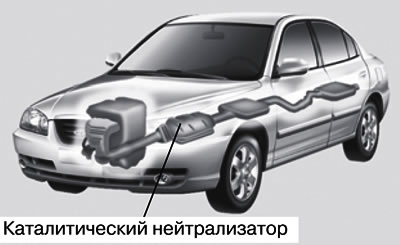
Catalytic converter of exhaust gases (Hyundai Elantra XD)

0
Contents: Cars with gasoline engines ⇓ Diesel Engine Cars ⇓
Cars with gasoline engines


All Hyundai vehicles are equipped with…


All Hyundai vehicles are equipped with a monoblock three-component neutralizer of exhaust gases, which reduces the content of carbon monoxide, hydrocarbons and nitrogen oxides in exhaust gases. When the exhaust gases pass through the neutralizer, it heats up to a very high temperature. Therefore, the presence of a large amount of unburned fuel in the exhaust gases can cause the neutralizer to overheat and create a dangerous situation. This can be avoided by following these rules:

Warning:
  • Use only unleaded gasoline.
  • Keep the engine in good working order. Overheating of the neutralizer can be caused by a malfunction of the electrical equipment, ignition system or multi-point fuel injection system.
  • If the engine stalls, knocks, or is difficult to start, take the vehicle to a Hyundai dealer as soon as possible to have the problem repaired.
  • Avoid driving with a minimum amount of fuel in the tank. When the fuel is completely used up, misfires of the mixture in the cylinders occur and the neutralizer is damaged.
  • Do not allow the engine to idle for more than 10 minutes.
  • Do not start the engine by pushing or towing the vehicle. This will overload the neutralizer.
  • To avoid burns, do not touch the hot neutralizer or other parts of the exhaust system. Before touching the catalytic converter or other parts of the exhaust system, stop the engine and wait at least an hour.
  • Remember that your best assistant is your Hyundai dealer.
  • Do not park your vehicle in areas where flammable materials may be underneath it (dry grass, paper, fallen leaves or rags), which may ignite upon contact with a hot neutralizer and cause a fire.


Diesel Engine Cars


All Hyundai vehicles are equipped with an oxidation-type catalytic converter, which reduces the content of carbon monoxide, hydrocarbons and solid particles in the exhaust gases.
This article is available at russian, bulgarian, belarusian, ukrainian, serbian, croatian, romanian, polish, slovak, hungarian
This article has been reviewed by: Konstantin Smirnov
Add to social network:

Previous
Elantra 3: Maintenance and care
Next

Exhaust gas recirculation system
Toxicity Reduction Systems
Lamps used in the car
Replacement of lighting lamps
Headlight adjustment
We recommend other articles on the topic of Hyundai manuals:

Exhaust manifold (engine with injection) Hyundai Accent 1 (1994-1999)
Catalytic converter of exhaust gases Hyundai Getz (2002-2011)
Catalytic converter and exhaust system Hyundai Sonata 4 (2001-2012, petrol)
Emission Control System (Catalytic Converter Models) Hyundai Santa Fe 2 (2007-2012, petrol)
Intake and exhaust systems — device Hyundai Tucson 1 (2005-2010)
Vehicles with a catalytic converter in the exhaust system Hyundai Matrix (2001-2010, petrol)

Link in different formats to this article

Visitor comments
No comments yet


How much will 41 + 10 ?


Elantra 3 (2000-2006) 
  • User manual
  • Control devices
  • Audio system
  • Starting the engine and driving
  • Faults en route
  • Maintenance and care
  • Technical information
  • Power unit
  • Gasoline engines
  • Diesel engines
  • Lubrication system
  • Cooling system
  • Fuel system (gasoline)
  • Fuel system (diesel)
  • Decreased toxicity
  • Ignition system
  • Transmission
  • Clutch
  • Mechanical gearbox
  • Automatic gearbox
  • Drive shafts and axles
  • Chassis
  • Car suspension
  • Steering
  • Brake system
  • Body
  • Exterior (external elements)
  • Interior (internal elements)
  • Air conditioning system
  • Electrical equipment
  • Equipment and devices
  • Headlights and lighting
  • Power devices
  • Electrical circuits
Elantra 2 (1995-2000, petrol) 
  • General information
  • Maintenance
  • Power unit
  • Engine repair
  • Cooling system
  • Intake and exhaust system
  • Fuel system
  • Transmission
  • Clutch
  • Manual gearbox
  • Automatic gearbox
  • Drive shafts and axles
  • Chassis
  • Front suspension
  • Rear suspension
  • Steering
  • Brake system
  • Body
  • Body elements
  • Electrical equipment
  • Equipment and devices
  • Electrical diagrams
Elantra 1 (1990-1995, petrol) 
  • General information
  • Introduction to the guide
  • Maintenance
  • Power unit
  • Minor engine repair
  • Engine overhaul
  • Lubrication system
  • Cooling system
  • Fuel injection system
  • Ignition system
  • Exhaust system
  • Transmission
  • Clutch
  • Manual gearbox
  • Automatic gearbox
  • Drive shafts
  • Chassis
  • Front suspension
  • Rear suspension
  • Steering
  • Wheels and tires
  • Troubleshooting
  • Brake system
  • Body
  • Body elements
  • Electrical equipment
  • Equipment and devices
  • Power devices
  • Heating and air conditioning
  • Electrical circuits
HyundaiBook.ru © 2018-2026 · Mobile version · Sitemap: EN BG BY UA RS HR RO PL SK HU · Administration · Site search · Hyundai owners Accent 1 · Accent 2 · Accent 3 · Elantra 1 · Elantra 2 · Elantra 3 · Getz · Sonata 3 · Sonata 4 · Santa Fe 2 · Tucson 1 · Tucson 2 · Matrix ·
This site uses cookies to optimize its functionality. By continuing, you agree to our terms.