
HyundaiBook.ru
Repair Chevrolet Repair Honda Repair Toyota Repair Land Rover Repair VAZ Repair Renault Repair Nissan
English Русский
Български
Беларускі
Український
Српски
Hrvatski
Română
Polski
Slovenský
Magyar
ArticlesSitemapContacts  


  Accent   Elantra   Getz   Grandeur   Sonata   Santa Fe   Tucson   Others
Tucson 1 (2005-2010) Tucson 2 (2009-2015)
  • Main
  • Tucson
  • LM (2009-2015)
  • Power unit
  • Engine lubrication system
  • Diesel Engine Oil Filter and Oil Cooler Assembly

Diesel Engine Oil Filter and Oil Cooler Assembly (Hyundai Tucson LM)

0

Removal and installation


1. Drain the engine oil.

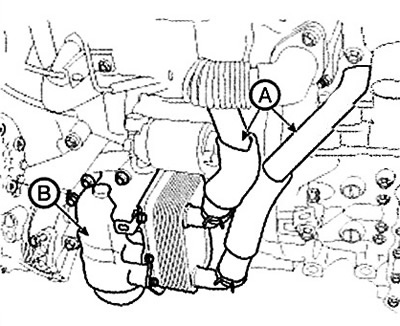
2. Disconnect the oil cooler hoses (A).

Caution: Do not use excessive force when disconnecting and connecting the oil cooler hoses.


3. Remove the oil filter and oil cooler assembly (B).

Note: Tightening torque: 19.6 - 26.5 Nm.


Caution: When installing the oil filter and oil cooler assembly, check for O-rings on the mating surface with the cylinder block. Tighten the 4 upper bolts first, then tighten the remaining lower bolt.

Caution: When installing the oil filter…


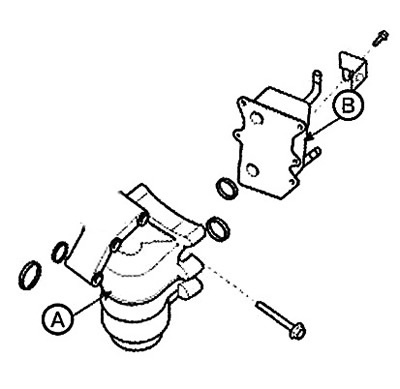
4. Remove the oil cooler (B) from the oil filter (A).

Note: Tightening torque: 9.8 - 11.8 Nm.


Caution: When installing the oil cooler, make sure that there are sealing rings on the mating surface with the oil filter.

Caution: When installing the oil…


5. Installation is carried out in reverse order.
This article is available at russian, bulgarian, belarusian, ukrainian, serbian, croatian, romanian, polish, slovak, hungarian
This article has been reviewed by: Konstantin Smirnov
Add to social network:

Previous
Tucson 2: Engine lubrication system
Next

Oil pump for diesel engines
Oil cooler for petrol engines (2.4L engines only)
Oil pump for gasoline engines
Oil pressure sensor — checking technical condition
Oil and oil filter change
Diesel Engine Oil Level Sensor
Special tools and accessories
We recommend other articles on the topic of Hyundai manuals:

Engine Identification Number Hyundai Accent 1 (1994-1999)
Starting and stopping an engine with a turbocharger and air… Hyundai Elantra 3 (2000-2006)
Removal water from the fuel filter (diesel engine) Hyundai Getz (2002-2011)
Replacing the engine oil filter Hyundai Sonata 3 (1993-1998)
Before starting the engine Hyundai Santa Fe 2 (2007-2012, petrol)
Identification data and engine compartment Hyundai Matrix (2001-2010, petrol)

Link in different formats to this article

Visitor comments
No comments yet


How much will 47 + 27 ?


Tucson 2 (2009-2015) 
  • General information
  • Faults en route
  • User manual
  • Maintenance
  • Power unit
  • Gasoline engines
  • Diesel engines
  • Engine cooling system
  • Engine lubrication system
  • Engine power system
  • Control system
  • Intake and exhaust systems
  • Engine electrical equipment
  • Transmission
  • Clutch
  • Mechanical gearbox
  • Automatic gearbox
  • Drive shafts
  • Chassis
  • Suspension and wheels
  • Brake system
  • Steering
  • Body
  • Exterior (external elements)
  • Interior (internal elements)
  • Security systems
  • Air conditioning and heater
  • Electrical equipment
  • Electrical circuits
Tucson 1 (2005-2010) 
  • General information
  • User manual
  • Maintenance
  • Power unit
  • Gasoline engine G6BA
  • Gasoline engine G4GC
  • Diesel engine D4EA
  • Fuel system (gasoline)
  • Fuel system (diesel)
  • Engine lubrication system
  • Engine cooling system
  • Engine electrical equipment
  • Transmission
  • Clutch
  • Car gearbox
  • Drive shafts and cardan
  • Chassis
  • Car suspension
  • Steering
  • Brake system
  • Body
  • Exterior (external elements)
  • Interior (internal elements)
  • Air conditioning and heater
  • Airbags
  • Electrical equipment
  • Equipment and devices
  • Electrical circuits
HyundaiBook.ru © 2018-2026 · Mobile version · Sitemap: EN BG BY UA RS HR RO PL SK HU · Administration · Site search · Hyundai owners Accent 1 · Accent 2 · Accent 3 · Elantra 1 · Elantra 2 · Elantra 3 · Getz · Sonata 3 · Sonata 4 · Santa Fe 2 · Tucson 1 · Tucson 2 · Matrix ·
This site uses cookies to optimize its functionality. By continuing, you agree to our terms.