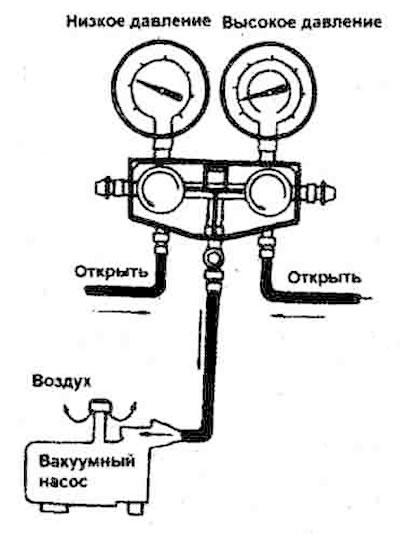
Note: Each time the system is opened, a vacuum must be created to prevent air and moisture from entering. After installing any component, the system must be kept under vacuum for approximately 15 minutes. Components of the system opened for repair must be kept under vacuum for 30 minutes.
1. Turn off the engine.
2. Attach a set of control pressure gauges to the compressor fittings. Close the valves of the high and low pressure lines.
3. Make sure that the refrigerant has been drained from the system.
4. Connect the central hose of the pressure gauge kit to the inlet pipe of the vacuum pump.
5. Turn on the vacuum pump and open the high and low pressure valves.
6. After about 10 minutes, check that the low pressure gauge shows a vacuum below 94.39 kPa. If a vacuum cannot be obtained, this indicates a leak in the system. In this case, eliminate the leak as follows:
- 1) Close both valves of the pressure gauge set and turn off the vacuum pump.
- 2) Charge the system with refrigerant from a container (approximately 0.4 kg) as indicated in the section "Refrigerant charging".
- 3) Locate the leak using a leak detector. Eliminate the leak (see section "Checking the tightness of the system").
- 4) Drain the refrigerant again and create a vacuum in the system. If no leaks are found, continue creating a vacuum in the system.
[The original text is published on the website HyundaiBook.ru]
7. Turn on the vacuum pump.
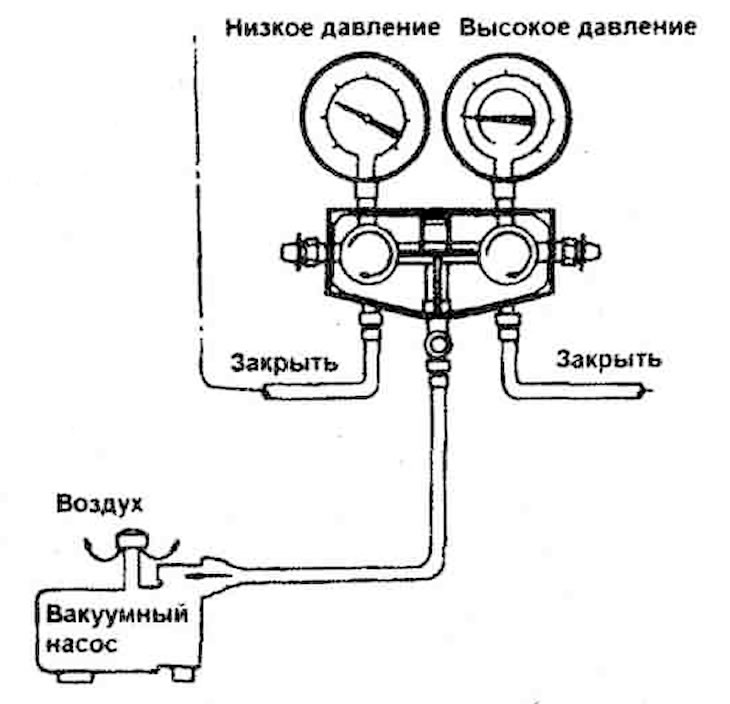
8. Open both valves of the pressure gauge set until a vacuum of 94.39 kPa is created.
9. After the low pressure gauge shows a vacuum of about 94.39 kPa, continue to create a vacuum for 15 minutes.
10. After the system has been under vacuum for 15 minutes, close both valves of the pressure gauge set and turn off the vacuum pump. Disconnect the hose from the vacuum pump. The system is ready for charging with refrigerant.