


Tire pressure
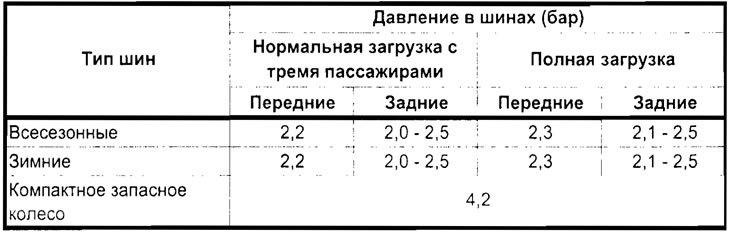
Tire pressure should be checked monthly or before each long trip. The pressure is measured on cold tires(after the vehicle has been parked for 3 hours or more, or after the vehicle has been driven a distance of no more than 1.6 km).
The air pressure in a hot tire can increase by 0.41 bar compared to a cold tire.
Exceeding the recommended air pressure in tires leads to the following consequences:
- deterioration of ride smoothness and comfort;
- damage to the tire frame;
- rapid wear of the tread in the central part of the tread.
Insufficient air pressure in tires leads to the following consequences:
- squealing tires when cornering;
- increasing the effort on the steering wheel;
- rapid and uneven wear of the tread along the edges of the tread;
- damage to the wheel rim and tire casing;
- breaking of cord threads;
- overheating of tires;
- deterioration of vehicle controllability;
- deterioration in fuel economy.
Uneven air pressure in tires mounted on the same axle can cause the following:
- vehicle drift when braking due to difference in braking forces;
- deterioration of controllability;
- car drift during acceleration;
- constant moment on the steering wheel when the car is moving in a straight line.
(The original text is available on the website: www.hyundaibook.ru)
Note: If wheel removal is difficult, the use of fast-penetrating compounds is not always effective. However, if such products have to be used, care must be taken to ensure that they are applied in small quantities and only directly in the vicinity of the central hole of the wheel. The penetration of fast-penetrating compounds into the mating surfaces between the wheel and the hub or brake drum may result in the wheel mounting bolts becoming loose while the vehicle is in motion.