


Checking the technical condition
1. Turn off the ignition.
2. Disconnect the electrical exhaust gas recirculation (EEGR) control valve connector.
3. Check the EEGR valve for foreign material contamination.
4. Measure the resistance between the (+) and (-) motor control terminals.
5. Check that the resistance matches the specification.
6. Measure the resistance between the power and ground terminals of the sensor.
7. Check that the resistance matches the specification.
Removal
1. Turn the ignition key to the "OFF" position and disconnect the negative (-) cable from the battery.
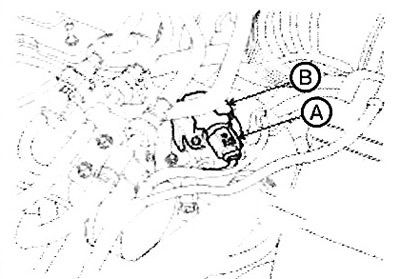
2. Disconnect the EEGR valve connector (A).
3. Loosen the mounting bolts and remove the EEGR valve (B).
Installation
Attention.
- Tighten the component mounting bolts to the specified torque.
- Be careful not to drop the component. If dropped, the component must be carefully checked before installation.
Installation is performed in the reverse order of removal.
Note: Tightening torque: EEGR valve mounting bolt: 7.8 - 11.8 Nm.
Replacement
After replacing the electrical control valve of the exhaust gas recirculation system (EEGR), the "Component Change Routine" procedure must be performed. Otherwise, a malfunction related to engine performance or exhaust control may occur and persist until data about the new component is registered in the engine control unit.
1. Turn off the ignition.
2. Connect the GDS scanner to the data link connector (DLC).
3. Turn on the ignition.
4. Select "Vehicle, Model year, Engine, System".
5. Select Vehicle S/W Management (Vehicle Software Management).
6. Select Component Change Routine.
7. Select EGR Valve Change (Exhaust gas recirculation valve replacement).
8. Follow the procedure according to the instructions on the screen.