


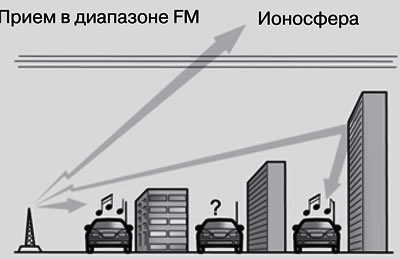
AM and FM radio signals are transmitted from transmitter towers around your city, received by your car's radio antennas, and transmitted to your radio receiver and then to your speakers.
When receiving a strong radio signal, your high-tech audio system delivers high-quality sound. However, in some cases the received signal is not strong and clear enough. This is due to factors such as distance from the radio station, proximity to other radio stations, or the presence of buildings, bridges, or other large structures that interfere with the propagation of radio waves.
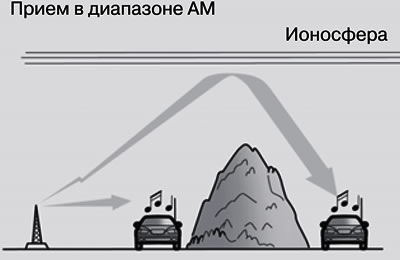
The reception range in the AM range is greater than in the FM range, since transmission in the AM range is carried out at low frequencies. Long low-frequency radio waves do not propagate in a straight line through the atmosphere, but follow the curvature of the earth's surface. In addition, they bend around obstacles, increasing the signal reception area.
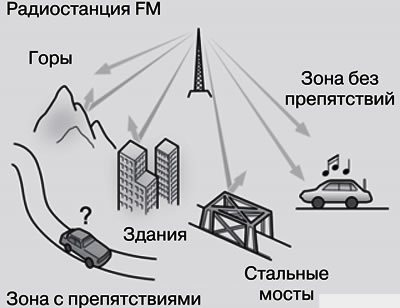
FM transmissions are carried out at high frequencies, so the radio waves do not bend around the earth's surface. For this reason, FM reception usually begins to weaken already at a short distance from the transmitter. In addition, the quality of FM signal reception is greatly affected by buildings, mountains and other obstacles. This results in poor reception, which you may perceive as a malfunction of the audio system. Below are possible cases of poor reception that are not due to a malfunction of the audio system.
Signal Fading - As the vehicle moves away from the radio, the signal fades and the volume decreases. In this case, we recommend switching to another, more powerful station
Rapid fluctuations in the signal level ("flutter")/Electrostatic interference — If the FM signal is weak or there are obstacles between the transmitter and the radio receiver, the signal is distorted in the form of electrostatic noise or rapid fluctuations in the volume level. These distortions can be removed by cutting the high frequencies using the tone control.
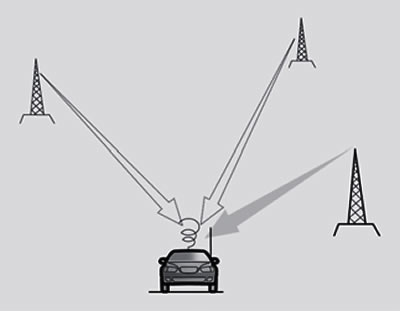
Station Swapping - As the FM signal weakens, you may begin to receive another, stronger station on a similar frequency at the same time, because your audio system is designed to receive the clearest signal possible. In this case, switch to a station with a stronger signal.
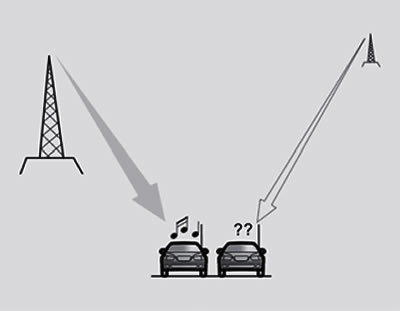
Interference Distortion - Receiving signals from different directions can cause reception distortion or "flutter". This is due to receiving direct and reflected signals from the same station or signals from two stations operating on similar frequencies. In this case, switch to receiving another station until the interference disappears.
Using a cell phone or radio
Using a cell phone may cause noise in the audio system. This does not mean that the audio system is faulty. In this case, use your cell phone as far away from the audio system as possible.
Caution: When using a cellular phone or radio in a vehicle, a separate external antenna must be installed. Using a cell phone or radio only through the internal antenna may interfere with the operation of some types of electrical equipment and may adversely affect the operation of vehicle systems.
Warning: Do not use your cell phone while driving. To do this, you should stop in a safe place.