


Contents: ON/VOL (power switch/volume control…⇓ BAL (left/right stereo balance…⇓ SCAN (automatic tuning knob for…⇓ FAD (Front/Rear Stereo Balance…⇓ BASS (low frequency tone control…⇓ TREBLE (tone control knob for high…⇓ FM/AM (band selection button). ⇓ TUNE (manual frequency tuning…⇓ Automatic frequency tuning. ⇓ Station memory buttons. ⇓ Storing station frequencies ⇓
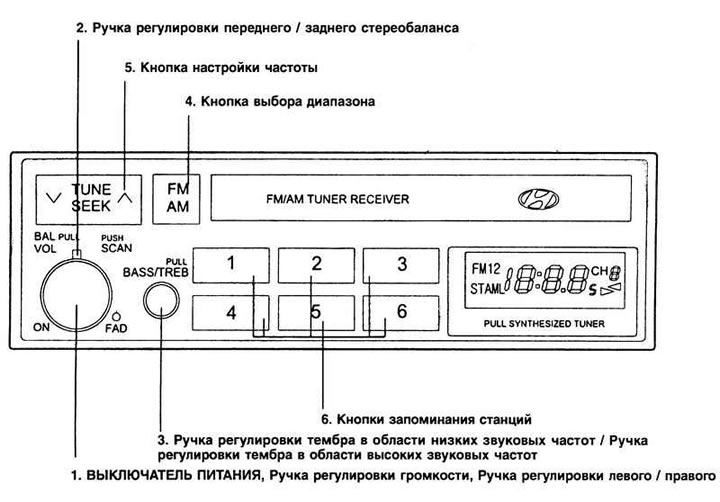
Fig. 1.67. Stereo receiver (H210)
ON/VOL (power switch/volume control knob/left/right stereo balance control knob, scan switch).
The radio operates when the ignition key is in the "ON" or "ACC" position. Turn the knob clockwise to turn on the power and increase the volume. The LCD display shows the frequency of the radio station in the radio reception mode. Turn the knob counterclockwise to decrease the volume and turn off the radio power.
BAL (left/right stereo balance control knob).
Pull the knob and turn it clockwise to increase the volume of the right speaker (the volume of the left speaker will decrease). When turning the knob counterclockwise, the volume of the left speaker will increase (the volume of the right speaker will decrease). After adjusting, push the knob back to its original position to use its other functions.
SCAN (automatic tuning knob for received stations).
When you press this knob, the frequency increases and the receiver tunes in for 5 seconds one by one to the received stations. To stop automatic tuning, press this button again.
FAD (Front/Rear Stereo Balance Adjustment Knob).
Turn the knob counterclockwise to increase the volume of the front speakers (decrease the volume of the rear speakers). Turn the knob clockwise to increase the volume of the rear speakers (decrease the volume of the front speakers).
BASS (low frequency tone control knob).
Push the knob to push it outwards, and turn it left or right to set the desired timbre in the low-frequency range.
TREBLE (tone control knob for high frequencies).
Pull the outward-facing knob to the next fixed position. Turn it left or right to set the desired timbre in the high frequency range.
FM/AM (band selection button).
Pressing this button switches between AM, FM1 and FM2 bands. The selected band is displayed on the LCD display.
TUNE (manual frequency tuning button).
Press on the sides
 or
or  this button to increase or decrease the frequency. If you hold this button for more than 1 second, the stop signal (stable signal of the radio station) will be ignored and continue searching for the next one.
Automatic frequency tuning.
Press and hold the TUNE button for 1 second or longer. When you press the side
 , the radio will automatically tune to the next station with a stable signal and a higher broadcast frequency, and when you press the side
  – the radio receiver will automatically tune to the next station with a lower broadcast frequency.
Station memory buttons.
You can store 6 stations in each of the AM, FM1 and FM2 ranges in the memory of this radio receiver.
Storing station frequencies
The audio system can store 6 AM stations and 12 FM stations in its memory. After that, you can select one of them by pressing the band selection button and one of the six station memory buttons. To store these stations in memory, do the following:
- press the band selection button to select one of the AM, FM1 or FM2 bands.
- select the station you want to store in memory using manual or automatic tuning;
- select the station memory button to which you want to assign this station;
- press and hold this station memory button for two seconds or more. The display will show an indicator with the number of the selected station memory button. Once the frequency is stored in memory, its value will flash on the display. Release the button and continue storing the next desired station.
A total of 18 stations can be programmed, assigning one AM station and two FM stations to one button.
Once programming is complete, turn on any of the programmed stations by selecting one of the AM, FM1 or FM2 ranges and pressing the corresponding station frequency memory button.