


Contents: Anti-lock braking system (ABS) ⇓ Electronic Brakeforce Distribution…⇓ Traction Control System (TCS) ⇓
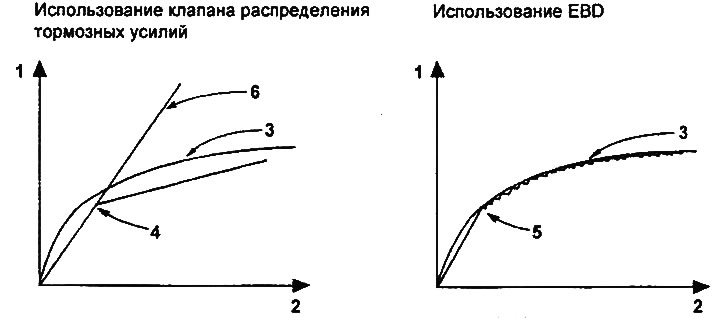
Brake force distribution characteristics.
1 - pressure in the rear brake lines, 2 - pressure in the front brake lines, 3 - ideal distribution, 4 - brake force distribution valve activation point, 5 - EBD activation point, 6 - constant (unchangeable) distribution.
Anti-lock braking system (ABS)
1. Anti-lock braking system (ABS) controls the pressure in the brake circuits of all four wheels, preventing the wheels from locking.
ABS allows:
- to avoid an obstacle with a high degree of confidence, even in the event of emergency braking;
- stop the vehicle during emergency braking while maintaining control and stability on the road, even on a curved trajectory.
2. The main function of the ABS system is to ensure the stability and control of the vehicle. However, the system cannot prevent the vehicle from skidding if the cornering speed limit is exceeded.
3. The ABS system consists of a hydraulic unit (ABS electronic control unit), a master brake cylinder with a vacuum booster and wheel speed sensors.
4. Receiving signals from all sensors during braking, the electronic control unit determines which wheel is on the verge of locking. At this point, the electronic control unit activates the corresponding electromagnetic valve in the hydraulic unit to provide the required pressure in the brake circuit of the corresponding wheel.
5. The electronic control unit has self-diagnostics and emergency mode functions. When a malfunction is detected, the "ABS" indicator lights up on the instrument cluster and the corresponding malfunction code is entered into the control unit memory, then the system goes into emergency mode (ABS, EBD, TCS systems are disabled).
6. The anti-lock braking system (ABS) is activated when the vehicle speed exceeds 10 km/h and deactivated when the speed is less than 5 km/h.
(The original can be found on the resource: HyundaiBook.ru)
Electronic Brakeforce Distribution (EBD)
Please note: vehicles equipped with this system do not have a rear brake pressure regulator.
1. The use of electronic brake force distribution (EBD) instead of the rear axle load-dependent brake force distribution valve allows for ideal pressure distribution in the front and rear brake circuits. As a result, rear wheel locking is prevented and greater brake response is achieved.
2. Advantages of electronic control.
- a) Functional improvement of the parameters of the main braking system.
- b) Compensation for different coefficients of wheel adhesion to the road.
- c) No need to install a rear axle load-dependent brake force distribution valve.
- d) Indication of the presence of faults.
3. The EBD system functions are performed by the ABS/EBD/TCS control unit.
Traction Control System (TCS)
1. The traction control system (TCS) is designed to automatically prevent wheel slip on roads with normal or slippery surfaces. When starting off, accelerating the car or when cornering, excess torque leads to a rapid increase in the rotation speed of one or all drive wheels. The TCS system maintains the slip of the drive wheels within the permissible level and thus ensures stable control, improves directional stability and traction characteristics of the car.
2. The status of the TCS system is shown by the "TCS" and "TCS-OFF" indicators located on the instrument cluster.
3. The TCS system functions are performed by the ABS/EBD/TCS control unit.