HyundaiBook.ru
Repair Chevrolet Repair Honda Repair Toyota Repair Land Rover Repair VAZ Repair Renault Repair Nissan
English Русский
Български
Беларускі
Український
Српски
Hrvatski
Română
Polski
Slovenský
Magyar
ArticlesSitemapContacts  


  Accent   Elantra   Getz   Grandeur   Sonata   Santa Fe   Tucson   Others
Sonata 3 (1993-1998) Sonata 4 (2001-2012, petrol)
  • Main
  • Sonata
  • EF (2001-2012)
  • Chassis
  • Brake system
  • Rear disc brake mechanism

Rear disc brake mechanism (Hyundai Sonata EF)

0
Contents: Replacing brake pads ⇓ Removal ⇓ Disassembly ⇓ Examination ⇓ Assembly ⇓ Installation ⇓
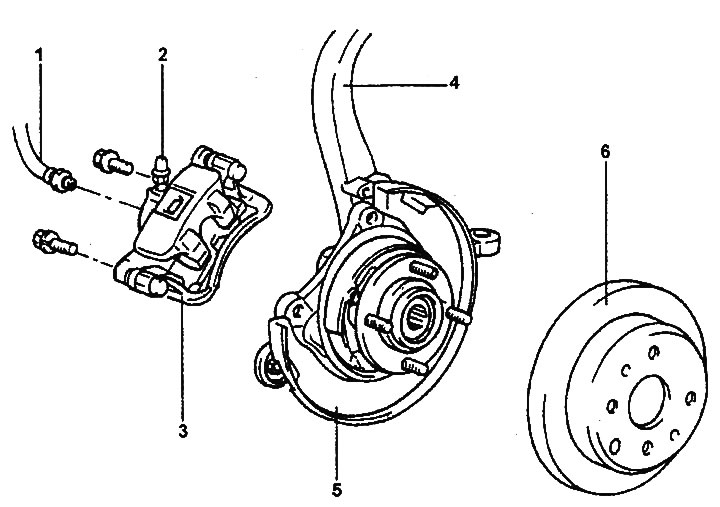
Rear disc brake mechanism.

Rear disc brake mechanism.

1 - brake hose, 2 - bleed nipple, 3 - caliper, 4 - fist, 5 - brake shield, 6 - brake disc.


Replacing brake pads


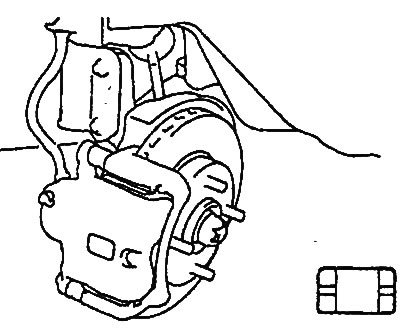
1. Jack up the car, unscrew the bolts and remove the rear wheel.

2. Check the thickness of the brake pads through the inspection hole in the caliper. Replace the pads if necessary.
  • Nominal thickness: 10 mm
  • Minimum thickness: 2 mm

Minimum thickness: 2 mm


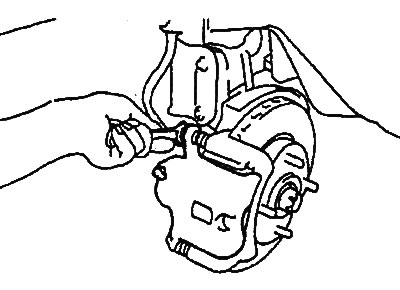
3. Raise the caliper.
  • a) Remove the guide pins.

a) Remove the guide pins.

  • b) Raise the caliper and secure it as shown in the figure.
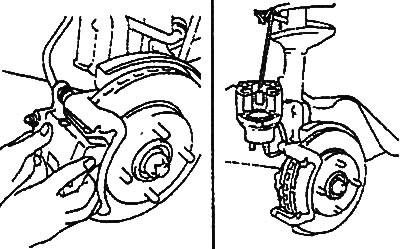
b) Raise the caliper and secure it as…


Caution: Do not disconnect the brake hose from the caliper.


4. Remove the brake pads, linings and retaining plates.
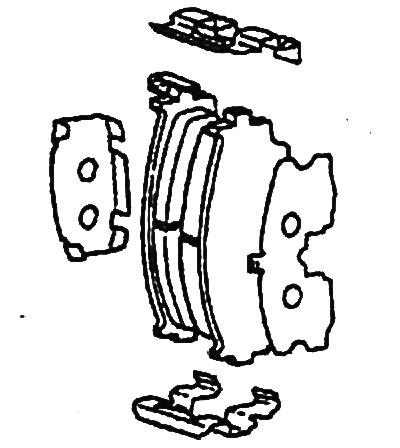
4. Remove the brake pads, linings and…


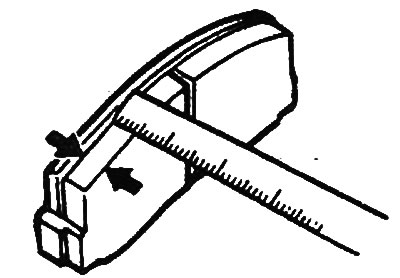
5. Measure the thickness of the brake shoe lining at the point of greatest wear.
  • Nominal thickness: 10 mm
  • Minimum thickness: 2 mm

Minimum thickness: 2 mm


If the brake pad lining thickness is less than the minimum value, replace the brake pads.
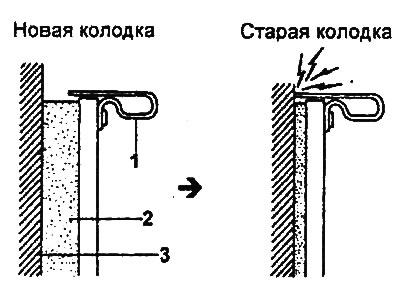
Wear of brake pad linings.

Wear of brake pad linings.

1 - lining wear indicator, 2 - lining, 3 - brake disc.


Attention:
  • When a brake pad needs to be replaced, replace the entire set of brake pads on both the left and right sides of the vehicle. Do not mix brake pads of different types or manufacturers in the same set.
  • All four brake pads must be replaced as a set.
  • When replacing brake pads, check for deformation. When replacing brake pad retainers, install a new or used retainer only after cleaning it from foreign particles.
  • If there is a noticeable difference in the thickness of the brake pads on the left and right sides, check the smooth movement of the piston, guide and locking pins.


6. Install the brake pad retainers into the caliper bracket.
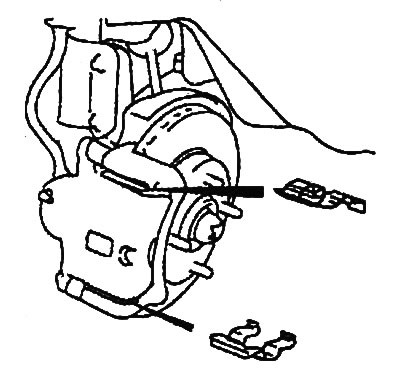
6. Install the brake pad retainers into…


7. Install the brake pads.

Note: Install the brake pad with the lining wear indicator facing up.


8. Press the piston into the caliper using a hammer handle or something similar.

9. Install the boot into the caliper.

Note: Be careful not to damage the boot.


10. Install two guide pins.
  • Tightening torque: 22-32 Nm

11. Install the rear wheel and tighten the bolts.
  • Tightening torque: 90-110 Nm

Removal


1. Jack up the car, unscrew the bolts and remove the rear wheel.
  • Tightening torque: 90-110 Nm

2. Disconnect the brake hose from the caliper.


  • Tightening torque: 7-13 Nm

3. Remove the brake mechanism assembly.

Disassembly


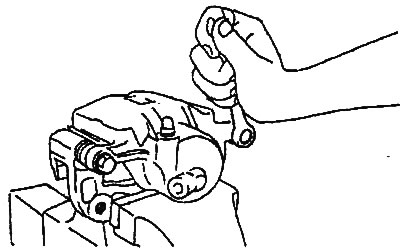
1. Unscrew the guide pins and detach the caliper from the bracket.

The original text is available on the website (hyundaibook)
  • Tightening torque: 22-32 Nm

Tightening torque: 22-32 Nm


2. Remove the boot from the caliper.

3. Remove the piston.
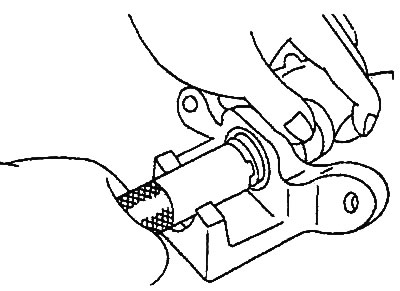
3. Remove the piston.


4. Remove the cuff as shown in the figure.
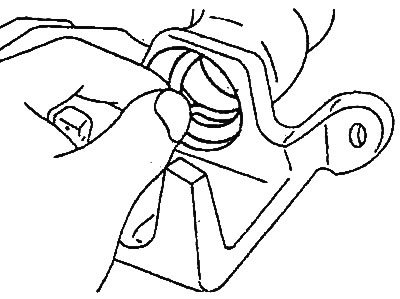
4. Remove the cuff as shown in the…


Examination


1. Clean the outer surface of the piston and the inner surface of the cylinder with brake fluid.

2. Check the brake cylinder for wear, damage and rust.

3. Check the inner diameter of the cylinder.
  • Nominal internal diameter: 34 mm

4. Check the piston surface for wear, damage and rust.

5. Check the brake pads for deformation and damage.

6. Check that the wear indicator pad is not damaged.

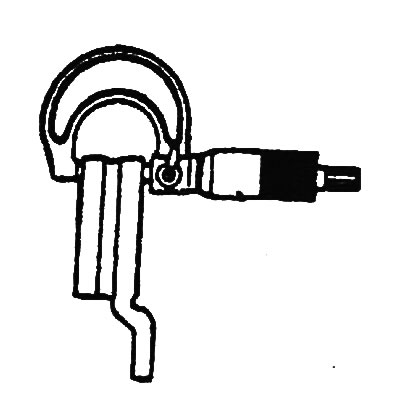
7. Using a micrometer, measure the thickness of the brake disc at eight points approximately every 45° at a distance of 10 mm from the outer edge of the disc.
  • Nominal thickness: 10 mm

Nominal thickness: 10 mm


If the thickness does not correspond to the technical data, replace the disk with a new one.

8. Check the outer diameter of the brake disc.
  • Brake disc outer diameter: 262 mm

Assembly


1. Assembly is carried out in the reverse order of disassembly.

2. When assembling, pay attention to the following operations:
  • a) Apply brake fluid to the piston seal, inner surface of the cylinder, piston dust boot and outer surface of the cylinder.
  • Brake fluid type: SAE J 1703 or FMVSS 116 DOT3 or DOT4
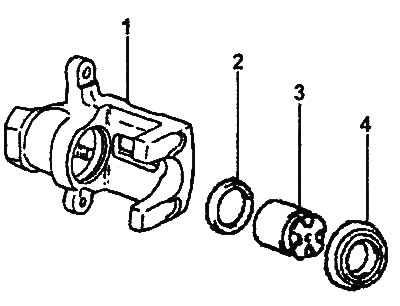
Disassembling the brake mechanism.

Disassembling the brake mechanism.

1 - caliper, 2 - cuff, 3 - piston, 4 - dust cover.


  • b) Apply sealant to the guide pins.
  • c) Align the marks as shown in the figure.
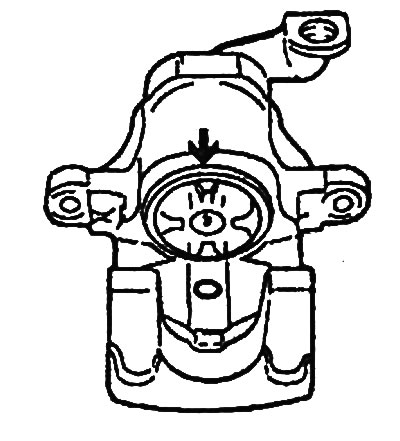
c) Align the marks as shown in the…


Installation


1. The brake mechanism is installed in the reverse order of removal; the tightening torques for the bolts and nuts are specified in the text describing the removal procedure.

2. After installation, bleed the brake system.
This article is available at russian, bulgarian, belarusian, ukrainian, serbian, croatian, romanian, polish, slovak, hungarian
This article has been reviewed by: Konstantin Smirnov
Add to social network:

Previous
Sonata 4: Brake system
Next

Rear drum brake mechanism
Front brake mechanism
Brake system lines
Rear axle load-sensing brake force distribution valve
Vacuum brake booster
Parking brake
ABS/EBD/TCS control unit
Front wheel speed sensors
Hydraulic diagram of ABS/EBD/TCS systems
Rear wheel speed sensors
We recommend other articles on the topic of Hyundai manuals:

Removal and installation the rear disc brake Hyundai Accent 3 (2005-2010)
Rear Disc Brake Pads — Removal and Installation Hyundai Elantra 1 (1990-1995, petrol)
Three-point rear seat center belt with inertia-reel locking… Hyundai Getz (2002-2011)
Rear brake pressure regulator Hyundai Santa Fe 2 (2007-2012, petrol)
Rear disc brake mechanism — device Hyundai Tucson 1 (2005-2010)
Rear brake pressure regulator Hyundai Matrix (2001-2010, petrol)

Link in different formats to this article

Visitor comments
No comments yet


How much will 50 + 46 ?


Sonata 4 (2001-2012, petrol) 
  • General information
  • User manual
  • Maintenance
  • Power unit
  • 2.0 and 2.4 liter engines
  • 2.7 liter engines
  • Engine overhaul
  • Cooling system
  • Intake and exhaust systems
  • Lubrication system
  • MFI fuel injection system
  • Engine electrical equipment
  • Transmission
  • Clutch
  • Mechanical gearbox
  • Automatic gearbox
  • Drive shafts
  • Chassis
  • Front suspension
  • Rear suspension
  • Steering
  • Brake system
  • Body
  • Exterior
  • Interior
  • Heater and air conditioner
  • Security systems
  • Electrical equipment
  • Troubleshooting
  • Electrical circuits
Sonata 3 (1993-1998) 
  • General information
  • Maintenance
  • Power unit
  • Engine repair I4 DOHC
  • Engine repair I4 SOHC
  • Engine repair V6 SOHC
  • Cooling system
  • Intake and exhaust system
  • Exhaust gas treatment
  • Fuel system
  • Transmission
  • Clutch
  • Mechanical gearbox
  • Automatic transmission KM-175
  • Automatic transmission F4A33
  • Chassis
  • Front suspension
  • Rear suspension
  • Steering
  • Brake system
  • Body
  • Body elements
  • Electrical equipment
  • Equipment and devices
HyundaiBook.ru © 2018-2026 · Mobile version · Sitemap: EN BG BY UA RS HR RO PL SK HU · Administration · Site search · Hyundai owners Accent 1 · Accent 2 · Accent 3 · Elantra 1 · Elantra 2 · Elantra 3 · Getz · Sonata 3 · Sonata 4 · Santa Fe 2 · Tucson 1 · Tucson 2 · Matrix ·
This site uses cookies to optimize its functionality. By continuing, you agree to our terms.