


Contents: Type, properties and volumes of…⇓ Recommended fuel ⇓ Low-emission gasoline ⇓ Recommendations for running in a new…⇓ Recommendations for choosing the…⇓ Air conditioning refrigerant ⇓
Type, properties and volumes of working fluids
Use of leaded gasoline and abuse of fuel additives may result in failure of the catalytic converter of exhaust gases, non-compliance with toxicity requirements of exhaust gases and engine failure. On diesel models, do not use additives for winter operation that increase fuel fluidity. Failure to comply with these requirements in the event of engine failure will not be covered by the manufacturer's warranty obligations for this vehicle.
Recommended fuel
Petrol engines: Use unleaded gasoline with an octane rating of at least 95 (research method).
Diesel engine: Use diesel fuel with a cetane number of at least 50.
Depending on the ambient temperature, operate your vehicle on summer or winter grade diesel fuel.
At temperatures above -7°C – summer grade fuel.
At temperatures below -7°C – winter grade fuel.
Attention! It is prohibited to fill the vehicle with liquid fuel intended for domestic heating boilers, gasoline and any flammable liquids except diesel fuel.
Warning! Using unsuitable fuel will cause serious engine damage.
Warning! Do not fill your car with summer grade diesel fuel if the ambient temperature is below -7°C. When cooled, paraffin crystals precipitate intensively in summer fuel, which clog the fuel filter. In this case, the engine may stop or work intermittently.
If unleaded super fuel is not available, fuel with an octane rating of 91 can be used, avoiding high engine loads and full vehicle loading, as well as driving in the mountains with a trailer or with a heavy load - this reduces engine power and torque. The detonation regulator automatically adjusts the ignition system depending on the type of fuel filled (its octane rating).
Note: Engines adjusted at the manufacturer to run on gasoline with an octane rating of AI-95 can be used without restrictions on AI-98 gasoline, but this will not lead to increased fuel economy or improved performance of the vehicle.
Low-emission gasoline
In order to reduce air pollution, Hyundai Motor Company recommends the use of gasoline containing special additives, which prevents the formation of deposits in the engine. This type of gasoline will ensure more efficient operation of the engine and emission control system.
Recommendations for running in a new car
A new car does not require any special operations for running in the car. However, the extension of service life, as well as improving fuel economy and maintaining high performance qualities of the new Hyundai car, contributes to compliance with the following rules during the first 2000 km of mileage.
Do not exceed the speed limit of 88 km/h.
While driving, keep the engine running at a speed between 2000 and 4000 min⁻¹.
Avoid sudden acceleration. Avoid sudden starts with the accelerator pedal fully depressed.
Avoid sudden braking during the first 300 km of driving.
Do not overload the engine (in other words, avoid driving slowly in too high a gear, shift into a lower gear). Avoid driving at a constant speed for long periods. On vehicles equipped with a catalytic converter, do not let the engine idle for more than 3 minutes. Avoid towing a trailer during the first 2,000 km (1,220 mi).
Recommendations for choosing the viscosity of motor oil (gasoline engines)
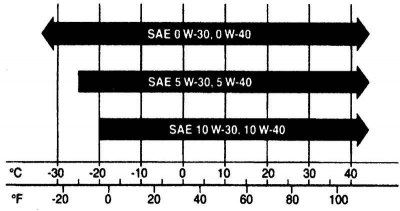
Fig. 1.4. Table of prevailing ambient air temperatures during the period until the next engine oil change
It is recommended to use motor oil with a viscosity of 5W-30; if such oil is not available, follow the diagram provided, taking into account the prevailing ambient temperatures.
Air conditioning refrigerant
Fill the air conditioning system of the vehicle with refrigerant HFC-134a (R-134a) or similar operating material, fully equivalent to the specified in its properties. Using another refrigerant will lead to serious damage to the air conditioning system and the need for a complete replacement of the system.
It is not recommended to release the refrigerant into the atmosphere. The refrigerant HFC-134a (R-134a), used in cars, does not have a harmful effect on the ozone layer of the atmosphere. However, the release of the refrigerant into the atmosphere may contribute to global warming to a small extent.
Attention! It is prohibited to use green-blue antifreezes/antifreezes containing silicate in the cooling system. It is not recommended to add any additives to the antifreeze (including for sealing the system and eliminating minor leaks).