

Contents: General information ⇓ Comprehensive battery check ⇓ Charging the battery ⇓ Checking the density of the…⇓
General information
The new car is equipped with a maintenance-free battery, which is completely sealed (except for a small ventilation hole in the cover), has no battery cell vent plugs and is maintenance-free (there is no need to add water to the battery electrolyte).
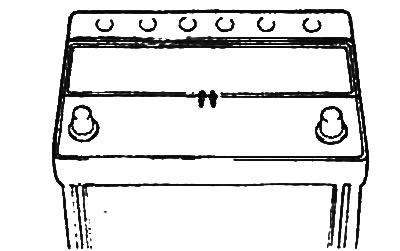
Table. Characteristics of standard batteries.
| Engine | 2.0 l/2.4 l | 2.7 l |
| Type | MF 60Ah | MF 68Ah |
| Capacity (not less than) 5-hour discharge 20-hour discharge | 48 Ah 60 Ah | 55 Ah 68 Ah |
| Peak current when cranking the crankshaft with the starter | not less than 550 A | not less than 540 A |
| Reserve capacity | 92 min. | 122 min. |
Note:
- Peak cranking current is the current generated by the battery for 30 seconds at 7.2 V and 17.8°C.
- Reserve capacity is the time during which the battery can supply a current of 25 A at a voltage of 10.5 V and a temperature of 26.7°C.
Comprehensive battery check
1. Visually check for cracks or other damage to the battery case that could cause electrolyte leakage. Determine the cause of the defect and eliminate it if necessary. Clean off rust with a solution of soda and water.
- a) If the cause of the defect cannot be determined and eliminated, replace the battery.
- b) If there are no cracks or other damage to the battery case, check the density of the electrolyte.
2. Determine the specific gravity of the electrolyte in the battery and the correction factor for the temperature of the electrolyte, then correctly select the appropriate value from the values below.
- a) If the density is below 1.10 g/cm³, slowly charge the battery with a current of 5 amperes for no more than 14 hours, then test the battery under load.
- b) If the density is within 1.10-1.22 g/cm³, recharge the battery. Pay special attention to the battery charging process and safety precautions when charging.
- c) If the density is higher than 1.22 g/cm³, check the battery under load.
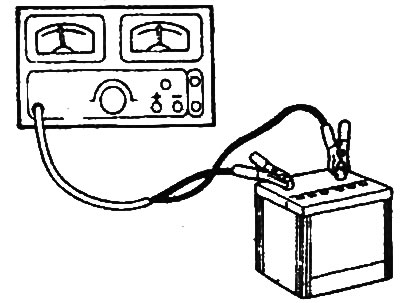
3. Check the battery under load. To do this, turn on a 200 A load for 15 seconds, measure the battery voltage and compare with the values below.
- a) If the voltage is above 9.6 V, the battery is normal.
- b) If the voltage is within 6.5 - 9.6 V, quickly charge the battery and check the battery again under load.
Note: If the battery voltage remains less than 9.6V after performing fast charging and load testing again, the battery should be replaced.
- c) If the voltage is below 6.5 V, the battery is faulty and must be replaced.
Charging the battery
1. When charging the battery, flammable and explosive gas is released under the battery cover. Do not smoke or use open flame near the battery that is being charged or has recently been charged.
2. Do not disconnect any live circuits near the terminals of a battery being charged. A spark may occur between the disconnected wires (in the open circuit) and cause an explosion. Keep flammable objects away from an open battery.
Table. Battery charging time.
| Density of electrolyte in battery | Charging method | |
| Slow (current 5A) | Fast (current 20 A) | |
| Below 1.10 | 14 hours | 4.0 hours |
| 1,1-1,13 | 12 hours | 3.0 hours |
| 1,13-1,16 | 10 hours | 2.5 hours |
| 1,16-1,19 | 8 hours | 2.0 hours |
| 1,19-1,22 | 6 hours | 1.5 hours |
| Above 1.22 | 4 hours | 1.0 hour |
Checking the density of the electrolyte
1. Checking the level and density of electrolyte in a conventional (serviced) battery.
- a) Check the electrolyte level, it should be between the minimum and maximum level marks. Add distilled water if necessary.
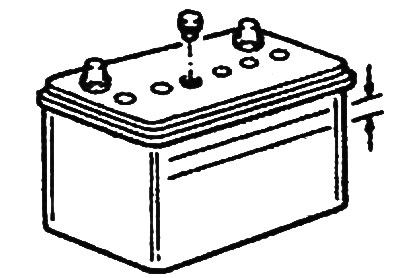
- b) Do not measure the specific gravity of the electrolyte with a hydrometer immediately after adding distilled water to the electrolyte. To ensure that the distilled water and electrolyte mix and achieve uniform specific gravity, either slowly charge the battery (at 5 A) for several minutes or leave the battery stationary for about an hour.
Note: If after charging the battery the electrolyte density does not meet the specifications, replace the battery.
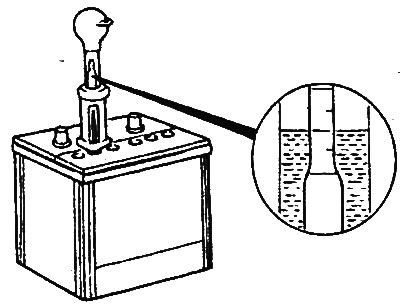
- c) Using a hydrometer and a thermometer, measure the density of the electrolyte in each cell of the battery.
- Nominal value: 1.22-1.29 (at 20°C)
Note: When the battery is fully charged, the electrolyte density should be 1.260-1.280 g/cm³ at a temperature of 26.7°C.
- d) Determine the difference in density between the battery banks. If the electrolyte density in any battery bank (one or more) differs from the average value by 50 points (0.05 g/cm³) or more, this is a sign of internal damage. In this case, the battery should be replaced.
2. Determination of the density correction based on the electrolyte temperature.
- a) The density of the battery electrolyte changes with temperature. Heating liquefies the solution and reduces the density of the electrolyte. Cooling thickens the solution and increases the density of the electrolyte.
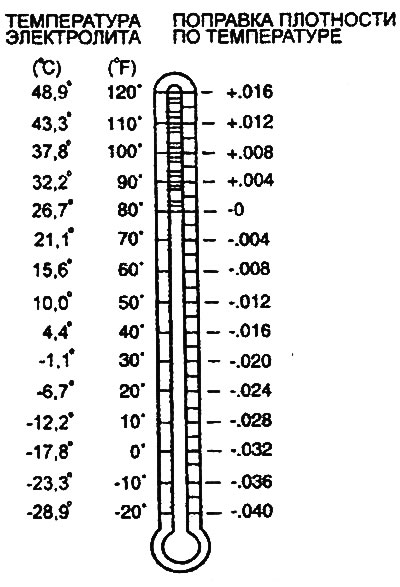
- b) If the actual temperature of the electrolyte deviates from the standard value, a correction must be made: 4 points (0.004 g/cm³) must be added to the density value for every 5.56°C of temperature above 26.7°C, or 4 points (0.004 g/cm³) must be subtracted for every 5.56°C of temperature below 26.7°C.
EXAMPLE: The hydrometer shows a density value of 1.280 g/cm³ and the thermometer shows an electrolyte temperature of -12.2°C (10°F). According to the figure provided, the measured density value should be reduced by 7 points (0.028 g/cm³).
Thus, the given value of the electrolyte density at 26.7°C will be 1.252 g/cm³.
1,280-0,028=1,252