


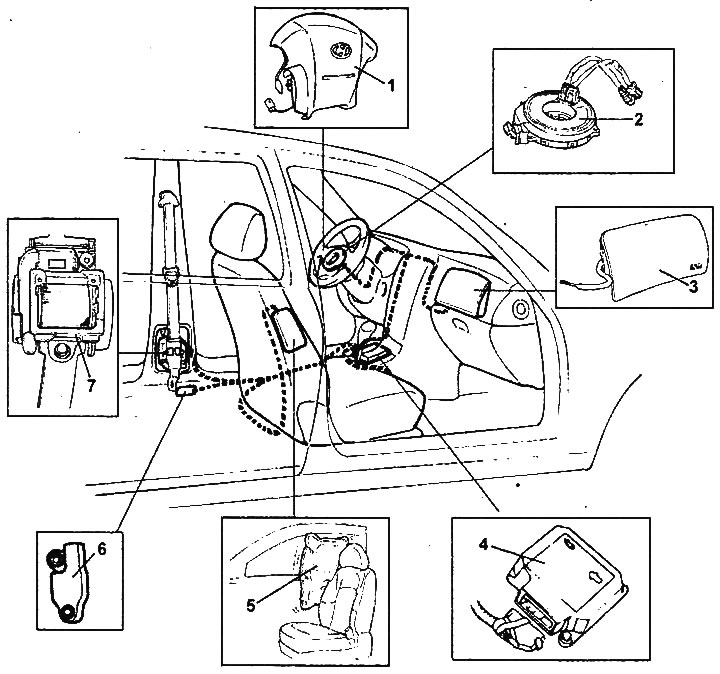
Location of SRS system components on the vehicle.
1 - Driver's front airbag module, 2 - Spiral wire, 3 - Passenger's front airbag module, 4 - SRS electronic control unit, 5 - Deployed side airbag, 6 - Side impact sensor, 7 - Seat belt pretensioner.
1. The Supplemental Restraint System (SRS) is designed to be used in conjunction with seat belts to enhance safety in crashes and reduce the risk of injury when front and side airbags deploy by keeping front occupants in their seats in the event of a frontal or side impact.
2. The SRS system consists of the following components:
- a) Inflatable airbags, each of which contains a module with a folded airbag and an inflating device (a gas generator with an electric igniter): the driver's front airbag (located in the center of the steering wheel), the front passenger's front airbag (located in the instrument panel on the passenger side), and the side airbags (located in the outer sidewalls of the front seat backs).
- b) Seat belt pretensioners for the driver and front passenger, each of which contains a gas generator with an electric igniter, a belt tensioner (an assembly with balls), an inertial locking mechanism and a load limiter (deformable at the maximum belt tension force).
- c) SRS electronic control unit (mounted under the front of the center console), which controls and diagnoses the system; the control unit has a built-in main impact sensor that activates the airbag module circuit in situations requiring airbag deployment, and a safety impact sensor (or deceleration sensor) that is triggered when it detects a vehicle deceleration value that exceeds the nominal value (an impact from the outside).
Note: a drop or surge in voltage in the on-board network does not lead to the SRS system being switched off, since the voltage value is regulated within acceptable limits by the voltage converter built into the SRS electronic control unit.
- d) Side impact sensors for the driver and passenger (located opposite the central body pillars) and frontal impact sensors operating as a deceleration sensor in constant mode with feedback from the SRS control unit.
- d) Seat belt switches, the OFF position of which prevents unnecessary deployment of the airbags and seat belt pretensioner in the event of an accident.
- e) A coiled wire connecting the steering wheel air bag module to the steering column wiring that allows the steering wheel to be turned while maintaining contact in this circuit.
- g) Wiring and connectors of the SRS system.
Note: The SRS wiring harness insulation is colored yellow (except for the front seat wiring) to distinguish it from the wiring of other vehicle systems.
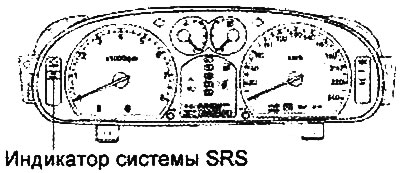
- c) SRS system indicator (located on the instrument cluster).
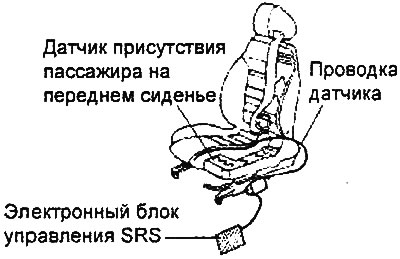
- i) Front seat passenger presence sensor. If the weight detected by the sensor is less than 15 kg, the front passenger airbag will not deploy in an accident.
3. On models with the ETACS system, the SRS electronic control unit has a built-in "Emergency Exit" function, which is used to unlock the door locks in the event of an accident.
4. Only qualified personnel are allowed to perform maintenance work on the Supplemental Restraint System (SRS) and related components. Before starting work, service personnel should carefully study this chapter.
This publication is based on information from the portal [HyundaiBook.ru]
Special care must be taken when servicing the SRS system to avoid injury or death to the service personnel (due to unintended deployment of the air bag and seat belt pretensioner) or the driver (due to inoperability of the SRS system due to improper service or repair).