


Contents: Checking the operation of the SRS…⇓ System diagnostics using a tester ⇓ Troubleshooting by diagnostic codes ⇓ Checking the component circuit ⇓
Checking the operation of the SRS indicator
1. If the SRS indicator flashes 6 times and then goes out after the ignition key is turned to the "ON" position for the first time, the indicator and SRS system are normal.
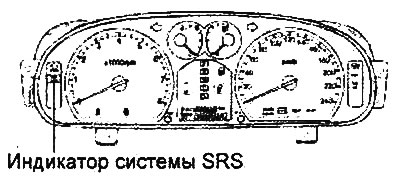 |
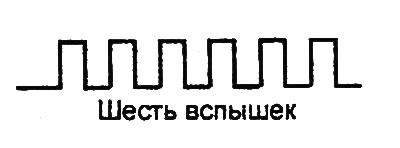
Normal state of the system. |
2. If the SRS indicator does not come on after the ignition is turned on, or is constantly on or flashing continuously, then the SRS system must be diagnosed.
Note: Even if the SRS control unit cannot function normally, the SRS indicator will remain on, indicating that there is no power supply voltage to the control unit from the ignition switch, no internal operating voltage of the SRS system, or no connection of the control unit connector.
3. Diagnostics using the SRS indicator:
- a) When the ignition is turned on and the engine is started: if the number of previously detected system faults is no more than 4, the SRS indicator will remain on continuously for 6 seconds and then go out.
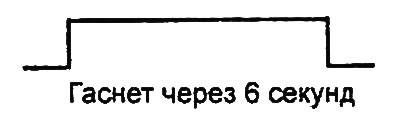
- b) When the ignition is turned on and the engine is started or the vehicle is moving: If the number of previously detected system failures is more than 5 or a current failure is detected, the SRS indicator will light continuously.
- Note: If the malfunction was intermittent and the malfunction symptom does not reappear, the SRS indicator will go out.
System diagnostics using a tester
1. Turn the ignition key to the "OFF" position.
2. Connect the tester to the standard diagnostic connector located under the front panel with driver's side.
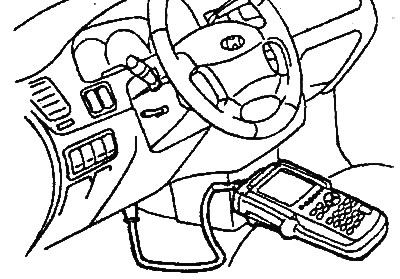
3. Turn the ignition switch to the "ON" position and turn on the tester.
4. Read the fault codes and perform diagnostics of the SRS system in accordance with the configuration of this vehicle model.
5. If fault codes are detected, replace the faulty system component, then clear the fault codes.
Caution: Never attempt to disassemble or repair any SRS system components.
6. If the tester determines that the system component is OK, although the fault code is present, then the fault may not be in the component, but in the SRS wiring or connector.
Troubleshooting by diagnostic codes
Code # B1111, B1112:
Battery voltage (too high or too low respectively).
Registration conditions: within 10 seconds the battery voltage is greater than 16 V or less than 10 V.
Note: If fault codes B1111 or B1112 are present, the SRS indicator lamp remains illuminated. If the battery voltage returns to normal, the SRS indicator lamp goes out automatically and the corresponding fault code is cleared.
Probable cause of the malfunction:
- 1. Battery.
- 2. Charging system.
- 3. Wiring or connector.
Codes B1346, B1347:
Driver frontal airbag circuit (resistance too high or resistance too low respectively).
Registration conditions: detected if the resistance in a given circuit is outside the acceptable range (too high (R > 6.0 Ohm) or too low (R < 0,9)).
Probable cause of the malfunction:
- 1. Driver's front airbag module (electric igniter).
- 2. SRS spiral wire.
- 3. SRS electronic control unit.
- 4. Wiring or connector.
Code B1348:
Short circuit in the driver's front airbag circuit to ground.
Registration conditions: a short circuit (to ground) was detected in the airbag module igniter circuit.
Probable cause of the malfunction:
- 1. Front airbag module (electric igniter).
- 2. SRS spiral wire.
- 3. SRS electronic control unit.
- 4. Wiring or connector.
Code B1349:
Short circuit in the driver's front airbag circuit to the battery voltage circuit.
Registration conditions: a short circuit (to battery voltage) was detected in the airbag module igniter circuit.
Probable cause of the malfunction:
- 1. Front airbag module (electric igniter).
- 2. SRS spiral wire.
- 3. SRS electronic control unit.
- 4. Wiring or connector.
Codes B1352, B1353:
Front passenger airbag circuit (resistance too high or resistance too low respectively).
Registration conditions: detected if the resistance in a given circuit is not within the acceptable range (too high (R > 4.2 Ohm) or too low (R < 1.0 Ohm)).
Probable cause of the malfunction:
- 1. Passenger front airbag module (electric igniter).
- 2. SRS electronic control unit.
- 3. Wiring or connector.
Code B1354:
Short circuit to ground in the front passenger airbag circuit.
Registration conditions: a short circuit (to ground) was detected in the airbag module igniter circuit.
Probable cause of the malfunction:
- 1. Passenger front airbag module (electric igniter).
- 2. SRS electronic control unit.
- 3. Wiring or connector.
Code B1355:
Short circuit in the front passenger airbag circuit to battery voltage.
Registration conditions: a short circuit (to battery voltage) was detected in the airbag module igniter circuit.
Probable cause of the malfunction:
- 1. Front airbag module (electric igniter).
- 2. SRS electronic control unit.
- 3. Wiring or connector.
Codes B1361, B1362:
Driver's seat belt pretensioner circuit (resistance too high or resistance too low, respectively).
Registration conditions: detected if the resistance in a given circuit is outside the acceptable range (too high (R > 4.7 Ohm) or too low (R < 0.9 Ohm)).
Probable cause of the malfunction:
- 1. Seat belt pretensioner (electric igniter).
- 2. SRS electronic control unit.
- 3. Wiring or connector.
Codes B1367, B1368:
Passenger seat belt pretensioner circuit (resistance too high or resistance too low respectively).
See codes B1361, B1362.
Codes B1363, B1369:
Short circuit in the seat belt pretensioner circuit (driver or passenger, respectively) to ground.
Registration conditions: a short circuit (to ground) was detected in the seat belt pretensioner ignition circuit.
Probable cause of the malfunction:
- 1. Seat belt pretensioner (electric igniter).
- 2. SRS electronic control unit.
- 3. Wiring or connector.
Code B1364, B1370:
Short circuit in the seat belt pretensioner circuit (driver or passenger, respectively) to the circuit with battery voltage.
Registration conditions: a short circuit (to battery voltage) was detected in the seat belt pretensioner ignition circuit.
Probable cause of the malfunction:
- 1. Seat belt pretensioner (electric igniter).
- 2. SRS electronic control unit.
- 3. Wiring or connector.
Codes B1378, B1379:
Driver side airbag circuit (resistance too high or resistance too low respectively).
Registration conditions: it was found that the resistance in this circuit is not within the acceptable range (too high (R > 4.2 Ohm) or too low (R < 1.0 Ohm)).
Probable cause of the malfunction:
- 1. Side airbag module (electric igniter).
- 2. SRS electronic control unit.
- 3. Wiring or connector.
Code B1380, B1384:
Short circuit in the side airbag circuit (driver or passenger, respectively) to ground.
Registration conditions:a short circuit (to ground) was detected in the airbag module igniter circuit.
Probable cause of the malfunction:
- 1. Side airbag module (electric igniter),
- 2. SRS electronic control unit.
- 3. Wiring or connector.
Code B1381, B1385:
Short circuit in the side airbag circuit (driver or passenger, respectively) to the circuit with battery voltage.
Registration conditions: a short circuit (to battery voltage) was detected in the airbag module igniter circuit.
Probable cause of the malfunction:
- 1. Side airbag module (electric igniter).
- 2. SRS electronic control unit.
- 3. Wiring or connector.
Codes B1382, B1383:
Passenger side airbag circuit (resistance too high or resistance too low respectively).
Material was obtained from an official resource: hyundaibook
See codes B1378, B1379.
Code B1395:
Malfunction in the side impact sensor circuit.
Registration conditions: a fault has been detected in the side impact sensor circuit.
Probable cause of the malfunction:
- 1. Side impact sensor.
- 2. SRS electronic control unit.
- 3. Wiring or connector.
Code B1400, B1409, B1414:
Driver side impact sensor (sensor malfunction, data bus communication not possible or incorrect sensor data ID respectively).
Registration conditions:a fault has been detected in the side impact sensor circuit, communication with the sensor via the data bus is not possible, or the sensor data block identifier does not match the template.
Probable cause of the malfunction:
- 1. Side impact sensor.
- 2. SRS electronic control unit.
- 3. Wiring or connector.
Code B1401, 1404:
Short circuit in the side impact sensor circuit (driver or passenger, respectively) to ground.
Registration conditions: a short circuit (to ground) was detected in the driver's side impact sensor circuit.
Probable cause of the malfunction:
- 1. Side impact sensor.
- 2. SRS electronic control unit.
- 3. Wiring or connector.
Code B1402, 1405:
Short circuit in the side impact sensor circuit (driver or passenger, respectively) to the circuit with battery voltage.
Registration conditions:a short circuit (to battery voltage) was detected in the passenger side impact sensor circuit.
Probable cause of the malfunction:
- 1. Side impact sensor.
- 2. SRS electronic control unit.
- 3. Wiring or connector.
Code B1403, B1410, B1415:
Passenger side impact sensor (sensor malfunction, data bus communication not possible or incorrect sensor ID respectively).
See codes B1400, B1409, B1414.
Code B1406, B1407:
Front seat passenger presence sensor (sensor malfunction or communication via data bus impossible, respectively).
Registration conditions: a malfunction is detected in the front seat occupant presence sensor circuit or communication with the sensor via the data bus is not possible.
Probable cause of the malfunction:
- 1. Front seat passenger presence sensor.
- 2. SRS electronic control unit.
- 3. Wiring or connector.
Code B1511, B1513:
Short circuit in the seat belt switch circuit (driver or passenger, respectively) to the circuit with battery voltage.
Registration conditions:a short circuit (to the circuit with battery voltage) was detected in the switch circuit.
Probable cause of the malfunction:
- 1. Safety belt release switch.
- 2. SRS electronic control unit.
- 3. Wiring or connector.
Code B1S12, B1514:
Short circuit in the circuit of the unfastened seat belt switch (driver or passenger, respectively) to ground.
Registration conditions: a short circuit (to ground) was detected in the switch circuit.
Probable cause of the malfunction:
- 1. Seat belt buckle switch.
- 2. SRS electronic control unit.
- 3. Wiring or connector.
Codes B1515, B1516:
Malfunction of the seat belt switch (driver or passenger respectively)
Registration conditions:seat belt sensor malfunction detected
Probable cause of the malfunction:
- 1. Seat belt sensor.
- 2. Wiring or connector.
Codes В1620, В1650, В1651, В1652, В1657:
SRS electronic control unit.
- B1620 - Internal failure of the electronic control unit SRS;
- B1650 - Recording of the deployment of the front airbag;
- B1651 - Driver's side airbag deployment record;
- B1652 - Passenger side airbag deployment record;
- B1657 - command to operate the seat belt pretensioner;
Registration conditions: the SRS electronic control unit's hardware safety circuit is not activated or a failure has been detected in one of the following system parameters that must be checked periodically:
- a) Functional readiness of the transistors activating the electric igniter control circuit.
Note: If the SRS electronic control unit's hardware safety circuit is not activated, the SRS indicator lamp will illuminate.
- b) Sufficient electrical power reserve for operation of SRS system components.
- c) Functionality of the safety sensor: detection of a faulty circuit short circuit.
- d) Reliability of signals from the built-in acceleration sensor.
- d) Functionality of the SRS system components.
Probable cause of malfunction: SRS electronic control unit.
Code B2500:
SRS indicator malfunction.
Registration conditions: if the SRS indicator starts flashing 6 seconds after the engine is started.
Probable cause of the malfunction:
- 1. Fuses.
- 2. Indicator in the instrument cluster.
- 3. Wiring or connector.
Checking the component circuit
1. Preliminary operations:
- a) Turn off the ignition.
- b) Disconnect the cable from the negative battery terminal and wait at least 30 seconds.
- c) Remove the driver's front airbag module.
- d) Disconnect the wiring connectors from the passenger front air bag module, side air bag modules, seat belt pretensioners, side impact sensors, frontal impact sensors, and front seat occupant sensor.
- d) Disconnect the SRS electronic control unit connector.
2. If there is a fault code corresponding to a short circuit:
- a) Check the resistance and voltage (no short circuit to ground or power supply circuit) between the H(+) terminal of the connector on the component side and the body ground. If the check result is normal, check the component using a tester.
Nominal value:
- Resistance: ∞ (circuit open)
- Voltage: 0 V
- b) If the test result is not normal, replace the wiring. For the driver's front airbag, check the SRS coil wire.
3. If there is a fault code corresponding to an open circuit or abnormal resistance:
Caution: The igniter circuit (airbag module or seat belt pretensioner) can only be tested using a special simulator connected to the connector instead of the component. Do not attempt to measure the igniter resistance directly.
Nominal values for the electric igniter circuit (tested with a simulator):
- Driver Front Airbag Module: 1.6-4.1 Ohm
- Passenger Front Airbag Module: 1.8 -2.8 Ohm
- Side airbag module: 1.8 - 2.8 ohms
- Seat belt pretensioner: 1.8-3.1 Ohm
- Seat belt pretensioner lock:
- Belt fastened: 3600-4400 Ohm
- Belt not fastened: 900-1100 Ohm
- Front seat occupant sensor: 50 kOhm (when the weight detected by the sensor is more than 15 kg)