

Warning: Accidental deployment of the airbag could result in serious injury, so perform only the operations and use only the tools specified in this chapter.
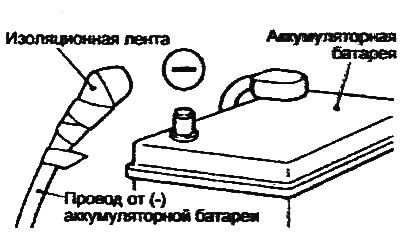
1. When performing work on the SRS system, wait at least 30 seconds after turning the ignition switch to the "LOCK" position and disconnecting the negative battery cable before proceeding with further work.
Caution: The SRS system is designed to maintain sufficient voltage (standby power) for a short period of time (at least 150 ms) to deploy the air bags and seat belt pretensioners if power from the battery is lost as a result of an accident.
Note: After disconnecting the wire from the negative terminal of the battery, the memory of some electronic devices (clock, audio system, etc.) will be erased. Therefore, before starting work, write down the basic settings from the memory of the audio system. After completing the work, restore the basic settings of the audio system to their original position and adjust the values of the electronic clock.
2. Since the symptoms of a malfunction of the SRS system are difficult to detect, the main source of information about the system when troubleshooting are the fault codes.
3. When troubleshooting the SRS system, always check the trouble codes before disconnecting the negative battery cable.
4. Never install SRS components from another vehicle. When replacing system components, use only new genuine spare parts.
5. After the airbags or seat belt pretensioners have deployed, it is necessary to replace the deployed system components and the SRS electronic control unit with new ones.
Attention:
- An SRS component (airbag or seat belt pretensioner) can only deploy once. Make sure the component is replaced after deployment.
- When handling a deployed seat belt pretensioner, wear protective goggles and gloves. If the contents of the fuse come into contact with your skin, wash the affected area immediately with soap and water.
6. Never attempt to disassemble the air bag module, seat belt pretensioner, coil wire, and SRS wire harness as they cannot be repaired or reused.
Caution: The airbag module contains a toxic and flammable substance.
7. Do not attempt to probe the air bag module or belt pretensioner with electrical instruments (such as measuring resistance) or otherwise tamper with SRS system components.
Warning: When measuring the resistance of the component's electric igniter circuit with a tester, it may be triggered unintentionally.
8. If any SRS component has been dropped or hit by other objects, or if cracks, dents, deformation, corrosion or other defects are found on the housing, bracket or connector, replace the component with a new one.
9. Keep air bag modules and belt pretensioners away from water, oil, and fuel. Do not allow the air bag module and belt pretensioner to reach temperatures above 93°C.
10. Store SRS components temporarily removed from the vehicle in a clean, dry place away from electrical equipment. The airbag module should be stored on a flat, horizontal surface with the protective pad (soft side) facing up. Do not place any foreign objects on these parts or store them stacked on top of each other.
11. If the vehicle is equipped with front seat side airbags, then:
- a) Do not install additional equipment on or near the side air bag module.
- b) Do not apply significant force to the side of the seat back.
- c) Before driving, do not cover the seats with any additional covers, as installing additional or non-original covers reduces the effectiveness of the side airbag.
12. When performing work in areas where SRS system components are installed (even if this work is not directly related to SRS system components), the following requirements must be observed:
- a) When removing or installing parts, do not subject the SRS system components to any impact or shock.
Caution: Do not place any objects on the air bag module or seat belt pretensioner.
- b) The SRS components cannot withstand temperatures above 93°C (SRS control unit, air bag modules, coil wire, side impact sensors and seat belt pretensioners), so remove the above components before baking the vehicle after painting.
- c) Before carrying out welding work on the vehicle, do not forget to disconnect the wire from the negative terminal of the battery, as well as the connectors of the airbag modules and seat belt pretensioners.
- d) When the ignition is on, avoid striking the body in the area where the SRS electronic control unit or side impact sensors are installed with a hammer or similar objects. Otherwise, this may cause unexpected activation of the SRS components during maintenance and repair.
- d) Turn off the ignition and disconnect the cable from the negative terminal of the battery before performing work involving the use of a pneumatic or impact tool, welding parts or removing heavy vehicle components (seats, instrument panel, etc.).
- e) When removing and installing parts, do not allow the SRS wiring to be pinched. To avoid damaging the connector, do not apply significant force when disconnecting the SRS component connector.
- g) If it is necessary to remove the steering gear, set the front wheels to the straight-ahead position and remove the key from the ignition switch.
13. After completing work on the SRS system or work in areas where SRS components are installed, check the system using the SRS indicator. In some cases, the SRS indicator may indicate a malfunction in other circuits of the vehicle systems. Therefore, if the SRS indicator lights up, make sure that the trouble codes are cleared with a tester immediately after repairing or replacing defective parts, including the fuse.
Warning labels
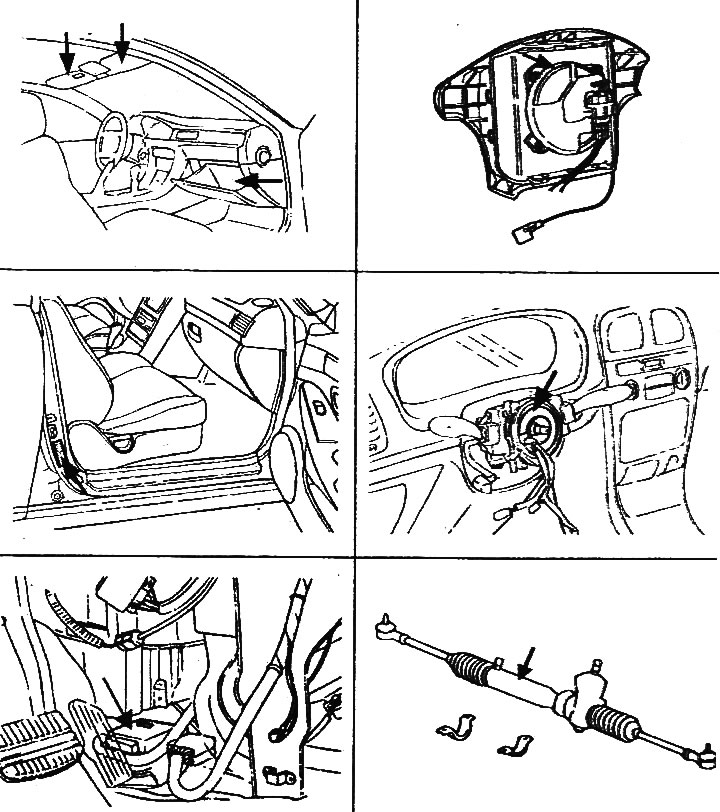
All SRS components and related components on the vehicle have appropriate labels describing maintenance requirements and safety precautions. The location of the labels is shown in the figure.