


Contents: Driver and front passenger airbag ⇓ Functions and elements of the SRS…⇓ Front passenger airbag switch…⇓ Disabling and enabling the front…⇓ Side airbags ⇓ Upper side impact airbag ⇓ Maintenance of the additional…⇓
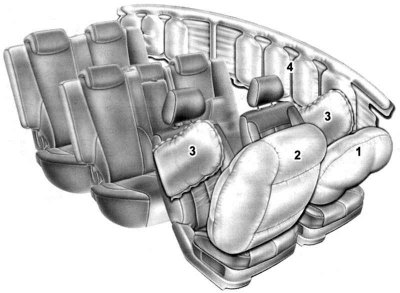
Fig. 1.173. Additional passive safety system: 1 – driver"s front airbag; 2 – front passenger airbag; 3 – front side airbags; 4 – Upper side airbags
Driver and front passenger airbag
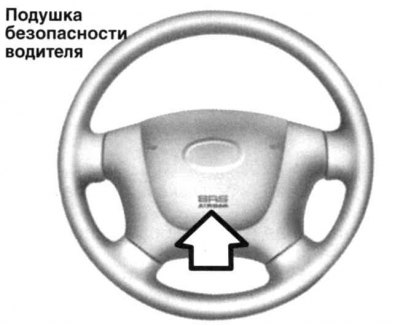
Fig. 1.174. Driver's airbag
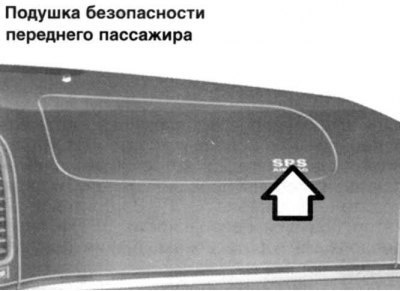
Fig. 1.175. Front passenger airbag
The car is equipped with an additional passive safety system (airbags) SRS. The presence of this system can be identified by the inscription "SRS AIR BAG" on the airbag cover in the steering wheel and on the panel trim on the front passenger side above the glove compartment.
The SRS supplemental passive safety system from Hyundai consists of airbags installed under the pads in the middle of the steering wheel and in the panel on the front passenger side above the glove compartment. The task of the SRS supplemental passive safety system (airbags) is to provide additional safety for the driver or front passenger in the event of a frontal impact of medium or high force.
Note: Be sure to read the SRS information on the labels located on the back of the driver's side sun visor and inside the glove compartment.
Functions and elements of the SRS system
The Supplemental Restraint System (SRS) includes the following components:
- driver's front airbag assembly;
- front passenger front airbag assembly;
- sRS (SRI) warning light;
- sRS (supplemental restraint system) electronic control unit (SRSCM).
The SRS (Supplemental Restraint System) Control Module (SRSCM) continuously monitors all system components when the ignition switch is in the "ON" position and determines whether a frontal or near-frontal impact has been severe enough to deploy the air bags.
The SRS indicator light (SRI) on the instrument cluster flashes for approximately 6 seconds after the ignition switch is turned to the "ON" position or after the engine is started, and then goes out.
The air bags are located in the center of the steering wheel and in the panel opposite the front passenger seat above the storage compartment. When the SRS (Supplemental Restraint System) Control Module (SRSCM) detects a frontal impact of sufficient force, it automatically deploys the air bags.
During deployment, the airbag, which expands when inflated by gas, knocks out the cover, which breaks along a special seam.
A fully deployed airbag, in combination with a properly fastened seat belt, slows the forward motion of the driver or front passenger, thereby reducing the risk of injury to the head and chest.
Once filled with gas, the airbag immediately begins to deflate, providing the driver with forward visibility.
Front passenger airbag switch ("ON/OFF")
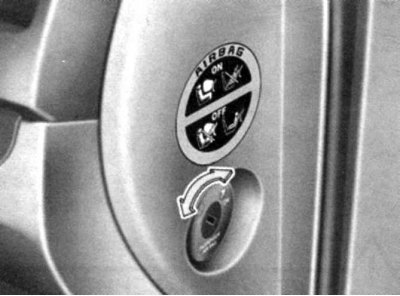
Fig. 1.176. Front passenger airbag switch
If the front passenger seat is unoccupied or a child restraint system (child seat) is installed on it, the airbag for this seat can be temporarily deactivated using the "ON/OFF" switch (Fig. 1.176). If, in exceptional cases, a rear-facing child seat is required on the front seat, the passenger seat airbag must be deactivated to ensure the child's safety.
Disabling and enabling the front passenger airbag
To temporarily disable the front passenger airbag, insert the main key into the front passenger airbag ON/OFF switch, which is located on the right side of the dashboard, and turn it to the OFF position. The airbag OFF indicator will come on and remain on until the airbag is activated.
To turn on the front passenger airbag, insert the main key into the airbag ON/OFF switch and turn it to the ON position. The airbag OFF indicator will go out.
Note: Do not install a child seat in the front passenger seat if the front passenger airbag activation switch is in the "ON" position, i.e. the airbag is activated.
Note: In case of emergency, it is permissible to install a child seat on the front passenger seat if the front passenger airbag activation switch is in the "OFF" position, i.e. the airbag is deactivated.
Caution! If the front passenger airbag switch is not working properly, the warning light on the instrument panel will come on. In addition, if the warning light does not come on, the passive restraint system control unit will reconnect this airbag and it will deploy in a frontal impact, even if the "ON/OFF" switch is set to the "OFF" position.
Caution: If the air bag warning light does not come on when the ignition switch is turned to the "ON" position, or if it comes on while the vehicle is moving, immediately contact an authorized Hyundai dealer to have the front passenger air bag switch, pre-tensioner seat belts, and air bags checked.
Side airbags
The vehicle is equipped with side airbags for each front seat. The purpose of the side airbag is to provide protection for the driver and front passenger in addition to the seat belts. Side airbags are designed to deploy only in some cases of side impacts, depending on the force and angle of the impact, the speed of the vehicle, and the location of the impact. Side airbags are not designed to deploy in all cases of side impacts.
Upper side impact airbag
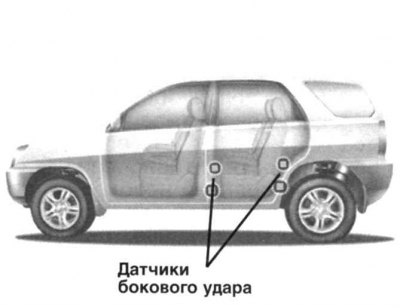
Fig. 1.177. Location of side impact sensors
Upper side impact airbags are installed along the vehicle's roof rails on both sides above the front and rear doors. They are designed to protect the heads of occupants of the front and rear outboard seats in certain side impacts.
Upper side impact airbags are designed to deploy only in certain types of side impacts, depending on the force, direction, speed and location of the impact. They are not designed to cover all types of side impacts, frontal or rear impacts, and will not deploy in most rollovers.
Maintenance of the additional passive restraint system SRS (airbag system)
The SRS additional passive restraint system is non-serviceable and does not have components or parts that can be safely serviced by yourself. If the SRS indicator lamp (SRI) does not light or lights up constantly, you should immediately contact an authorized Hyundai dealer to have the SRS passive restraint system checked.
Any work on or near the SRS (airbag) components, such as removal, installation, repair, or any work on the steering wheel, must be performed by qualified personnel only. Incorrect work on the components (parts) or wiring of the SRS (airbag) components may result in serious injury.