
HyundaiBook.ru
Repair Chevrolet Repair Honda Repair Toyota Repair Land Rover Repair VAZ Repair Renault Repair Nissan
English Русский
Български
Беларускі
Український
Српски
Hrvatski
Română
Polski
Slovenský
Magyar
ArticlesSitemapContacts  


  Accent   Elantra   Getz   Grandeur   Sonata   Santa Fe   Tucson   Others
Getz (2002-2011)
  • Main
  • Getz
  • 1 (2002-2011)
  • Power unit
  • Lubrication system
  • Oil pump for 1.1 and 1.3 l engines — removal and installation

Oil pump for 1.1 and 1.3 l engines — removal and installation (Hyundai Getz 1)

0
Contents: Removal ⇓ Examination ⇓ Installation ⇓

Removal


1. Remove the timing belt.
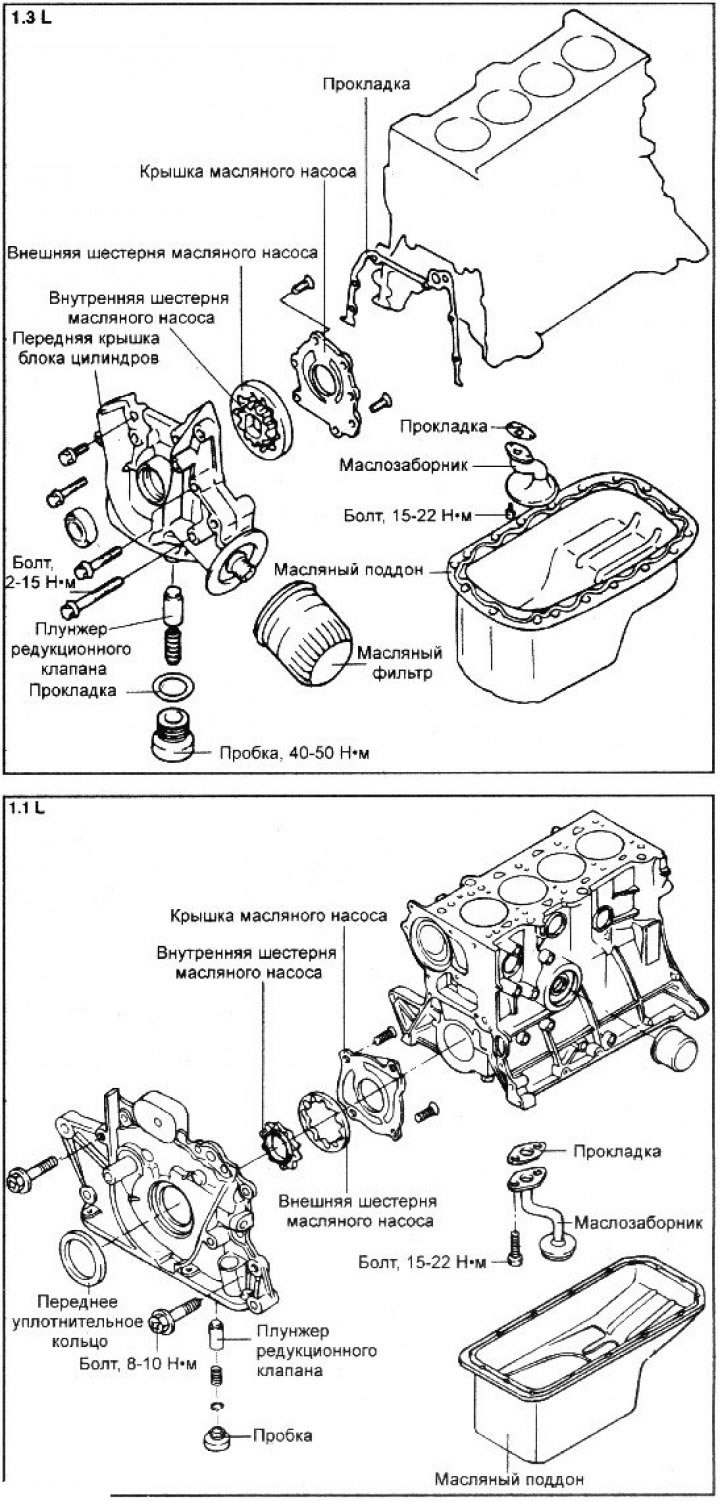
1. Remove the timing belt.


2. Remove all oil pan mounting bolts.

3. Remove the oil pan.

4. Unscrew 2 bolts and remove the mesh oil filter with the oil intake pipe.

5. Remove the front cover.

6. Remove the oil pump cover.

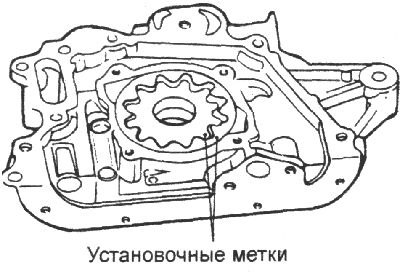
7. Remove the oil pump inner and outer gears from the front cover. The gears have alignment marks. The pump inner and outer gears must be installed as shown in the figure.
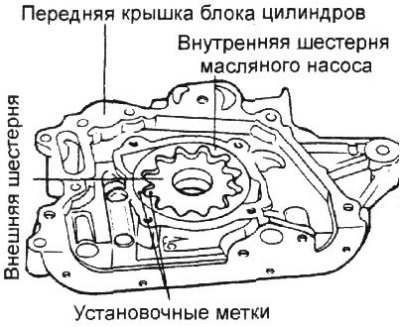
7. Remove the oil pump inner and outer…


8. Unscrew the plug of the pressure reducing valve and remove the spring and plunger.

Examination


1. Check the oil pan for cracks or damage and replace it if necessary.

2. Check the oil filter mesh for cracks or damage and replace it if necessary.


3. Check the front cover for wear or damage where it contacts the oil pump gears and replace it if necessary.

4. Check the oil pump gear teeth for wear or damage.

5. Using a feeler gauge, measure the clearance between the outer gear of the oil pump and the socket in the pump housing.
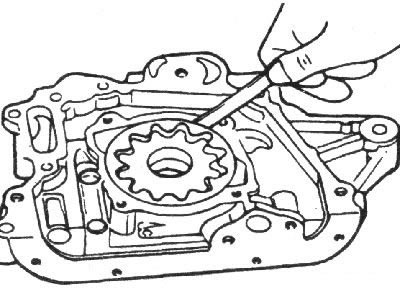
5. Using a feeler gauge, measure the…


Radial clearance between the outer diameter of the outer gear and the socket in the pump body, mm:
  • 1.3L engine: 0.12–0.18
  • 1.1L engine: 0.10–0.18

6. Use a feeler gauge to measure the gap between the teeth of the oil pump gears.
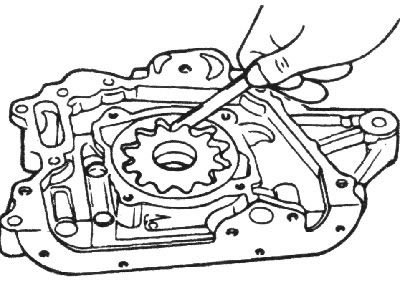
6. Use a feeler gauge to measure the…


Clearance between oil pump gear teeth, mm:
  • 1.3L engine: 0.025–0.069
  • 1.1L engine: 0.06–0.18

7. Check the clearance between the end of the outer gear and the plane of the pump body.
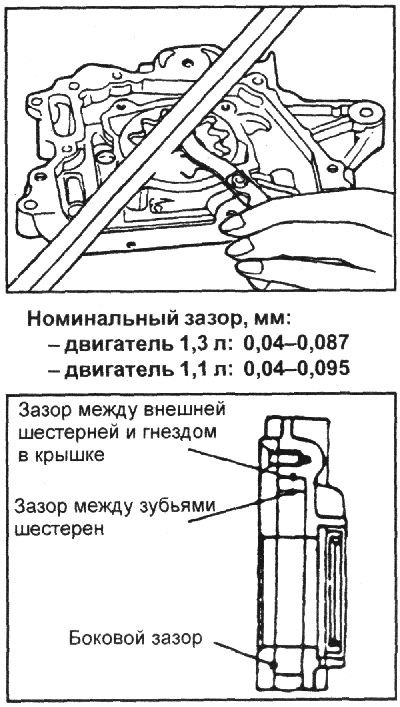
7. Check the clearance between the end…


8. Check the front oil seal for wear or damage to the sealing lips and replace it if necessary.


9. Check the sealing lip for deterioration. Replace the oil seal if necessary.

Installation


1. Install the outer and inner gears of the oil pump into the front cover, after aligning the installation marks.

2. Install the oil pump cover and secure it with bolts. After tightening the bolts, make sure the gears turn easily and smoothly.
2. Install the oil pump cover and…


Tightening torque: 8–12 Nm

3. Install the relief valve plunger, spring and screw in the plug, tightening it to the required torque. Before installation, lubricate the relief valve with engine oil.

[The original version is stored on the website HyundaiBook.ru]

Tightening torque:
  • 1.3L engine: 40–50 Nm
  • 1.1L engine: 20–30 Nm

4. Install the 09231-2210 (jig) front crankshaft seal installation tool onto the crankshaft nose. Apply engine oil to the outside of the jig and manually push the new seal over the jig until it contacts the front crankshaft cover. Install only a new seal.
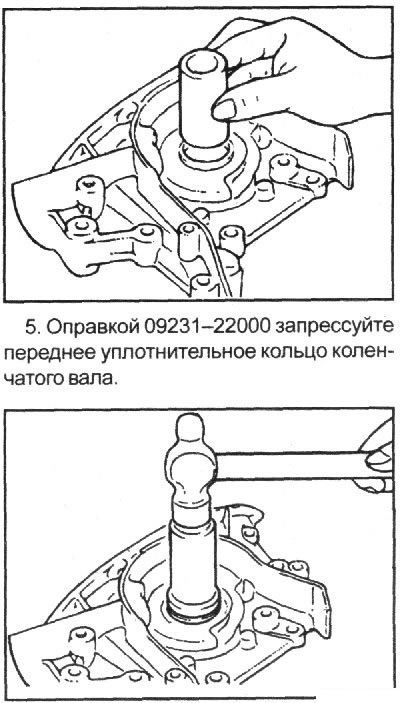
4. Install the 09231-2210 (jig) front…


6. Install the timing belt crankshaft pulley, timing belt and accessory drive crankshaft pulley.


7. Install the oil filter.

8. Clean the mating surfaces of the oil pan and cylinder block from any remaining old gasket.

9. Apply a continuous bead of sealant into the oil pan flange groove. Around the bolt holes, place the sealant on the inside.

Attention!
  • 1. The thickness of the sealant layer should be about 4 mm.
  • 2. After applying the sealant, install the oil pan within 15 minutes.


10. Install the oil pan onto the cylinder block and secure with bolts.

Tightening torques: 6–8 Nm
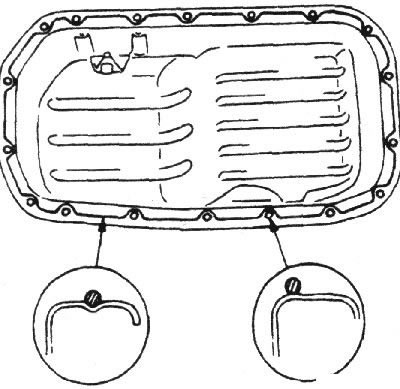
Tightening torques: 6–8 Nm
This article is available at russian, bulgarian, belarusian, ukrainian, serbian, croatian, romanian, polish, slovak, hungarian
This article has been reviewed by: Konstantin Smirnov
Add to social network:

Previous
Getz: Lubrication system
Next

Replacing the oil filter
Engine oil change
Checking the engine oil level
Selecting Motor Oil for Gasoline Engines
Features of the lubrication system
Lubrication System Specifications
Oil pump for 1.5 and 1.6 l engines — removal and installation
Oil pressure sensor
We recommend other articles on the topic of Hyundai manuals:

Front cover, oil pump — removal, inspection and installation Hyundai Accent 1 (1994-1999)
Camshaft drive belt and balance shaft drive belt for 1.6 and 1.8… Hyundai Elantra 1 (1990-1995, petrol)
Front Cover, Oil Pump and Balance Shafts — Removal and… Hyundai Sonata 3 (1993-1998)
Removal, checking and installation the coolant pump Hyundai Santa Fe 2 (2007-2012, petrol)
Fuel pump — removal and installation Hyundai Tucson 1 (2005-2010)
Removal, checking and installation the oil pump Hyundai Matrix (2001-2010, petrol)
Link in different formats to this article

Visitor comments
No comments yet


How much will 40 + 43 ?


Getz (2002-2011) 
  • User manual
  • Control devices
  • Heating and ventilation
  • Audio system
  • Car driving
  • Faults en route
  • Maintenance
  • Technical information
  • Power unit
  • Engine repair 1.1/1.3 l
  • Engine repair 1.5/1.6 l
  • Lubrication system
  • Cooling system
  • Fuel system
  • Exhaust system
  • Ignition system
  • Transmission
  • Clutch
  • Mechanical gearbox
  • Automatic gearbox
  • Drive shafts and axles
  • Chassis
  • Suspension and wheels
  • Steering
  • Brake system
  • Body
  • Exterior (external elements)
  • Interior (internal elements)
  • Air conditioning and heater
  • Electrical equipment
  • Equipment and devices
  • Power devices
  • Electrical circuits
HyundaiBook.ru © 2018-2026 · Mobile version · Sitemap: EN BG BY UA RS HR RO PL SK HU · Administration · Site search · Hyundai owners Accent 1 · Accent 2 · Accent 3 · Elantra 1 · Elantra 2 · Elantra 3 · Getz · Sonata 3 · Sonata 4 · Santa Fe 2 · Tucson 1 · Tucson 2 · Matrix ·
This site uses cookies to optimize its functionality. By continuing, you agree to our terms.