


Removal
1. Remove the front wheel.
2. Remove the hollow bolt and disconnect the brake hose from the caliper.
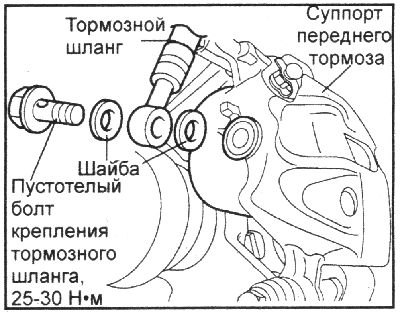
Attention!
- Brake fluid dissolves paint, plastic and wire insulation, so if the fluid accidentally gets on the paintwork or its components, wash them with plenty of water.
- To prevent brake fluid leakage, wrap the hose connections with rags or napkins.
3. Loosen the caliper cylinder mounting bolt.
4. Remove the caliper and brake pads.
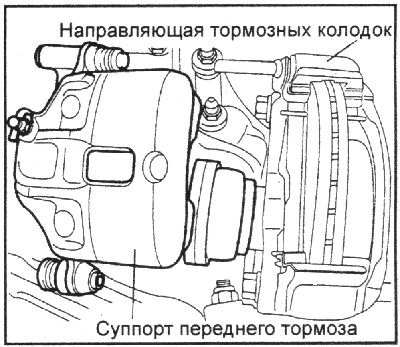
5. Loosen the bolts securing the shoe guide to the steering knuckle.
6. Remove the brake shoe guide.
Examination
1. Check the caliper for wear, damage, cracks and rust.
2. Check the piston for rust, damage, cracks and wear on the outer surface.
3. Check the bushing and guide pin for damage and rust.
4. Check the springs and protective covers for damage.
5. Check the brake shoe guide for wear, damage, cracks and rust.
Attention!
- 1. Do not use sandpaper to clean the piston surface.
- 2. All rubber parts must be replaced with new ones.
6. Measure the thickness of the brake disc. Using a dial indicator, measure the runout of the brake disc at a short distance from the outer edge.
Brake disc thickness:
- Nominal: 19 mm
- Minimum allowable: 17 mm
- Maximum permissible runout: 0.04 mm
- Maximum permissible difference in brake disc thickness: 0.01 mm
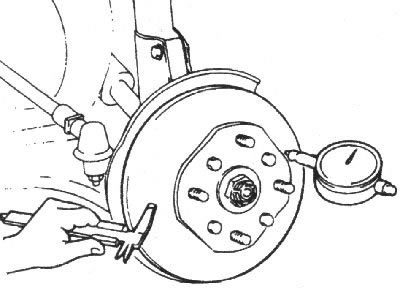
Notes
1. Using a micrometer, measure the thickness of the disc in eight places, approximately every 45° at a distance of 10 mm from the outer edge of the disc.
2. Use a dial indicator to check the runout of the brake disc. Attach the dial indicator to any convenient place and, by turning the brake disc, determine its runout at a distance of 5 mm from the outer edge.
7. Determine the value of axial runout of the working surface of the disk as the difference between the largest and smallest runout values.
Disassembly
1. Remove the piston dust cover.
2. Use compressed air to push the piston out of the caliper cylinder.
Note.
- 1. When pushing the piston out with compressed air, do not place your fingers in front of the piston.
- 2. Be careful, as the brake fluid will be blown out of the channel by compressed air along with the piston.
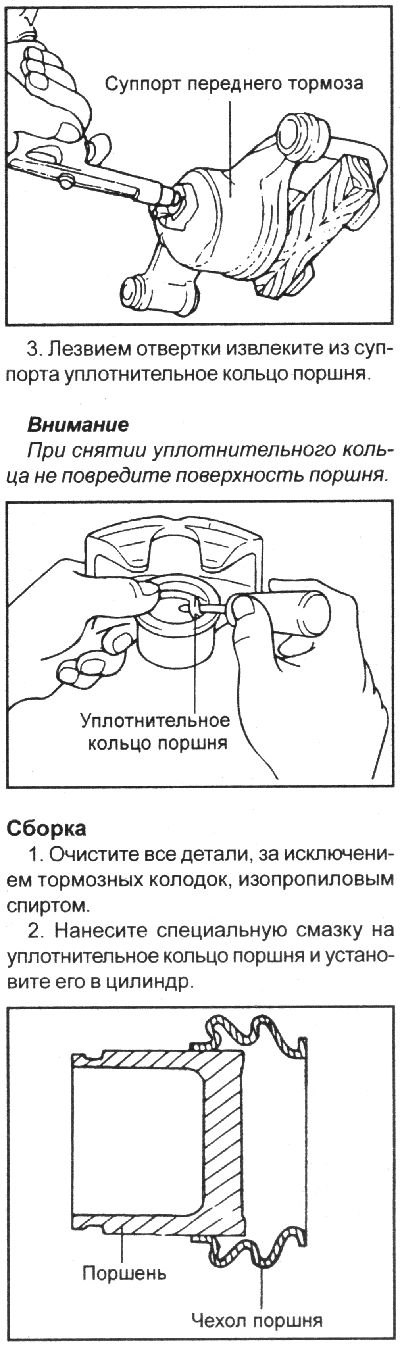
3. Assemble the piston and piston boots in the following order.
- 1) Apply special grease to the walls of the caliper cylinder, the outer surface of the piston and the piston boot;
- 2) Install the piston boot as shown in the figure;
- 3) Insert the piston boot into the inner groove of the caliper and push the piston into the caliper.
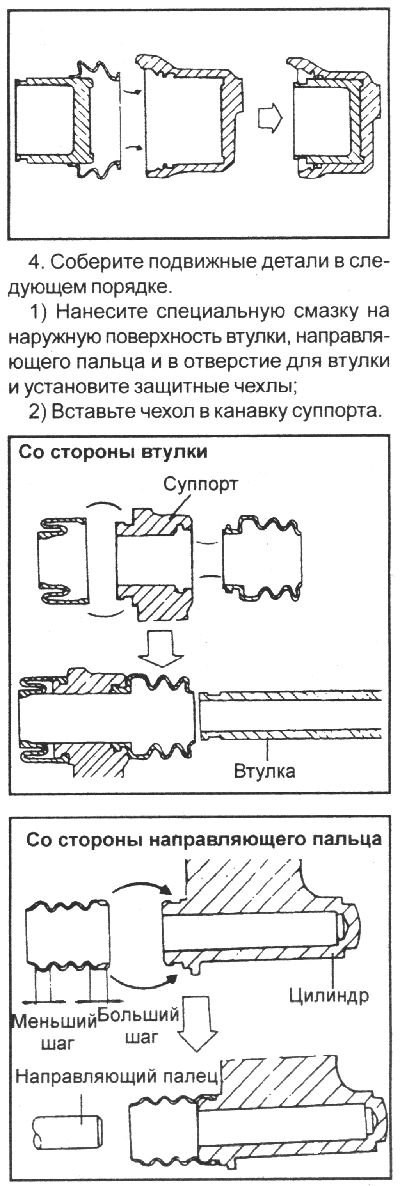
5. Install the brake pads.
Note: Never apply grease to the brake disc or brake pads.
Installation
Installation is carried out in the reverse order of removal, taking into account the following.
1. Install the brake pads and caliper. Never apply grease to the brake disc or brake pads.
2. Screw in and tighten the caliper mounting bolt to the required tightening torque.
[The original text is published on the website: HyundaiBook.ru]
3. Screw in and tighten the hollow brake hose mounting bolt to the required tightening torque.