
HyundaiBook.ru
Repair Chevrolet Repair Honda Repair Toyota Repair Land Rover Repair VAZ Repair Renault Repair Nissan
English Русский
Български
Беларускі
Український
Српски
Hrvatski
Română
Polski
Slovenský
Magyar
ArticlesSitemapContacts  


  Accent   Elantra   Getz   Grandeur   Sonata   Santa Fe   Tucson   Others
Sonata 3 (1993-1998) Sonata 4 (2001-2012, petrol)
  • Main
  • Sonata
  • EF (2001-2012)
  • Chassis
  • Brake system
  • Master brake cylinder

Master brake cylinder (Hyundai Sonata EF)

0
Contents: Removal ⇓ Disassembly ⇓ Examination ⇓ Assembly ⇓ Installation ⇓
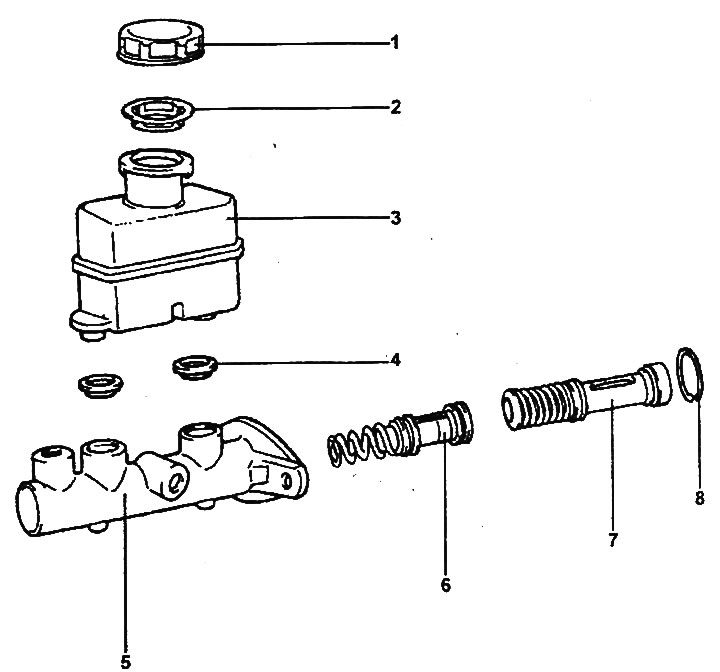
Master brake cylinder.

Master brake cylinder.

1 - reservoir cover, 2 - filter, 3 - brake fluid reservoir, 4 - sealing sleeve, 5 - brake master cylinder housing, 6 - secondary piston assembly with spring, 7 - primary piston assembly with spring, 8 - retaining ring.


Removal


1. Disconnect the brake pipes from the master cylinder. Install plugs on the open holes.

Caution: Do not allow brake fluid to come into contact with painted surfaces. If brake fluid does come into contact with a painted surface, wash it off immediately.


2. Loosen the nuts securing the master brake cylinder and remove the cylinder.
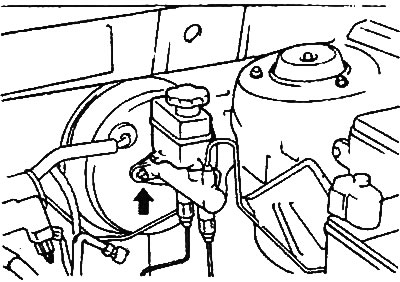
2. Loosen the nuts securing the master…


Disassembly


1. Remove the brake fluid reservoir cap and drain the brake fluid into a suitable container.


2. Using a screwdriver, disconnect the reservoir from the master brake cylinder and remove the sealing bushings.

The article is copied from this website [HyundaiBook]

Note: Do not press the brake pedal while bleeding the brake system.
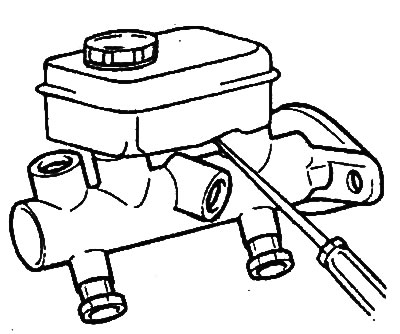

Note: Do not press the brake pedal…


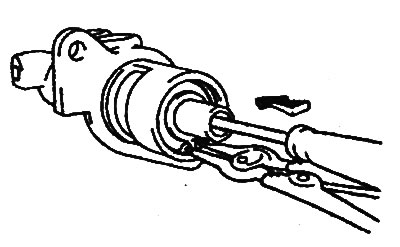
3. Using a special puller, remove the retaining ring.
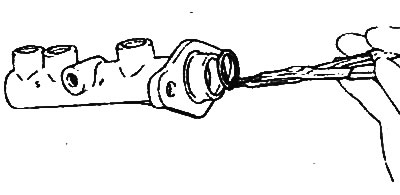
3. Using a special puller, remove the…


4. (Models with ABS) Remove the piston stroke limiter.

5. Remove the primary piston assembly.

6. (Models with ABS) Using a screwdriver, remove the piston stroke limiter.
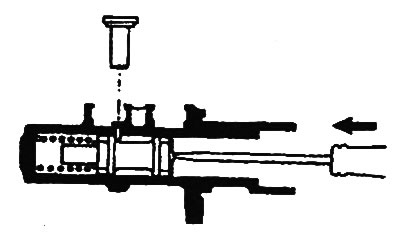
6. (Models with ABS) Using a…


7. Remove the secondary piston assembly.


Note: Do not disassemble the pistons.


Examination


1. Check the inner surface of the master cylinder housing for rust and scuff marks.
  • Nominal inner diameter of master cylinder: 23.8 mm

2. Check the primary and secondary pistons of the master cylinder for rust, scoring, wear and damage.

Note:
  • If the inner surface of the master cylinder housing is damaged, replace the master cylinder assembly.
  • Wash the master cylinder parts with alcohol.


Assembly


1. Lubricate all rubber parts of the brake master cylinder kit and sealing bushings with clean brake fluid.
1. Lubricate all rubber parts of the…


2. Carefully install the springs and pistons into the master cylinder.

3. Press the piston with a screwdriver and install the retaining ring.
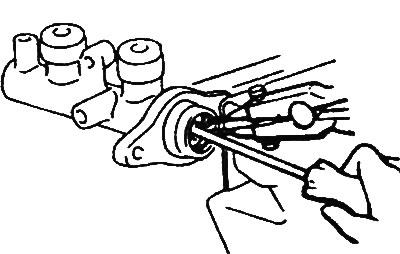
3. Press the piston with a screwdriver…


4. Press the piston until the spring is fully compressed and set the piston stroke limiter.


5. Install the sealing bushings.
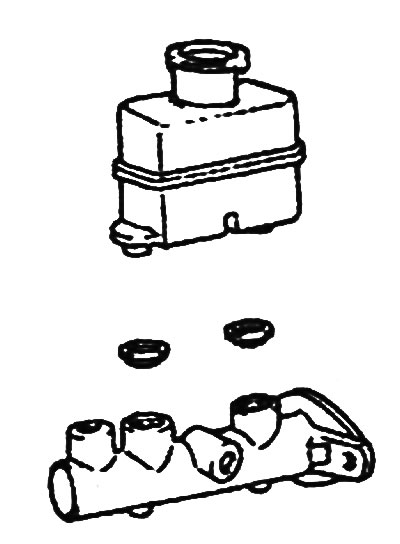
5. Install the sealing bushings.


6. Install the brake fluid reservoir onto the master cylinder.

Installation


1. Check and adjust the rod length if necessary.
  • Tightening torque: 8.25±0.125 mm

2. Install the master cylinder onto the brake booster and tighten the two nuts.
  • Tightening torque: 8-12 Nm

3. Connect the brake pipes to the master cylinder.
  • Tightening torque: 13-17 Nm

4. Fill the reservoir with brake fluid, then bleed the brake system.
This article is available at russian, bulgarian, belarusian, ukrainian, serbian, croatian, romanian, polish, slovak, hungarian
This article has been reviewed by: Konstantin Smirnov
Add to social network:

Previous
Sonata 4: Brake system
Next

Brake pedal — removal and installation
Checking and adjusting the travel of the parking brake lever
Bleeding the brake system (models with ABS)
Bleeding the brake system (models without ABS)
Checking the operation of the brake booster
Vacuum brake booster
Rear axle load-sensing brake force distribution valve
Brake system lines
Front brake mechanism
Rear drum brake mechanism
We recommend other articles on the topic of Hyundai manuals:

Master brake cylinder — device Hyundai Accent 1 (1994-1999)
Brake Master Cylinder/Vacuum Booster — Removal and Installation Hyundai Elantra 1 (1990-1995, petrol)
Master brake cylinder Hyundai Getz (2002-2011)
Disassembly, inspection, assembly and installation of the master… Hyundai Santa Fe 2 (2007-2012, petrol)
Master brake cylinder Hyundai Tucson 2 (2009-2015)
Disassembly, inspection, assembly and installation of the master… Hyundai Matrix (2001-2010, petrol)

Link in different formats to this article

Visitor comments
No comments yet


How much will 33 + 35 ?


Sonata 4 (2001-2012, petrol) 
  • General information
  • User manual
  • Maintenance
  • Power unit
  • 2.0 and 2.4 liter engines
  • 2.7 liter engines
  • Engine overhaul
  • Cooling system
  • Intake and exhaust systems
  • Lubrication system
  • MFI fuel injection system
  • Engine electrical equipment
  • Transmission
  • Clutch
  • Mechanical gearbox
  • Automatic gearbox
  • Drive shafts
  • Chassis
  • Front suspension
  • Rear suspension
  • Steering
  • Brake system
  • Body
  • Exterior
  • Interior
  • Heater and air conditioner
  • Security systems
  • Electrical equipment
  • Troubleshooting
  • Electrical circuits
Sonata 3 (1993-1998) 
  • General information
  • Maintenance
  • Power unit
  • Engine repair I4 DOHC
  • Engine repair I4 SOHC
  • Engine repair V6 SOHC
  • Cooling system
  • Intake and exhaust system
  • Exhaust gas treatment
  • Fuel system
  • Transmission
  • Clutch
  • Mechanical gearbox
  • Automatic transmission KM-175
  • Automatic transmission F4A33
  • Chassis
  • Front suspension
  • Rear suspension
  • Steering
  • Brake system
  • Body
  • Body elements
  • Electrical equipment
  • Equipment and devices
HyundaiBook.ru © 2018-2026 · Mobile version · Sitemap: EN BG BY UA RS HR RO PL SK HU · Administration · Site search · Hyundai owners Accent 1 · Accent 2 · Accent 3 · Elantra 1 · Elantra 2 · Elantra 3 · Getz · Sonata 3 · Sonata 4 · Santa Fe 2 · Tucson 1 · Tucson 2 · Matrix ·
This site uses cookies to optimize its functionality. By continuing, you agree to our terms.