2. Start the engine and set the operating mode to 2000 rpm. Turn on the air conditioner, move the temperature control switch to the maximum cooling position and the heater electric fan switch to the high speed position.
3. Leave all windows and doors of the car open.
4. Place a dry bulb thermometer in the cold air deflector.
5. Place the psychrometer as close as possible to the cabin air intake (the place where air from the cabin is drawn into the evaporator).
6. Make sure that the pressure value in the high-pressure line of the system is 1373-1575 kPa. If the pressure is higher than the specified value, cool the condenser by pouring water on it. If the pressure is lower than the specified value, close the front part of the condenser.
7. Make sure that the air temperature measured with a dry thermometer near the air intake in the cabin is within 25 - 35°C.
8. Determine the relative air humidity (in %) using the graph below. Relative humidity is determined using the readings of the "dry" and "wet" thermometers of the psychrometer near the air intake in the cabin.
Note: an example of determining the relative humidity of the air using a graph: if the readings of the "dry" thermometer are 25°C, the readings of the "wet" thermometer are 19.5°C, then the intersection point of the dotted lines corresponding to the temperature values gives a relative humidity value of 60%.
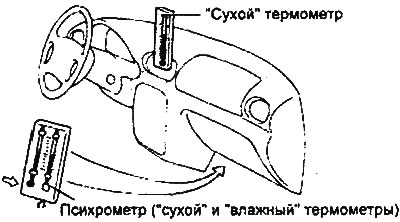
9. Measure the temperature of the cooled air at the outlet of the deflector and calculate the temperature difference at the inlet and outlet of the evaporator based on the readings of the dry thermometers (at the air intake in the cabin and at the deflector).
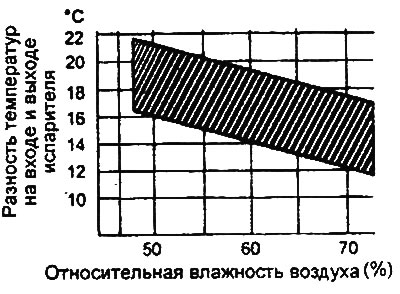
10. Check that the relative humidity and temperature difference values are within the nominal range (i.e. the intersection of the lines corresponding to the relative humidity and temperature difference is between the two shaded lines). In this case, the air conditioner's operating efficiency is normal.