
HyundaiBook.ru
Repair Chevrolet Repair Honda Repair Toyota Repair Land Rover Repair VAZ Repair Renault Repair Nissan
English Русский
Български
Беларускі
Український
Српски
Hrvatski
Română
Polski
Slovenský
Magyar
ArticlesSitemapContacts  


  Accent   Elantra   Getz   Grandeur   Sonata   Santa Fe   Tucson   Others
Getz (2002-2011)
  • Main
  • Getz
  • 1 (2002-2011)
  • Body
  • Air conditioning and heater
  • Performance testing

Performance testing (Hyundai Getz 1)

0
1. Install pressure gauges on the line.

2. Start the engine, let it run at 2000 rpm⁻¹ and set the maximum cooling mode with high fan speed.
2. Start the engine, let it run at 2000…


2. Start the engine, let it run at 2000…


3. Open all windows or doors.

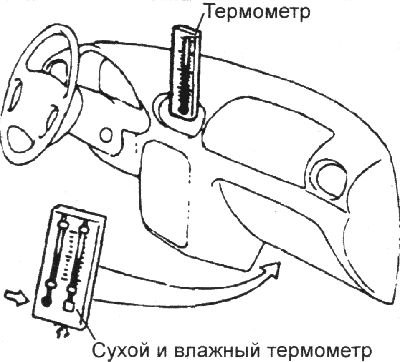
4. Install a dry thermometer in the air supply grille into the passenger compartment.

5. Install the wet and dry bulb thermometers as close to the cooling unit inlet as possible.

6. Check that the pressure gauge shows between 1.373 and 1.575 kPa. If the pressure is too high, pour water onto the condenser. If the pressure is too low, close the front of the condenser.

7.-Check that the air temperature in the air supply grille into the passenger compartment is within 25–35°C

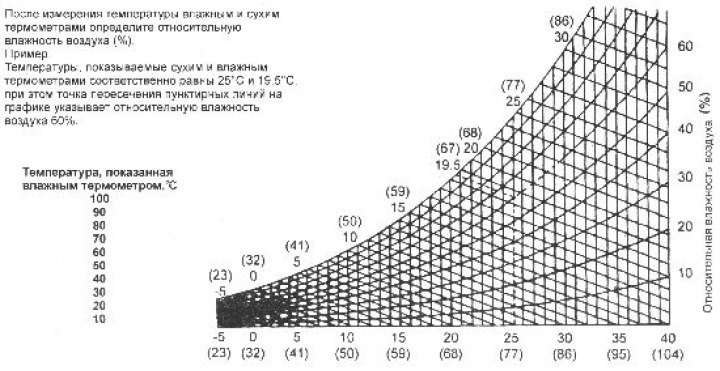
8. Use the graph to calculate the relative humidity by comparing the temperature of the wet and dry thermometers.


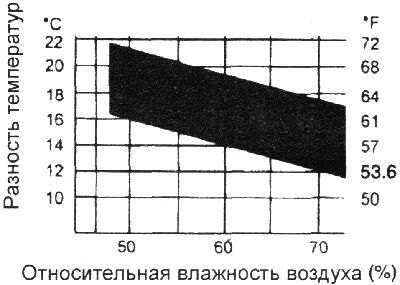
9. Measure the temperature in the air supply grille of the car interior and calculate the difference using a dry thermometer and a thermometer in the air supply grille.
9. Measure the temperature in the air…


10. Check that if the intersection of relative humidity and temperature difference are within the tolerance range, then the air conditioning system is working normally.
This article is available at russian, bulgarian, belarusian, ukrainian, serbian, croatian, romanian, polish, slovak, hungarian
This article has been reviewed by: Konstantin Smirnov
Add to social network:

Previous
Getz: Air conditioning and heater
Next

Tensioning the poly V-belt of the air conditioning compressor drive
Checking the air conditioning system for leaks
Charging the system with liquid refrigerant
Charging the system with refrigerant vapor
Connecting the inlet valve to the refrigerant cylinder
Air conditioning system air filter
Evaporator — removal and installation
Air Conditioning Compressor — Removal and Installation
Clutch hub and compressor pulley
Compressor coil — removal and installation
We recommend other articles on the topic of Hyundai manuals:

Testing the torque converter Hyundai Accent 1 (1994-1999)
Coolant Temperature Sensor — Removal, Installation and Testing Hyundai Elantra 1 (1990-1995, petrol)
Anti-lock Brake System — Wheel Speed Sensor — Removal and Testing Hyundai Sonata 3 (1993-1998)
Testing the torque converter on a fully braked vehicle (Torque… Hyundai Santa Fe 2 (2007-2012, petrol)
Testing power relays Hyundai Tucson 1 (2005-2010)
Checking the performance of the fuel pump Hyundai Matrix (2001-2010, petrol)

Link in different formats to this article

Visitor comments
No comments yet


How much will 28 + 30 ?


Getz (2002-2011) 
  • User manual
  • Control devices
  • Heating and ventilation
  • Audio system
  • Car driving
  • Faults en route
  • Maintenance
  • Technical information
  • Power unit
  • Engine repair 1.1/1.3 l
  • Engine repair 1.5/1.6 l
  • Lubrication system
  • Cooling system
  • Fuel system
  • Exhaust system
  • Ignition system
  • Transmission
  • Clutch
  • Mechanical gearbox
  • Automatic gearbox
  • Drive shafts and axles
  • Chassis
  • Suspension and wheels
  • Steering
  • Brake system
  • Body
  • Exterior (external elements)
  • Interior (internal elements)
  • Air conditioning and heater
  • Electrical equipment
  • Equipment and devices
  • Power devices
  • Electrical circuits
HyundaiBook.ru © 2018-2026 · Mobile version · Sitemap: EN BG BY UA RS HR RO PL SK HU · Administration · Site search · Hyundai owners Accent 1 · Accent 2 · Accent 3 · Elantra 1 · Elantra 2 · Elantra 3 · Getz · Sonata 3 · Sonata 4 · Santa Fe 2 · Tucson 1 · Tucson 2 · Matrix ·
This site uses cookies to optimize its functionality. By continuing, you agree to our terms.