


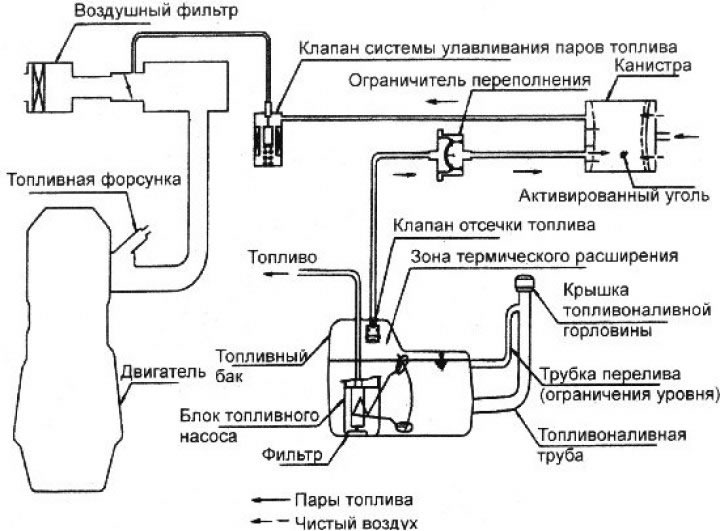
Fuel vapors are accumulated in a canister with activated carbon. When the engine is running, the electronic control unit opens the valve and fuel vapors enter the engine, where they are burned.
The control valve is used to control the fuel vapor pressure in the fuel tank.
Examination
1. Disconnect the vacuum hose from the throttle body and connect a vacuum pump with a vacuum hose in its place.
2. Using the tables, check the following parameters on a cold engine with a coolant temperature below 60°C and on a hot engine with a coolant temperature above 80°C.
Fuel vapor recovery system diagram
Cold engine
| Engine operating mode | Underpressure | Result |
| Idling | 50 kPa | Vacuum is maintained |
| 3000 min⁻¹ |
Hot engine
| Engine operating mode | Underpressure | Result |
| Idling | 50 kPa | Vacuum is maintained |
| Within 3 minutes after increasing the rotation speed to 3000 min⁻¹ | Attempt to change vacuum | Vacuum is maintained |
| 3 minutes after increasing the rotation speed to 3000 min⁻¹ | 50 kPa | The vacuum is maintained for a short time and then decreases |