HyundaiBook.ru
Repair Chevrolet Repair Honda Repair Toyota Repair Land Rover Repair VAZ Repair Renault Repair Nissan
English Русский
Български
Беларускі
Український
Српски
Hrvatski
Română
Polski
Slovenský
Magyar
ArticlesSitemapContacts  


  Accent   Elantra   Getz   Grandeur   Sonata   Santa Fe   Tucson   Others
Matrix (2001-2010, petrol)
  • Main
  • Hyundai
  • Matrix (2001-2010)
  • Power unit
  • Power and exhaust system
  • Fuel vapor recovery system

Fuel vapor recovery system (Mitsubishi Matrix)

0
Contents: Checking the fuel vapor recovery…⇓ Checking the adsorber ⇓ Checking the purge solenoid valve of…⇓
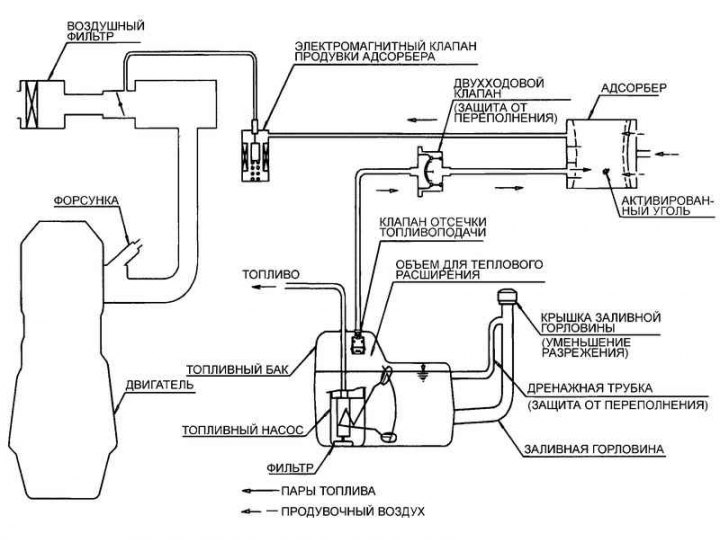
Fig. 2.222. Schematic diagram of the…

Fig. 2.222. Schematic diagram of the fuel vapor recovery system


Checking the fuel vapor recovery system
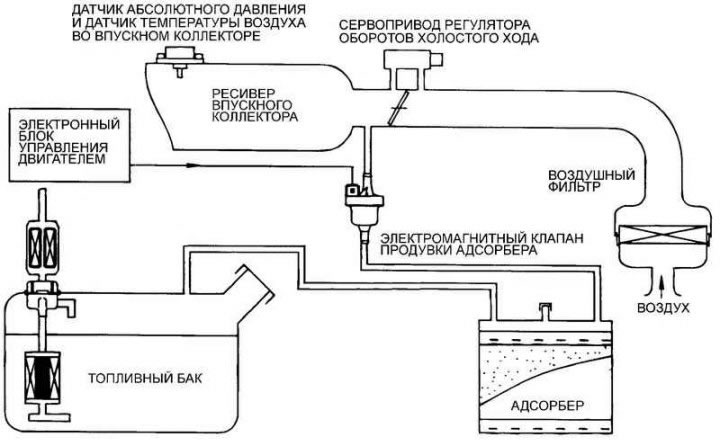


Fig. 2.223. Fuel vapor recovery system…

Fig. 2.223. Fuel vapor recovery system test diagram


Disconnect the vacuum hose from the throttle body and connect a hand vacuum pump to the vacuum hose.

Check the vacuum at the specified engine operating conditions, when the engine is cold (coolant temperature 60°C or below) and when the engine is warm (coolant temperature 80°C or above).

Checking the adsorber


Check the fuel vapor recovery system lines for loose connections, sharp kinks, or damage.

Check for deformation, cracks and fuel leaks.
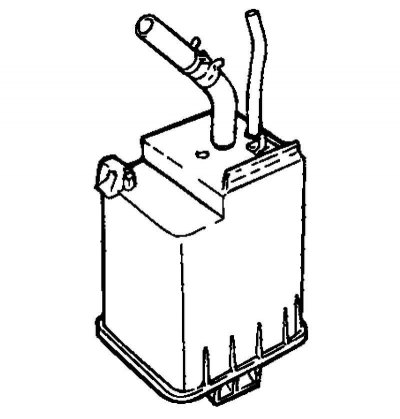


Fig. 2.224. Adsorber

Fig. 2.224. Adsorber


After removing the adsorber, check it for cracks and deformation (Fig. 2.224).

[The article is borrowed from an online resource: HYUNDAIBOOK.RU]

Checking the purge solenoid valve of the adsorber


Note: When disconnecting vacuum hoses, always make alignment marks first so that the hoses are in their original positions when reconnected.


Disconnect the vacuum hose from the canister purge solenoid valve.

Disconnect the wiring harness connector from the solenoid valve.

Connect a hand vacuum pump to the solenoid valve fitting from which the hose with the red stripe was disconnected.

Battery voltageIn good condition
ServedThe vacuum decreases
Not servedThe vacuum remains

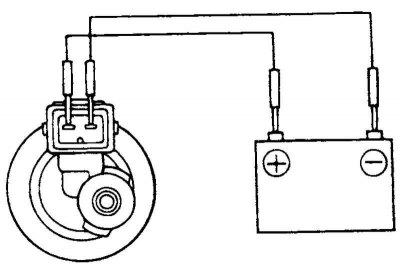
Fig. 2.225. Test diagram when…

Fig. 2.225. Test diagram when connecting/disconnecting power from the battery to the terminals of the electromagnetic valve


Create a vacuum and check the operation of the valve by connecting/disconnecting the power supply from the battery to the terminals of the electromagnetic valve (Fig. 2.225).
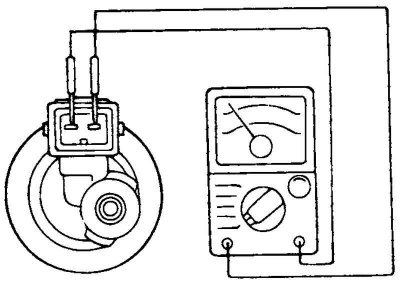
Fig. 2.226. Measuring the resistance…

Fig. 2.226. Measuring the resistance between the terminals of the electromagnetic valve


Measure the resistance between the terminals of the solenoid valve (Fig. 2.226).

Evaporative canister purge solenoid valve: winding resistance – 26 Ohm (at a temperature of 20°C).
This article is available at russian, bulgarian, belarusian, ukrainian, serbian, croatian, romanian, polish, slovak, hungarian
This article has been reviewed by: Konstantin Smirnov
Add to social network:

Previous
Matrix: Power and exhaust system
Next

Forced crankcase ventilation system
Checking the performance of the fuel pump
Checking the engine crankshaft speed at idle
Main faults and their causes
Removal, checking and installation the air filter
Fuel supply system
Removal, inspection and installation of fuel injectors
Exhaust gas toxicity reduction system
Removal and installation the main muffler
Checking the exhaust system for leaks
We recommend other articles on the topic of Hyundai manuals:

Checking the fuel vapor recovery system Hyundai Accent 3 (2005-2010)
Fuel vapor recovery system Hyundai Elantra 3 (2000-2006)
Fuel vapor recovery system Hyundai Getz (2002-2011)
Fuel lines and fuel vapor recovery system lines — removal and… Hyundai Sonata 4 (2001-2012, petrol)
Fuel vapor recovery system Hyundai Santa Fe 2 (2007-2012, petrol)
Characteristics of the fuel system of gasoline engines (G4GC,… Hyundai Tucson 1 (2005-2010)

Link in different formats to this article

Visitor comments
No comments yet


How much will 47 + 17 ?


Matrix (2001-2010, petrol) 
  • User manual
  • Control devices
  • Salon equipment
  • Car driving
  • Current service
  • Vehicle specifications
  • Power unit
  • Engine specifications
  • Engine maintenance
  • Engine repair 1.6 l
  • Engine repair 1.8 l
  • Cooling and lubrication system
  • Power and exhaust system
  • Control system
  • Transmission
  • Transmission specifications
  • Clutch
  • Mechanical gearbox
  • Automatic gearbox
  • Drive shafts
  • Chassis
  • Suspension and wheels
  • Steering
  • Brake system
  • Body
  • Exterior (external elements)
  • Passive safety system
  • Heater and air conditioner
  • Electrical equipment
  • Specifications
  • Equipment and devices
  • Power devices
  • Electrical circuits
HyundaiBook.ru © 2018-2026 · Mobile version · Sitemap: EN BG BY UA RS HR RO PL SK HU · Administration · Site search · Hyundai owners Accent 1 · Accent 2 · Accent 3 · Elantra 1 · Elantra 2 · Elantra 3 · Getz · Sonata 3 · Sonata 4 · Santa Fe 2 · Tucson 1 · Tucson 2 · Matrix ·
This site uses cookies to optimize its functionality. By continuing, you agree to our terms.