

Contents: Troubleshooting automatic…⇓ Reading diagnostic trouble codes ⇓ Explanations on the operation of the…⇓ Instructions for troubleshooting…⇓
Troubleshooting automatic transmission
Note:
- Automatic transmission faults may be caused by improper maintenance, improper adjustment or faulty electronic transmission control system, mechanical faulty transmission, faulty hydraulic transmission control system, insufficient engine power or a combination of these faults. Therefore, before starting the inspection, it is necessary to determine the area of the fault (engine, control system or transmission).
- Troubleshooting should begin with the simplest operations and proceed in order of increasing complexity.
1. Check for signs of automatic transmission malfunctions and the conditions under which they occur.
2. Read diagnostic trouble codes. Write down the trouble codes, and then delete the codes from the memory of the automatic transmission electronic control unit.
3. Perform basic checks and adjustments (checking tire pressure, checking the level and condition of the automatic transmission fluid, checking the automatic transmission control mechanism, etc.) for which deviations from the norm can be easily determined.
Note: Analysis of the results of checking the level of the automatic transmission fluid:
- If the level of the automatic transmission fluid is lower than required, the automatic transmission pump will capture the fluid together with air, which will lead to various malfunctions. Air bubbles that have entered the automatic transmission hydraulic system are the cause of oil foaming. This will cause unstable pressure in the hydraulic system, which in turn will lead to a delay in gear shifting (late gear engagement) and slippage of clutches or brakes, etc.
- If the level of the automatic transmission fluid is higher than required, then due to the rotation of the planetary gears, abundant foaming will occur, which will ultimately lead to the same consequences as in the case of a low level of the automatic transmission fluid, and will cause premature deterioration of the condition of the working fluid.
- In both cases, air bubbles cause overheating, oxidation of the working fluid and deposition of varnish, which disables valves, couplings and actuators. Foaming also leads to the release of working fluid through the crankcase breather of the automatic transmission, which is mistaken for leaks.
4. Conduct a road test to determine the need for further diagnostics of the automatic transmission.
- a) Check the correct gear shifting. Check the electrical part of the control system if the gear shifting is normal.
- b) Make sure that the fault is related to the automatic transmission only. If there is noise or vibration, the compressor, engine, etc. may be possible sources.
5. Read diagnostic trouble codes (again).
- a) If the fault codes are displayed when a malfunction symptom is present, refer to the subsection "Reading diagnostic fault codes".
- b) If there is a malfunction symptom (no malfunction codes) or if there is no malfunction symptom, it is necessary to check for the presence of malfunction codes read before the road test. If the malfunction codes are displayed, refer to the subsection "Reading diagnostic malfunction codes", if the malfunction codes are not displayed, refer to the subsection "Finding malfunctions by their symptoms" of the section "Finding automatic transmission malfunctions".
6. If the possible cause is a malfunction in the electronic control system of the automatic transmission, then use a tester or oscilloscope to check the input and output signals of the electronic control unit of the automatic transmission.
- a) If there are incorrect input and output signals from the electronic control unit of the automatic transmission, check the wiring according to the corresponding electrical diagram.
- b) If no fault is found when checking the electrical wiring, then check the individual components of the system.
7. If the signals from the electronic control system are normal or if a possible cause is a malfunction in the automatic transmission hydraulic control system, check the pressure in the automatic transmission hydraulic control system (hydraulic test). If the condition of the hydraulic system differs from the required one, perform the appropriate checks and adjustments in the section "Checking the mechanical systems of the automatic transmission".
8. If the pressure in the automatic transmission control hydraulic system is normal or if the possible cause is a malfunction in the main automatic transmission system (mechanical part), then check the engine and torque converter with the vehicle fully braked (stall-test), identify the faulty part and perform the necessary major repairs.
9. After completing the repair, perform a road test to ensure that the problem has been corrected.
Reading diagnostic trouble codes
1. Prepare the vehicle for inspection.
- a) Make sure that the battery is in good condition, as fault detection is impossible if the battery voltage is low.
- b) Turn off all additional equipment.
- c) Set the automatic transmission selector to position "N".
Caution: Do not disconnect the battery until the diagnostic results have been fully read, as the fault code will be cleared from the ECU memory when the battery or ECU connector is disconnected.
3. Connect the tester to the diagnostic connector.
Caution: Before connecting the tester, turn off the ignition.
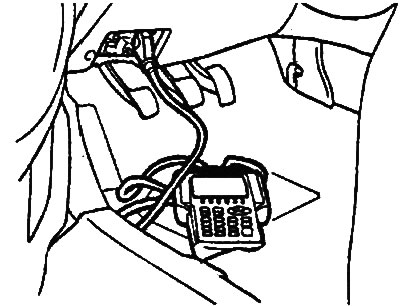
4. Turn on the ignition and read the diagnostic codes.
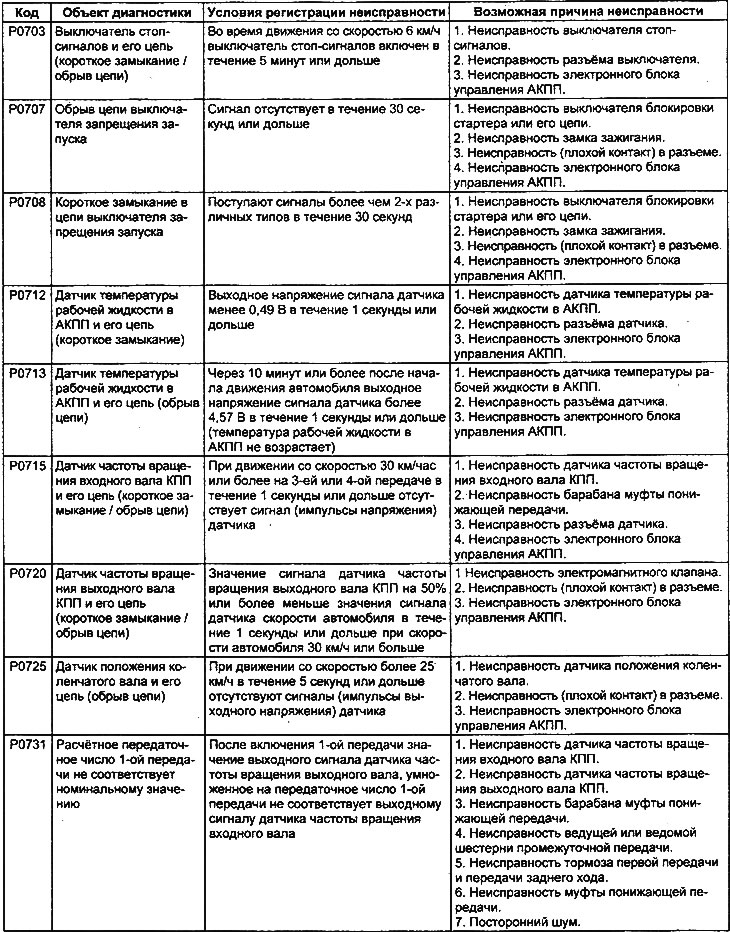
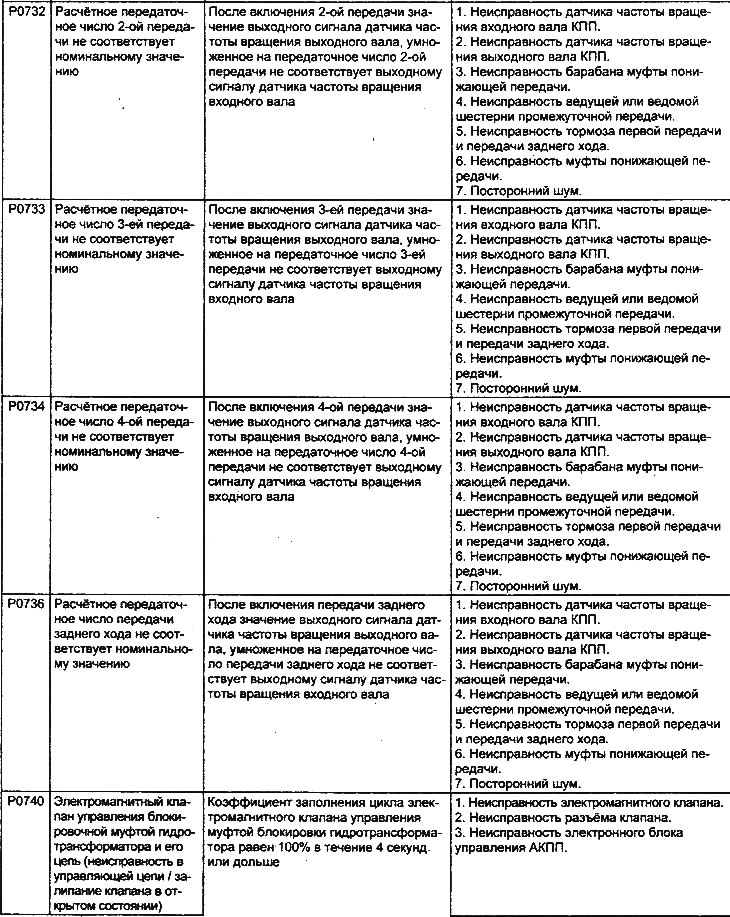
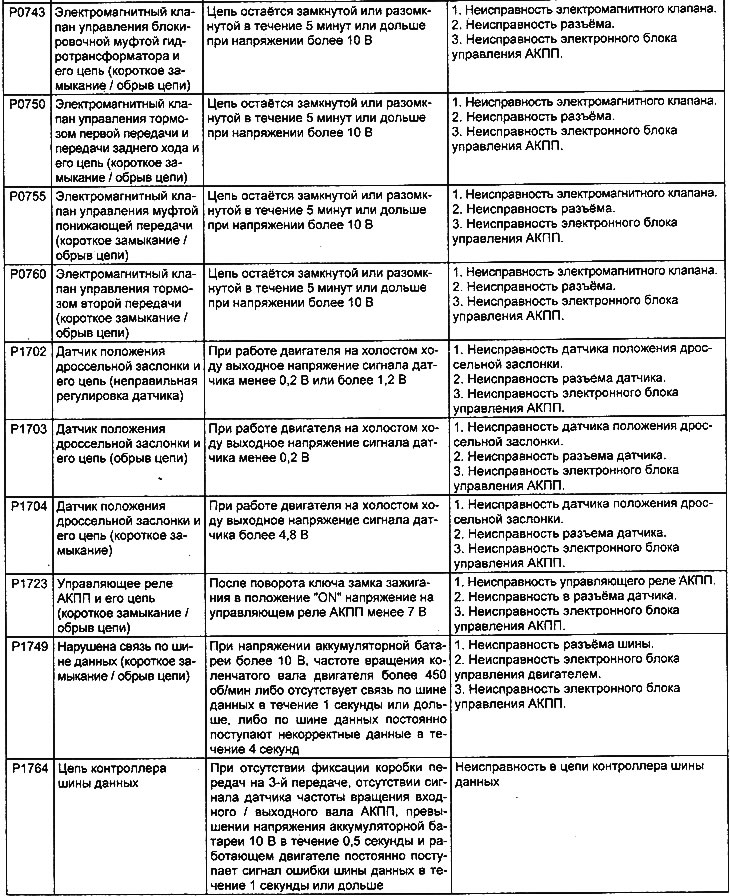
5. Determine the malfunction using the diagnostic code (see the table "Automatic transmission control system malfunction codes").
6. After finishing reading the diagnostic codes, turn off the ignition and disconnect the tester.
Explanations on the operation of the self-diagnostic system
1. Error codes.
- a) The structure of the standard diagnostic trouble code is described in the chapter "Fuel injection system".
- b) A maximum of 8 diagnostic trouble codes (in the order in which they appear) can be recorded in the RAM of the electronic control unit.
- c) If any fault code appears multiple times, it will be written to the memory only once.
- d) If the number of stored diagnostic trouble codes or malfunction conditions exceeds 8, the previously stored trouble codes will be replaced in memory by new codes in sequence, starting from the earliest.
Caution: Do not disconnect the battery before reading diagnostic trouble codes or fault conditions, as disconnecting the battery will clear them from the ECU memory.
Note:
- If the P0715 fault code occurs 4 times, the transmission will go into limp home mode (gear shifting is locked) and will lock into 3rd gear or 2nd gear.
- If the P0720 fault code occurs 4 times, the transmission goes into emergency mode (gear shifting is blocked) and is fixed in 3rd gear or in 2nd gear, the automatic transmission range indicator "N" flashes at a frequency of 1 Hz.
- If one of the specified fault codes occurs 4 times, the gearbox goes into emergency mode (gear shifting is blocked) and is fixed in 3rd gear: P0731, P0732, P0733, P0734, P0736.
- If one of the specified fault codes is recorded in the memory of the electronic control unit, the gearbox goes into emergency mode (gear shifting is blocked) and is fixed in 3rd gear: P0740, P0743, P0750, P0755, P0760, P0765, P1723.
2. Emergency operation mode codes.
- a) If the system has switched to emergency control mode and the gearbox is fixed in 3rd gear (gear shifting is blocked), then a diagnostic trouble code is written into the operational memory of the electronic control unit in the form of an emergency operation mode code.
- b) No more than 3 emergency operation mode codes can be stored in the memory. If the number of recorded codes (emergency mode parameters) exceeds 3, the previously recorded codes will be replaced in the memory by new codes in sequence, starting from the earliest. The same malfunction code cannot be recorded in the memory more than once.
- c) If the transmission is in third gear only (gear shifting is locked) and the ignition key is turned to the "OFF" position, the emergency operation mode will be cancelled, but the diagnostic trouble codes will be stored in the RAM of the electronic control unit.
3. Automatic deletion of fault codes from memory.
All diagnostic trouble codes are automatically cleared from the memory after the temperature of the working fluid in the automatic transmission reaches 50°C 200 times after the last trouble code was written to the memory.
4. Forced deletion of fault codes from memory.
Stored diagnostic trouble codes can be cleared using the tester if the following conditions are met:
- The ignition switch key is set to the "ON" position.
- No signals were detected from the crankshaft position sensor, gearbox output shaft speed sensor, or vehicle speed sensor.
- The automatic transmission emergency mode is not activated.
Instructions for troubleshooting based on their symptoms
1. Automatic transmission malfunctions can be caused by engine system malfunctions, incorrect adjustment or internal malfunction of the electronic or hydraulic transmission control systems, mechanical malfunction of the transmission. Therefore, always start diagnostics by checking the level and condition of the working fluid in the automatic transmission and adjusting the control cables.
2. Checking engine systems means checking the engine management system, ignition system, fuel system, and the engine itself.
3. Checking the gearbox housing parts means checking the clutches, brakes, and internal gears of the gearbox.
4. When checking the control valve block, pay attention to the tightening torques of the bolts, damage or displacement of the sealing rings, valves and their bushings. If the damage that has occurred cannot be repaired, replace the control valve block as a whole.
5. Check the torque converter for correct installation (no skewing, etc.) and damage to the splines. If the splines are damaged and repair is not possible, replace the torque converter.
Table. Automatic transmission control system error codes.