Contents: Adjusting the clearance between the…⇓ Checking the starter traction relay…⇓ Checking the holding winding of the…⇓ Checking the return of the traction…⇓
Adjusting the clearance between the end of the gear and the stop
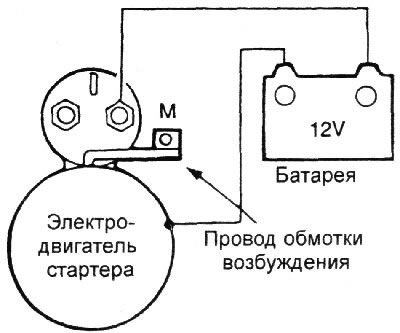
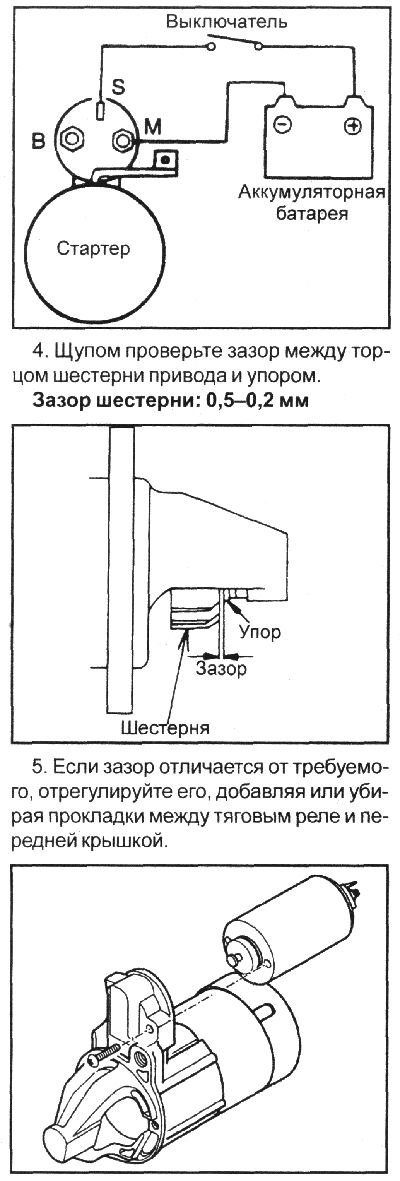
1. Disconnect the starter motor excitation winding wire from the "M" terminal of the traction relay.
2. Using additional wires, connect the battery terminals to terminals "S" and "M".
3. The drive gear should move to the engaged position.
Warning! This test must be performed within 10 seconds, otherwise the traction relay solenoid may burn out.
Checking the starter traction relay pull-in winding
1. Disconnect the starter motor excitation winding wire from the "M" terminal of the traction relay.
2. Using additional wires, connect the battery terminals to terminals "S" and "M".
Warning! This test must be performed within 10 seconds, otherwise the traction relay coil may burn out.
3. If the starter pinion moves forward, the relay pull-in winding is OK. If the pinion does not move forward, replace the traction relay.
Checking the holding winding of the traction relay
1. Disconnect the starter motor excitation winding wire from the "M" terminal of the traction relay.
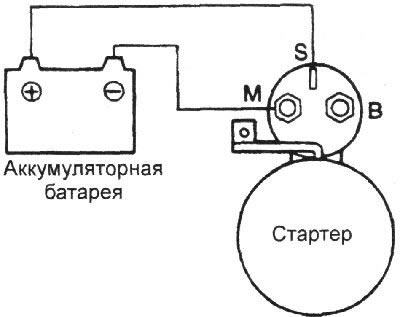
2. Using additional wires, connect the battery terminals to the "S" terminal and the traction relay housing.
Warning! This test must be performed within 10 seconds, otherwise the traction relay coil may burn out.
3. If the drive gear extends to the engagement position, the traction relay is in good condition. If the gear extends and returns to its original position multiple times, this indicates a break in the holding winding and the traction relay must be replaced.
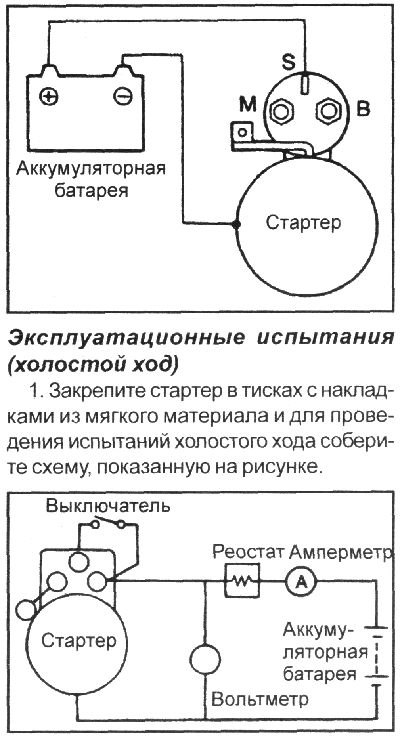
2. Connect the control ammeter (with a 100 A scale) and the carbon rheostat as shown in the figure.
3. Connect a voltmeter with a 15 V scale in parallel to the starter.
4. Set the carbon rheostat to the off position.
5. Connect the wire from the negative terminal of the battery to the starter housing.
6. Set the rheostat slider to a position where the voltmeter shows a voltage of 11.5 V.
7. Turn on the starter and check the current consumed by the starter and make sure that the starter shaft turns easily and smoothly.
Current consumption: no more than 90 A Anchor rotation frequency, min⁻¹: no less than 2800
Checking the return of the traction relay plunger
1. Disconnect the starter motor excitation winding wire from the "M" terminal of the traction relay.
2. Using additional wires, connect the battery terminals to the "M" terminal and the traction relay housing.
Warning! This test must be performed within 10 seconds, otherwise the traction relay coil may burn out.
3. Extend and retract the drive pinion. If the pinion quickly returns to its original position, the traction relay is OK.