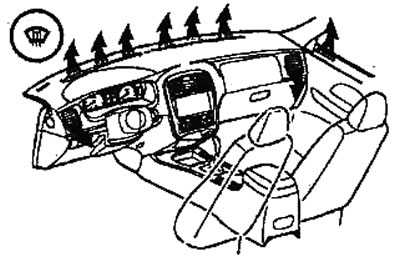
Contents: General information ⇓ Heater and Air Conditioner Control…⇓ Heater and Air Conditioner Control…⇓
General information
1. For LCD models, do not place items on the sun sensor. Also, do not block the air temperature sensor openings.
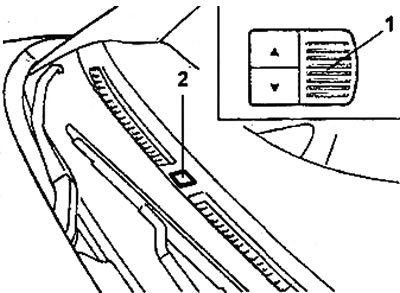
1 - cabin air temperature sensor, 2 - sunlight sensor.
2. The heater and air conditioner operate only when the engine is running. The heater operation is directly related to the engine coolant temperature, so operate the heater when the engine is sufficiently warm. The amount of air passing through the heater/air conditioner can be adjusted by changing the fan speed.
3. On cars with air conditioning, after the cooling starts, the air coming out of the deflectors may look like fog for the first few minutes. This is due to the sudden cooling of moist air and is not a sign of a malfunction.
4. Too much cooling is harmful to health. The air temperature in the cabin should be only 5-6°C lower than the outside air temperature.
5. When using the air conditioner, make sure that the air outlet located in front of the windshield is not blocked by anything (such as leaves).
6. The air conditioner should be turned on for at least 5 minutes every month, even in cold weather. This is necessary to lubricate the internal parts of the compressor and keep the air conditioner in working order.
7. When the air conditioner is turned on, the engine idle speed increases. Be careful when starting the car.
8. The air conditioning system has a built-in cabin filter to clean the air from dust and dirt.
Note: The procedure for replacing the cabin filter is given in the chapter "Maintenance and general check and adjustment procedures".
9. The direction and strength of the air flow coming out of the deflector are adjusted using the handle and the dial on the deflector, respectively.
Heater and Air Conditioner Control Panel (models without LCD display)
Note: The location of the switches is shown in the figure "Heater and Air Conditioner Control Panel without LCD Display".
1. Switch [2] is used to turn on the air conditioner. When pressed again, the air conditioner mode is turned off. The heater operates if the air conditioner mode is turned off.
2. The air intake location selection switch [1] allows air to be taken either from outside the vehicle (ventilation) or from the passenger compartment (recirculation). The intake mode is selected by pressing the corresponding switch (for each mode, the indicator on the corresponding switch will light).
Note: The recirculation mode, especially in cold weather, should be used for a short period of time to avoid excessive fogging of the windows.
3. Switch [4] sets the rotation speed of the heater fan (air flow power). There are a total of "5" positions for adjusting the fan speed. Under normal conditions, it is recommended to set the switch to the first ("1") or second position ("2"). Position "0" - turns off the fan.
4. Switch [5] is used to set the air temperature in the cabin. Turning to the left decreases the temperature.
Note: If the engine coolant temperature is low, the temperature of the air entering the passenger compartment does not change even when the switch is in the extreme right position.
5. Switch [3] is used to select the air flow distribution mode. Turn the handle to turn on the desired mode.
Note: Air flow distribution for different modes is shown in the subsection "Heater and air conditioner control panel (models with LCD display)".
Heater and Air Conditioner Control Panel (LCD Models)
Note: The location of the switches is shown in the figure "Heat and Air Conditioning Control Panel with Liquid Crystal Display (LCD)".
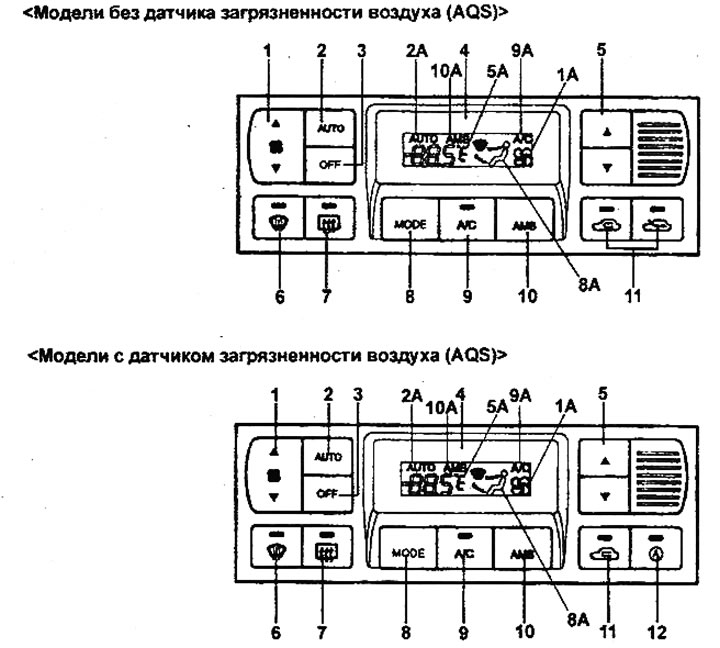
Heating and air conditioning control panel with LCD display (air conditioning with automatic control).
1 - fan mode switch, 2 - automatic control switch, 3 - control system switch, 4 - LCD display, 5 - temperature selection switch, 6 - windshield blower switch, 7 - rear window heater and side mirror heater switch, 8 - ventilation mode selection switch, 9 - air conditioner switch, 10 - switch for displaying outside air temperature readings, 11 - air intake location selection switch, 12 - AQS system switch.
(The text is provided by the web resource: HyundaiBook.ru)
Note: For a description of the switches, see the "Heater and Air Conditioner Control Panel (LCD Models)" subsection.
1. Switch [9] (A/C) is used to turn on the air conditioner mode. When the air conditioner is on, the indicator on the switch and the [9A] indication on the LCD display are lit. Switching off the air conditioner mode (selecting the heater mode) is done by pressing the switch again.
2. Switch [3] (OFF) is used to switch off the control system (turn off the air conditioner and heater). When the system is on, the LCD display shows the air temperature outside the car.
3. Switch [2] (AUTO) is designed for automatic control of the air conditioner and heater.
- a) When you press the switch, the automatic mode of the air conditioner/heater is activated, in which the set temperature, air flow power, etc. are automatically maintained. The [2A] indication on the LCD display shows that the "AUTO" mode is on. When this mode is turned on again (including after restarting the engine), all selected settings (mode, temperature, air flow power, etc.) are saved.
Note: If the battery has been disconnected, all settings will be erased and when the air conditioner is turned on, the standard temperature of 25°C will be maintained (in "AUTO" mode).
- b) The "AUTO" mode is switched off by pressing any switch except switches [2] (AUTO), [5] (TEMP).
- c) To resume the system operation in fully automatic mode, press the switch [2] (AUTO) again.
4. Switch [5] (TEMP) is used to set the air temperature in the passenger compartment. The temperature can be changed within the range from 17°C to 32°C (in 0.5°C increments) by pressing the switch. The indication [5A] on the LCD display shows the selected air temperature in the passenger compartment (to which it is cooled or heated).
Note:
- To change the temperature units (°C to F or F to°C), hold down switch [5] (TEMP) and switch [10] (АМВ) simultaneously for 3 seconds or more.
- When you turn the air conditioner on again, the LCD display will show the interior temperature previously set before turning it off.
- If the switch is held down, the set temperature value will change 2 times faster, and each change in value will be accompanied by a sound signal.
- Setting the minimum permissible (17°C, "MAX COOL" mode) or maximum permissible (32°C, "MAX HOT" mode) temperature or attempting to set a temperature outside the permissible range will be accompanied by a warning sound signal.
5. (Models without air quality sensor (AQS)) The air intake mode selection switch [11] (ventilation/recirculation) allows air to be taken in either from outside the vehicle or from the passenger compartment. The intake mode is selected by pressing the corresponding switch (for each mode, the indicator on the corresponding switch will light).
6. (Models with Air Quality Sensor (AQS)) Switch [11] allows air to be drawn in either from outside the vehicle or from inside the vehicle and automatically prevents exhaust gases from entering the vehicle interior when air is drawn in from outside if switch [12] is on (the indicator on the switch will light when on). The selection of the intake mode is made by pressing the switch (in the "Recirculation" position, the indicator on the switch will light).
- a) The operation of the outside air intake mode and the recirculation mode is completely analogous to that described in point "5".
- b) "AQS" system mode - outside air enters the car interior, but if a concentration of exhaust gases is detected in the incoming air, the recirculation mode will be automatically switched on.
Caution: If the car windows fog up or the air becomes dry and stale when operating in the recirculation or AQS mode, turn off the AQS mode or turn on the outside air intake mode.
7. The windshield defroster switch [6] is used to prevent the windshield from fogging up. When pressed, the indicator on the switch turns on. In this mode, the outside air intake mode and air conditioning will be automatically turned on (if the outside air temperature is above 3.5°C).
8. Switch [1] sets the rotation speed of the electric fan (air flow power), which is displayed on the LCD display [ZA]. There are 7 levels of fan rotation speed adjustment. By pressing switch [3] (OFF), you can turn off the electric fan.
![8. Switch [1] sets the rotation speed of the electric fan (air flow power),…](https://www.hyundaibook.ru/img/sonata/0896.jpg)
9. Switch [8] (MODE) is used to change the mode of distribution of air flows supplied to the passenger compartment. The mode is selected by successive pressing of the switch and is displayed by the corresponding icons [8A] on the LCD display.
Note: The number of directional arrows on the LCD display indicates the power of the air flow coming out of the corresponding deflectors.
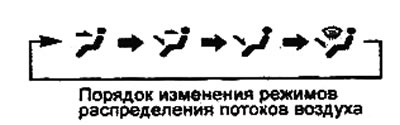
- a) The air flow is directed towards the head area.
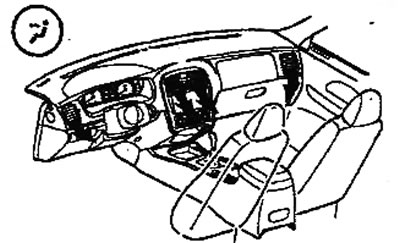
- 6) The air flow is directed to the head and floor area simultaneously.
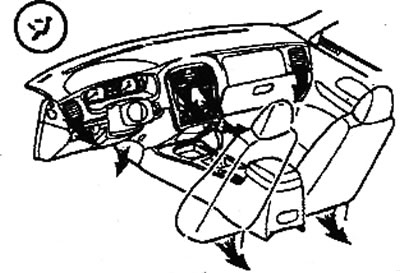
- c) The air flow is directed almost entirely towards the floor.
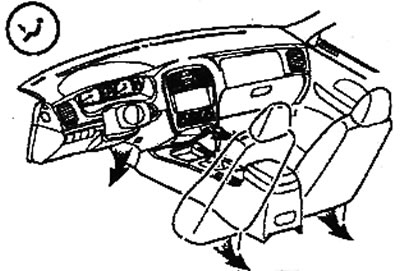
- d) The air flow is directed to the windshield and to the floor.
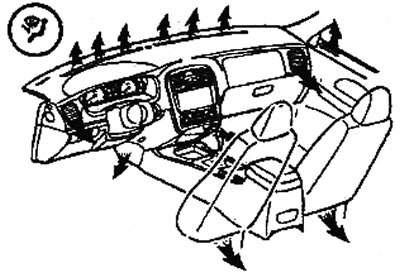
- d) The air flow is directed towards the windshield and is used in case of fogging of the windshield.