


Removal
1. Remove the timing belt, front cylinder block cover, flywheel, cylinder head and oil pan.
2. Remove the rear cover from the cylinder block and the rear crankshaft seal ring.
3. Loosen the nuts and remove the connecting rod caps.
4. Unscrew the bolts and remove the crankshaft main bearing caps.
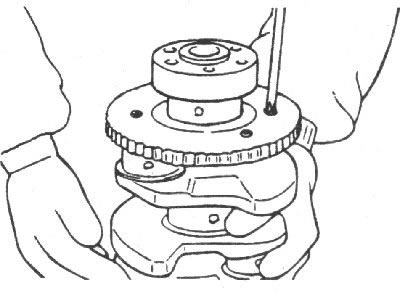
5. Remove the crankshaft angle sensor toothed rotor.
Caution: Mark the crankshaft main bearing caps to ensure that they are installed in their proper locations and in the same position.
Examination
1. Check the crankshaft main and connecting rod bearing journals for wear and tear. Check the crankshaft lubrication holes for clogging.
2. Using a micrometer, measure the crankshaft journal diameters in two diametrically opposite directions. If there is wear or ovality, regrind the crankshaft. Regrind the crankshaft journals only to the next repair size.
Diameter of crankshaft main journals, mm:
- 1.3L engine: 50
- 1.1L engine: 42
Diameter of crankshaft connecting rod journals, mm:
- 1.3L engine: 45
- 1.1L engine: 38
Ovality and taper of crankshaft journals: no more than 0.01 mm
Main and connecting rod bearing shells
Check the connecting rod and main bearings for local corrosion, peeling, melting, wear and other damage. Replace the bearings if necessary.
Measuring the clearance between the bearing shells and the crankshaft journals
To measure the clearance of the main and connecting rod bearings, measure the crankshaft journal diameters and the corresponding bearing inside diameters. The clearance value is the difference between the bearing inside diameter and the corresponding crankshaft journal diameter.
Nominal clearance values for 1.3 l engines, mm:
- clearance between liners and main journals No.1, 2,4, 5 of the crankshaft: 0.028–0.046
- clearance between liners and main journal No.3 of crankshaft: 0.034–0.52
- clearance between bearings and crankshaft journals: 0.024–0.042
Nominal clearance values for 1.1 l engines, mm:
- clearance between liners and main journals No.1,2, 3, 4, 5 of the crankshaft: 0.020–0.038
- clearance between bearings and crankshaft journals: 0.012–0.041
Measuring main and connecting rod bearing clearance using a Plastigage plastic calibrated rod
The clearance between the bearings and the crankshaft journals can be checked using a plastic calibrated Plastigage rod.
1. Clean the main and connecting rod journals of the crankshaft from grease, and blow out the lubrication holes with compressed air.
2. Install the main bearing shells onto the engine cylinder block.
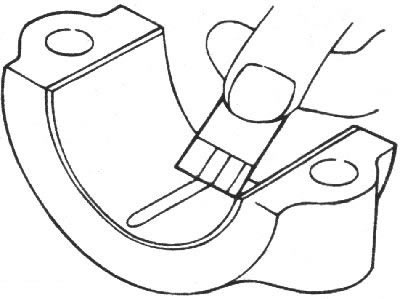
Install the crankshaft onto the main bearing shells in the cylinder block. Install the remaining main bearing shells into the crankshaft main bearing caps. Place lengths of Plastigage on the crankshaft main bearing journals.
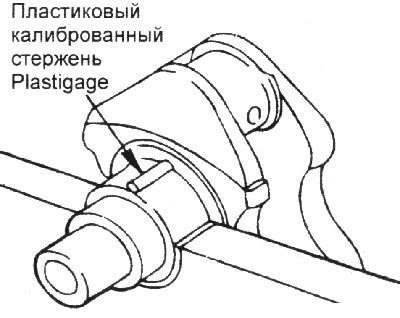
3. Install the main bearing caps according to the marking. Tighten the crankshaft main bearing cap bolts in the specified sequence. Do not rotate the engine crankshaft when measuring the crankshaft main bearing clearance. Loosen the bolts and remove the crankshaft main bearing caps. Use a measuring template to measure the width of the deformed Plastigage plastic rod and determine the clearance value.
If the clearance exceeds the maximum permissible value, regrind the crankshaft journals and use oversized repair bearings.
Oil sealing rings
Check the front and rear oil seal rings for damage or wear on the sealing lips. If any defects are found, replace the seal ring.
Crankshaft angle sensor rotor
1. Remove the crankshaft angle sensor rotor.
2. Check the crankshaft angle sensor rotor for damage, cracks and wear.
3. Check the clearance between the crankshaft angle sensor rotor and the crankshaft angle sensor.
The gap between the crankshaft angle sensor rotor and the crankshaft angle sensor: 0.5–1.5 mm.
Note.
- 1. Measure the installation depth of the sensor, i.e. the distance from the top of the crankshaft angle sensor rotor teeth to the surface of the cylinder block mating with the plane of the gearbox.
- 2. Calculate the difference between the length of the crankshaft angle sensor and the obtained distance.
- 3. The length of the sensor is equal to the distance between the end of the sensor and the inner point of the contact surface.
Selection of main bearing shells
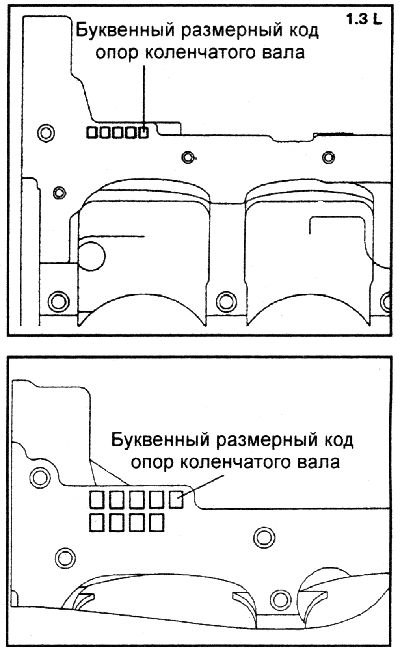
1. Check the crankshaft bore size code in the cylinder block.
Note.
- Record the letter code for the crankshaft bore size in the cylinder block.
- The reading order is from left to right, with the first code corresponding to the size of the front hole in the cylinder block.
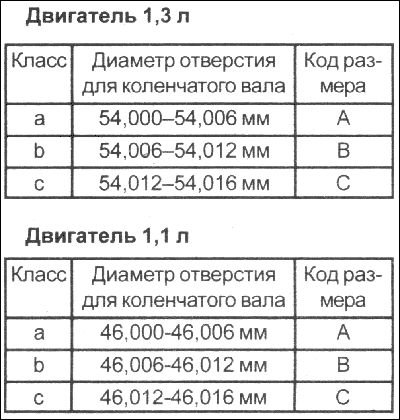
2. Check the crankshaft journal diameter size code.
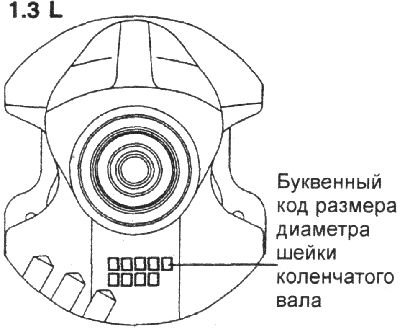
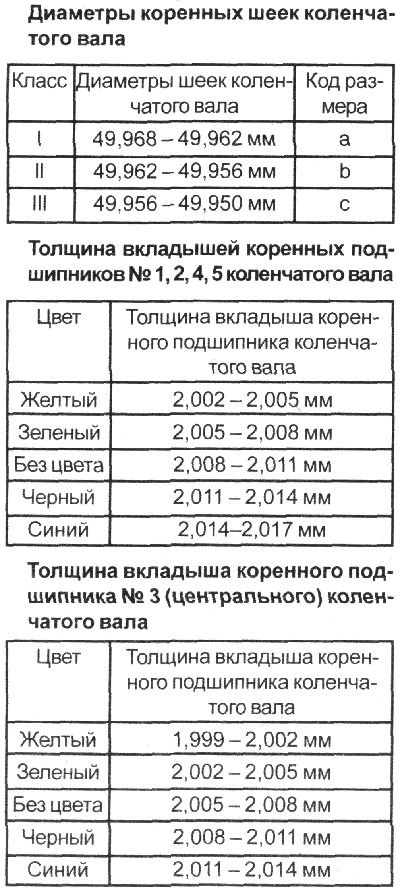
Engine 1.3 l
Note: Record the crankshaft journal diameter size letter code located on the crankshaft balancer.
The reading order is from left to right, with the first code corresponding to the size of the front crankshaft journal.
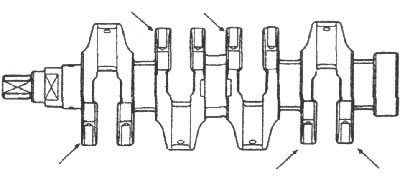
Engine 1.1 l
Note: Write down the letter code of the crankshaft journal diameter size located on the places painted in the places shown in the figure.
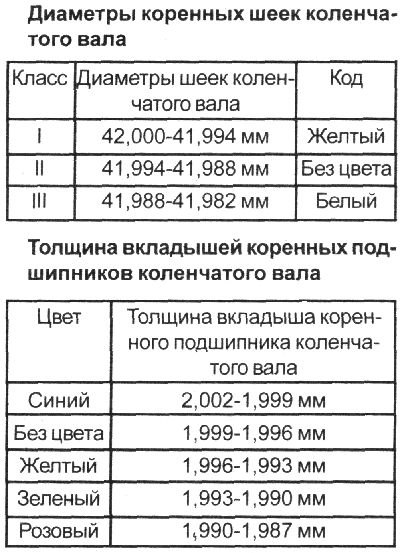
3. Select the thickness of the main bearing shells from the table.
Installation
1. Install the upper main bearing shells onto the engine block. When reinstalling the shells, install them in the same locations they were in before removal.
2. Before installing the crankshaft, apply a thin layer of clean engine oil to all sliding surfaces. Install the crankshaft on the main bearing shells in the cylinder block.
3. Install the remaining main bearing shells into the crankshaft main bearing caps. Install the crankshaft main bearing caps according to the markings, with the arrow on each cap facing the crankshaft pulley. Tighten the crankshaft main bearing cap bolts in a specific sequence in 2 or 3 stages in the following order: center, #2, #4, front, and rear.
Tightening torque:
Main bearing cap mounting bolts:
- 1.3L engines: 55–60 Nm
- 1.1L engines: 50–55 Nm
Connecting rod cap mounting bolts:
- 1.3L engines: 32–35 Nm
- 1.1L engines: 20–23 Nm
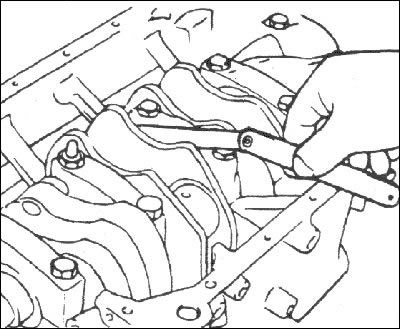
4. Turn the crankshaft and check that it rotates easily and smoothly. Using a feeler gauge inserted between the thrust flange of the central bearing and the crankshaft, check the axial play of the crankshaft.
(The original text is located on the portal www.HyundaiBook.ru)
Crankshaft axial clearance:
- 1.3L engines: 0.05–0.175 mm
- 1.1L engines: 0.05–0.25 mm
5. Lubricate the outer surface of the new rear sealing ring with engine oil. Using special tool 09231–22000, install the sealing ring into the rear cover seat until it stops.
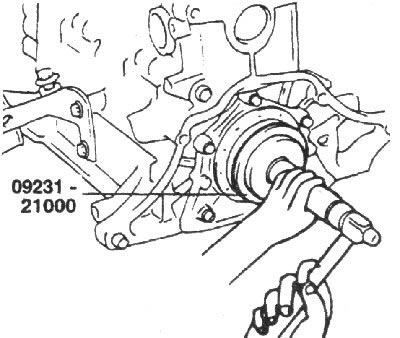
6. Install the rear sealing ring cover, gasket and tighten the bolts. When installing, lubricate the working lips and the outer surface of the sealing ring with clean engine oil.
7. Install the rear cover of the unit and tighten the bolts.
8. Install the connecting rod caps.
9. Install the flywheel, front cover, oil pan and timing belt.