


Contents: Disassembly ⇓ Examination ⇓ Checking the main and connecting rod…⇓ Measuring bearing clearance ⇓ Checking the crankshaft seals ⇓ Checking the Crankshaft Position…⇓ Assembly ⇓
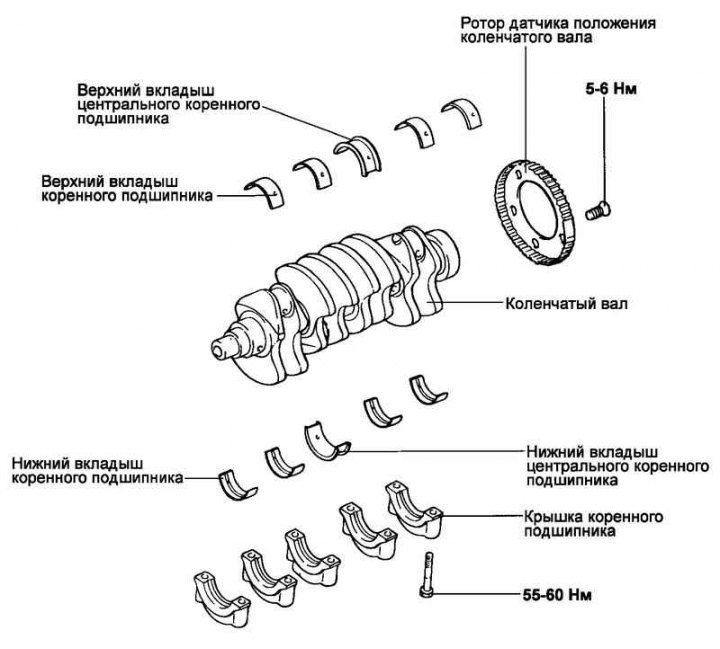
Fig. 2.66. Crankshaft components
Disassembly
Remove the timing belt, oil pump housing, flywheel, cylinder head assembly and oil pan. Refer to the appropriate sections for part removal procedures.
Remove the rear plate of the cylinder block and the rear crankshaft oil seal.
Remove the connecting rod caps and connecting rod bearing shells from the crankshaft.
Remove the crankshaft main bearing caps and remove the crankshaft.
Remove the crankshaft position sensor rotor.
Note: To simplify installation, arrange the removed parts (connecting rod caps, connecting rod and main bearing shells) in the order of their cylinder numbers and orientation at the installation location.
Examination
Check the crankshaft main and connecting rod journals for damage (scoring and seizure), excessive wear and cracks. Also check the oil passage holes for blockage. Repair or replace the faulty part.
Check the taper and out-of-roundness of the crankshaft main and connecting rod journals.
Nominal value:
- main journal diameter - 50 mm;
- crank pin diameter - 45 mm;
- taper and out-of-roundness of main and connecting rod journals - 0.005 mm or less.
Checking the main and connecting rod bearing shells
Visually inspect the surface condition of each bearing (peeling, uneven contact, scratches, scoring, etc.). Replace defective bearings.
Measuring bearing clearance
Measure the diameter of the main and connecting rod journals of the crankshaft.
Measure the inside diameters of the main bearing holes in the crankshaft bed (in the cylinder block and bearing cap) and the connecting rod bearing holes (in the small connecting rod head and connecting rod cap).
Measure the thickness of the connecting rod and main bearing shells.
Calculate the bearing clearance based on the measurements taken (you need to subtract the shaft journal diameter and the bearing shell thickness from the value of the inner diameter of the bearing hole).
- Connecting rod bearing clearance: 0.018–0.036 mm.
- Main bearing clearance: No.1, 2, 4, 5 - 0.022–0.040 mm, No.3 - 0.028–0.046 mm.
Checking the crankshaft seals
Check the front and rear crankshaft oil seals for damage or wear on the working edges. If there are any defects, replace the oil seal.
Checking the Crankshaft Position Sensor Rotor
Remove the crankshaft position sensor rotor.
Check the crankshaft position sensor rotor for damage, cracks, and wear. Replace the sensor rotor if necessary.
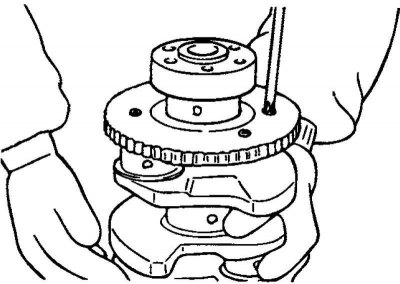
Fig. 2.67. Checking the gap between the sensor rotor tooth and the sensor tip using a depth gauge
Check the gap between the sensor rotor tooth and the sensor tip using a depth gauge (Fig. 2.67).
The nominal value of the gap between the sensor rotor tooth and the sensor tip: 0.5–1.1 mm.
Note: Measure the distance from the top of the crankshaft position sensor rotor tooth to the sensor mounting surface on the cylinder block.
Measure the length of the crankshaft position sensor tip as the distance between the end of the sensor tip and the sensor mounting plane.
Calculate the gap as the difference between the given values.
Assembly
Install the upper main bearing shells into the crankshaft bed on the cylinder block.
Note: Be careful when installing the main bearing shells removed earlier during disassembly, position them in accordance with the installation marks made before removal.
Install the crankshaft. Apply engine oil to the crankshaft main journals.
Install the lower bearing shells and main bearing caps. Tighten the cap mounting bolts to the specified tightening torque in the following sequence: center bearing cap, bearing cap No.2, bearing cap No.4, front bearing cap, and rear bearing cap.
Tighten the bolts gradually in two or three stages, then tighten to the specified torque.
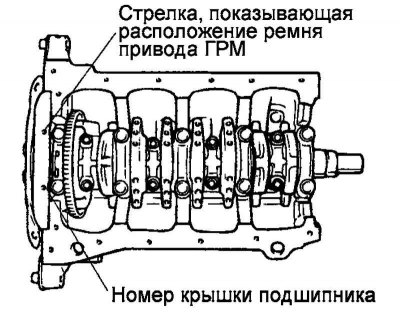
Fig. 2.68. Installing main bearing caps
When installing the covers, they must be positioned so that the arrows on the covers point towards the crankshaft pulley and the cover numbers correspond to the cylinder numbers (Fig. 2.68).
Tightening torque of main bearing cap bolts: 55–60 N·m, connecting rod cap bolts: 32–35 N·m.
Check again that the crankshaft rotates smoothly and that the crankshaft axial clearance (the clearance between the thrust flange of the central main bearing and the corresponding crankshaft web) corresponds to the nominal value.
Nominal value: crankshaft axial clearance – 0.050–0.175 mm.
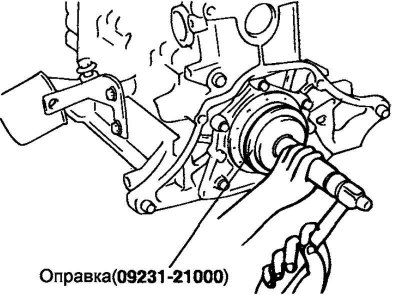
Fig. 2.69. Installing the rear crankshaft oil seal
Using a special tool (crankshaft rear oil seal installation tool 09231-2100), install the crankshaft rear oil seal into the oil seal housing as shown in Figure 2.69. Be careful to position the tool correctly to avoid damaging or deforming the oil seal during installation.
Install the rear plate of the cylinder block and tighten its mounting bolts.
Install the connecting rod caps.
Install the flywheel, oil pump housing, oil pan and timing belt. The installation procedures for the parts are given in the appropriate sections.