


Removal
1. Remove the timing belt drive gears, front cover, flywheel cylinder head and oil pan (refer to the relevant sections for instructions).
2. Remove the rear plate and rear oil seal.
3. Remove the lower connecting rod head caps.
Note: Mark the crankshaft main bearing caps to ensure they are installed in their correct positions.
4. Remove the main bearing caps and crankshaft. Arrange the liners according to the bearing cap numbers.
Examination
Crankshaft
1. Check the crankshaft main and connecting rod journals for damage, wear and cracks. Also check that the holes are not clogged. Repair or replace any defective parts.
2. Check the crankshaft main and connecting rod journals for roundness and taper. Visually inspect each bearing for delamination, melted areas, scoring, etc. Replace defective bearings.
Measuring oil clearances
Check the oil clearances by measuring the outside diameter of the main and connecting rod journals of the crankshaft and the inside diameter of the liners. The clearance value is obtained by determining the difference between the measured inside and outside diameters.
| Nominal value | |
| Oil clearance | |
| Main bearing shells | 0.02-0.05 mm |
| Connecting rod bearing shells | 0.02-0.05 mm |
| Limit value | 0.1 mm |
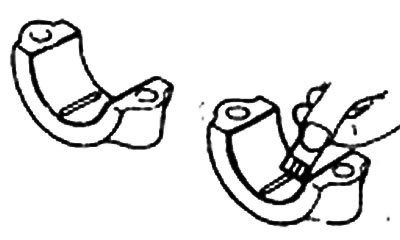
Method of using plastic template
You can use a plastic template to measure gaps.
1. Remove oil, dirt and grease from the bearings and crankshaft journals.
2. Cut a piece of plastic the same length as the width of the bearing and place it along the journal axis away from the lubrication holes.
3. Install the crankshaft, bearing shells and caps and tighten them to the specified torque. Do not turn the crankshaft during this operation. Remove the bearing caps. Using the scale printed on the template packaging, measure the thickness of the template. If the clearance exceeds the permissible value, the shell must be replaced. When installing a new crankshaft, use shells of the nominal size.
Seal
Check the front and rear oil seals for damage and rib wear. Replace the defective oil seal.
Main bearing caps
After installing the main bearing caps, make sure that the crankshaft rotates easily and that its axial clearance is within the permissible limits. If the clearance exceeds the maximum value, replace the crankshaft bearing.
- Nominal value: 0.05-0.18 mm
- Limit value - 0.25 mm
Flywheel
1. Check the flywheel surface that interacts with the clutch disc for damage and wear.
Replace excessively worn or damaged flywheel.
2. Check the runout of the flywheel surface interacting with the clutch disc.
- Limit value: Flywheel runout - 0.13 mm
3. Check the flywheel ring gear for damage, cracks and wear and replace it if necessary.
Installation
1. Install the main bearing with groove (upper bearing) into the cylinder block bed.
2. Install the main bearing shell without groove (lower shell) into the bearing cap bed.
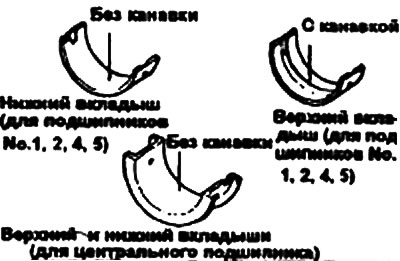
3. The upper and lower shells of the central main bearing have no grooves.
4. Install the crankshaft. Apply engine oil to its journals.
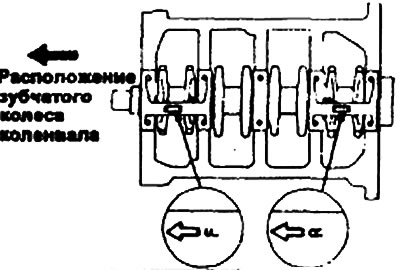
5. Bearing caps should be installed with the arrow pointing towards the front of the engine. The cap numbers must be correct.
6. Tighten the cover mounting bolts to the required torque in the following sequence: central; № 2; № 4; front and back.
- Tightening torque: Main bearing cap bolts - 130-140 Nm
7. Until the required tightening torque is reached, the cover bolts should be tightened evenly in 4-5 steps.
8. Make sure that the crankshaft rotates freely and has adequate axial clearance.
9. Using a special tool, install the seal into its housing.
10. Install the oil separator into the oil seal so that the oil hole in the oil separator faces downwards (arrow in the figure).
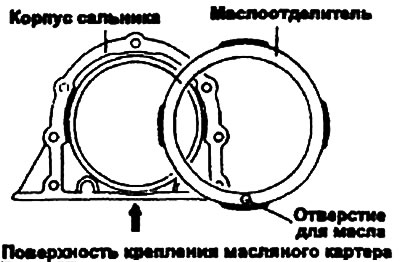
11. Install the new seal housing gasket and seal housing.
12. Attach the rear plate to the cylinder block.
13. Install the flywheel and tighten its mounting bolts to the required torque.