


Precautions when driving a four-wheel drive vehicle
Always wear your seat belt.
Do not operate the vehicle in severe off-road conditions for which the vehicle is not designed or if the driver is not qualified to operate the vehicle in such conditions.
In strong crosswinds, drive at low speed. The car has a high center of gravity, its stability is strongly affected by crosswinds. Low speed provides better control of the car.
Check the condition of the brake system after driving on a wet and slippery surface. Press the brake pedal several times while driving at low speed until you feel the braking efficiency return.
Long-term movement in deep water is not permitted.
The braking distance of a 4WD vehicle is not much different from that of a 2WD vehicle. When driving on snowy or muddy roads, make sure there is enough space between you and the vehicle in front.
Since torque is constantly transmitted to all 4 wheels, the effectiveness of 4WD is highly dependent on the condition of the tires. The tires on all wheels must be the same size and type.
If you need to replace even one tire or wheel, replace all the others as well.
Rotate your tires and check tire pressure regularly.
A 4WD vehicle cannot be towed by a regular tractor. If towing is necessary, all 4 wheels of the vehicle must not touch the ground, i.e. a special tow truck is used.
If you tow a 4WD vehicle with both wheels on the ground, the 4WD system will be damaged.
In case of emergency, if the vehicle is towed with all wheels rolling on the ground, it must move only forward, on a cable attached to the tractor.
When towing, ensure the following:
- the key in the ignition switch is in the "ACC" or "ON" position;
- set the gearshift lever to neutral (for automatic transmission, the selector to position "N");
- release the parking brake.
Note: To avoid serious damage to your 4WD vehicle, do not tow it faster than 15 km/h (9.3 mph) for more than 1.5 km (9.3 mi).
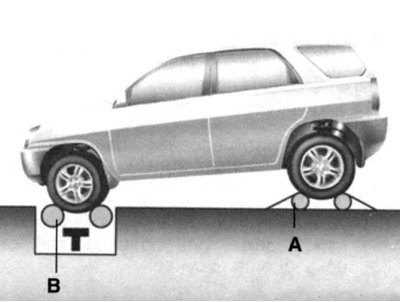
Fig. 1.187. Checking a car on a stand with running drums: A – temporary rollers without drive; B - running drums (checking the speedometer)
When performing a speedometer check or general inspection/maintenance of a four-wheel drive vehicle, it is recommended to use a stand with running drums on all four wheels, as shown in Figure 1.187.
Caution! When conducting such tests, the use of the parking brake is not permitted.
When using a front-wheel drive vehicle test stand to check a 4WD vehicle, please strictly follow the following rules.
Check the tire pressure on all wheels.
Place the front wheels of the vehicle on the rollers of the stand as shown in the figure.
Release the parking brake.
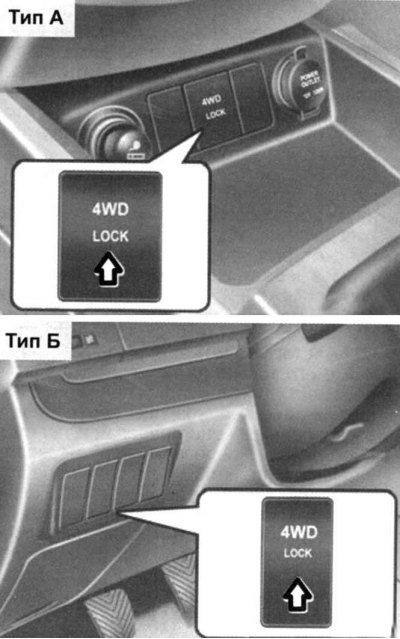
Fig. 1.188. All-wheel drive lock switch
Install the rear wheels on temporary rollers without drive, as shown in Figure 1.188.
When using snow chains, install them on all wheels.
If the front and rear wheels are stuck in mud, do not spin the engine unnecessarily. The 4WD system may be damaged.
Warning! If a vehicle with permanent all-wheel drive (4WD) is raised on a jack, do not start the engine, this may cause the wheels to spin. There is a risk that the spinning wheels may touch the ground and cause the vehicle to "jump".
Warning! If one of the front or rear wheels starts to slip in mud, snow, etc., the car can sometimes be pulled out by pressing the accelerator pedal more; however, avoid running the engine at high speed for long periods of time, as this may damage the 4WD system.